Service · Crawley and 30 miles around

Misted and failed rooflight replacement in Crawley, for a quieter room

When a rooflight mists, cracks or stops sealing, we replace it with a unit specified for today's regulations and for the noise the room actually hears.

Get a quote What is a quiet spec?

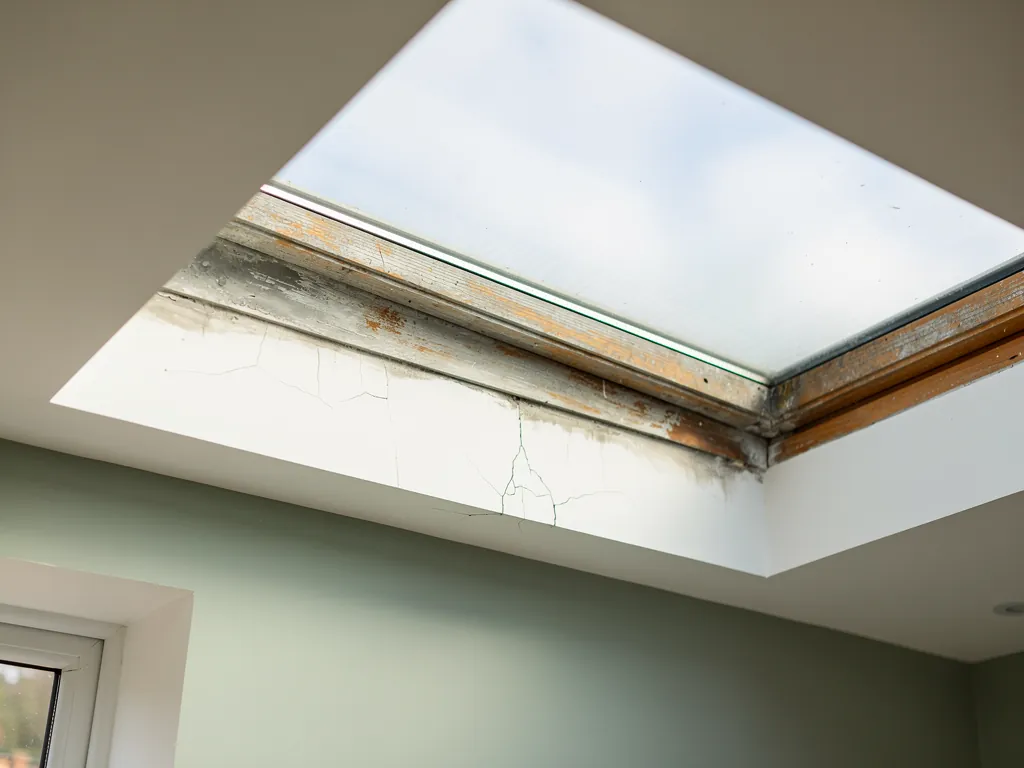
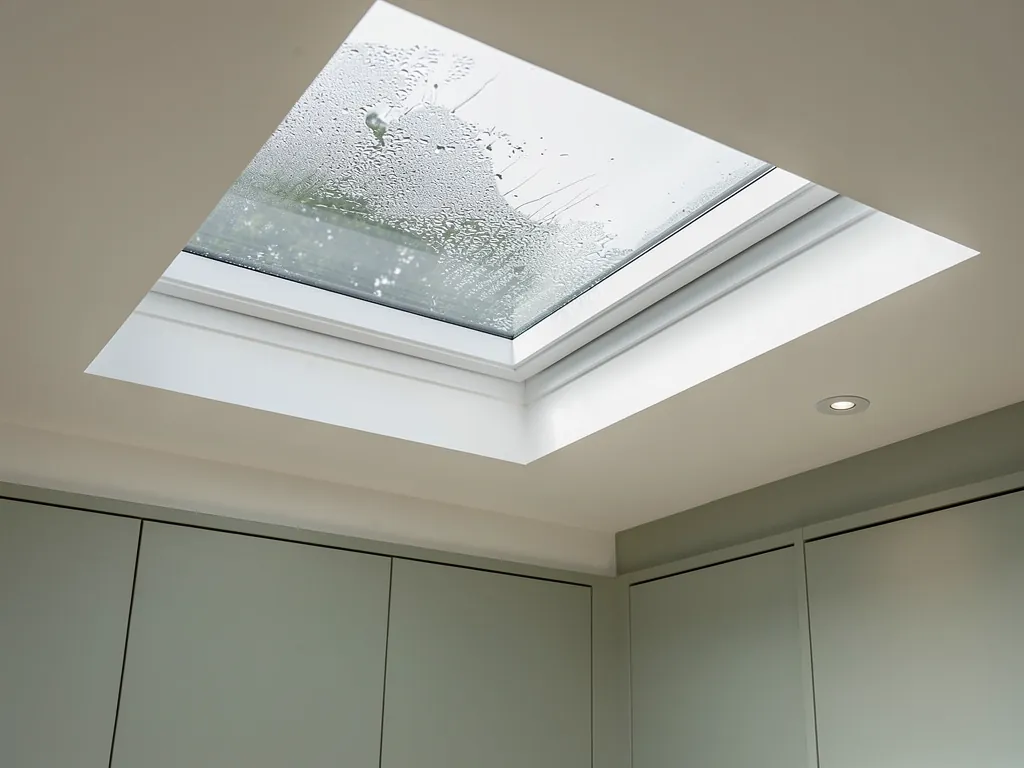
A failed rooflight with misting trapped between the panes
  • 10-year workmanship guarantee
  • Building Control notification handled
  • Fitted to current Building Regulations
  • A quiet spec with every quote
  • Crawley and 30 miles around

The failed seal

What has actually failed when a rooflight mists

A misted rooflight is a sealed unit whose edge seal has gone, and the frame around it may be perfectly sound.

A misted rooflight has a sealed glass unit whose seal has gone. Moist air has entered the gap between the panes, and that gap cannot be dried or sealed again, so the unit is replaced. The frame around it may be perfectly sound.

A modern rooflight pane is not one sheet of glass. It is two or three sheets held apart by a spacer bar around the edge, with the gap between them filled with dry air or argon. The spacer is packed with a desiccant, a fine drying salt that keeps the gap free of moisture for as long as the edge seal holds. Around the spacer runs a sealant, and that sealant is the part that matters. It has to stay bonded to the glass and keep water vapour out for decades, through every summer afternoon when the roof glass is hot and every January night when it is cold.

Sooner or later, on some units, the sealant loosens. A hairline path opens at a corner or along an edge. Vapour finds it, the desiccant takes up what it can, and then it is full. After that, each cold night leaves a film of condensation inside the gap. You see a cloudy bloom, a fog that comes and goes with the weather, and in time a permanent grey haze with mineral streaks where the droplets dried. That is a misted rooflight, and it is the commonest thing we are asked to replace.

How a unit comes to mist

  1. 01Sealant loosensOn some units the sealant around the spacer stops holding.
  2. 02A hairline path opensIt appears at a corner or along an edge.
  3. 03Desiccant fillsVapour finds the path and the desiccant takes up what it can, until it is full.
  4. 04Condensation formsEach cold night leaves a film of condensation inside the gap.
  5. 05Permanent hazeA grey haze with mineral streaks where the droplets dried.

Misting is one way a unit fails. There are others, and they appear on this page because the job is the same: take out the unit that has stopped doing its work and fit one that will. A pane can crack. A seal between the glass and the frame can harden and open. A frame can corrode or distort. An opening rooflight can lose its hinge or its motor. A polycarbonate dome can craze and yellow until it lets in less light than the ceiling paint reflects. In every case the answer we offer is replacement, specified for today's regulations and for the room as it is now.

This page is for the narrow job: a rooflight or skylight that has misted or failed and needs a new unit or a new rooflight. If you are still deciding whether to add roof glazing to a room that has none, the pages on flat roof rooflight installation and roof window installation start from a blank roof. If you are comparing glass and frame options across the whole house, the homepage, skylight and rooflight installation in Crawley, is the place to begin.

We start with telling a misted unit from a condensing one, then go through the kinds of failure, the choice between replacing the glass and replacing the rooflight, what each product type involves, how we measure, what the new unit is built from, and what it does for the sound of the room. We finish with guarantees, lead times, selling a house and a set of questions particular to this job.

NextReading the glass: misted, condensing or only dirty

Where the cloud sits

Reading the glass: misted, condensing or only dirty

Three things make a rooflight look cloudy, and only one of them needs a new unit.

Three things make a rooflight look cloudy, and only one of them needs a new unit. The position of the cloud tells you which: between the panes, on the room side, or on the outside face.

Start with the outside face. A dome or flat rooflight that has collected pollen, moss, bird droppings and a season of Weald rain can look grey from below. Wipe the outer face with clean water and a soft cloth, if you can reach it safely from a window or a ladder held by someone else, and see whether the dullness shifts. Dirt comes off. Mist between the panes does not. Do not climb onto a flat roof or a pitched one to try this. A roof is not a safe place to test a theory, and the view from inside the room is enough to work with.

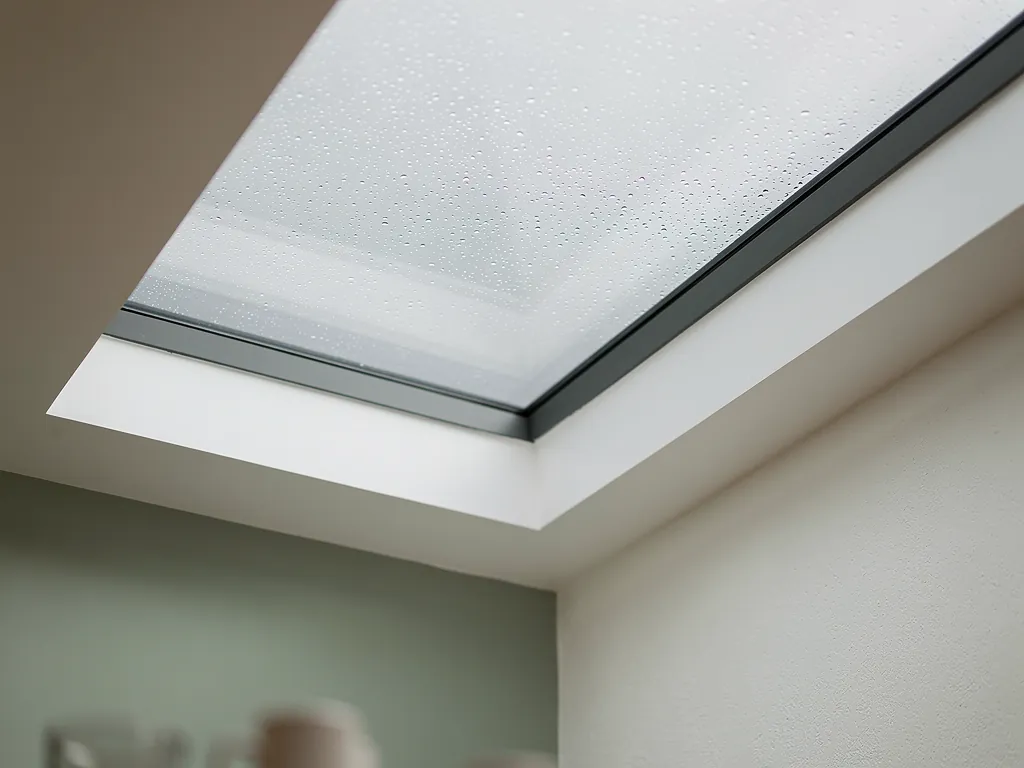
Then the room side. Condensation on the inner face of the glass is a sign of humid air meeting a cold surface. It wipes away with a finger and returns on a cold morning after a shower or a pan of pasta. That is a ventilation and surface temperature matter, not a failed unit. It can still tell you something: a single-glazed rooflight or an old double unit with poor edge warmth will run wet every cold morning, and a new unit with a warm edge spacer will hold its inner face much closer to room temperature. The answer on why a new rooflight has misted on the room side goes through the causes.

Three clouds, three answers

  • Outside face Dirt comes off with clean water and a soft cloth. Mist between the panes does not.
  • Room side It wipes away with a finger and returns on a cold morning. A ventilation matter, not a failed unit.
  • Between the panes Out of reach of a cloth from either side. It may fade on a warm afternoon, but it has not cured itself.

The third case is the one we replace. The haze sits inside the glass. You cannot reach it with a cloth from either side. It often starts at one corner or edge, and it shows most clearly in the first hour after dawn or on a cold damp evening, when the gap is at its coldest. On a warm, dry afternoon it may fade and leave the pane looking almost clear, which makes people hope it has cured itself. It has not. The guide to why rooflights mist between the panes follows the path the moisture takes, and the answer on whether a misted rooflight will clear by itself says plainly why it will not.

One pane in a group can mist while its neighbours stay clear. That is normal, because each unit is its own sealed package with its own edge. In a roof lantern or a row of glass panels, the pane facing the prevailing weather or taking the most afternoon sun is the likelier one to go first, though the physics does not guarantee it. The answer on why only one pane of a rooflight is misted covers the reasons.

NextCracks, failed seals and tired frames: the other ways a rooflight gives out

Other failures

Cracks, failed seals and tired frames: the other ways a rooflight gives out

Misting is the commonest failure, but cracked glass, hardened seals and corroded frames lead to the same decision.

Misting is the commonest failure, not the only one. Cracked glass, hardened seals and corroded frames all lead to the same decision, and each has a different sense of urgency.

Cracked glass is the failure people notice first. A crack in the outer pane of a double unit may start from a corner where the glass was nipped during fitting, from a thermal stress when a hot pane is hit by cold rain, from a knock by a branch or a ball, or from a frame that has moved and is squeezing the glass. The guide to cracked rooflight glass and what replacing it involves walks through the process, and the answer on what causes rooflight glass to crack explains the mechanisms one by one.

A crack is not always a sudden failure in the sense of rain pouring in. In a double unit the outer pane is one layer and the sealed gap is another, so a cracked outer pane does not necessarily open a path into the room. The answer on whether a cracked outer pane lets rain into a rooflight sets this out. It does mean the unit has lost its seal, so it will mist soon, and the crack itself can spread. A cracked inner pane is another matter, since that is the pane over your head. The answer to whether a cracked skylight is an urgent job gives the order in which we would treat each case. As a rule of thumb, cracks over a bed, a cooker or a place where people sit get attention first.

Ways a rooflight gives out

  • Cracked glassCracks over a bed, a cooker or a place where people sit get attention first.
  • Hardened sealsGaskets and sealant that harden show as staining on a reveal or a whistle in wind.
  • Tired framesTimber softens, aluminium corrodes at the joints and PVCu warps.
  • Opening partsHinges, stays, gas struts, motors and rain sensors wear out.
  • Plastic domesA twin-skin dome collects moisture and the plastic crazes in sunlight.

Failed seals in the other sense are the gaskets and sealants that join the glass to the frame and the frame to the roof. A rubber gasket that has gone hard and shrunk away from the glass lets in air and water. A bead of sealant that has cracked or lifted does the same. Inside, these show as dark staining on a reveal, a soft patch of plaster beside the glass, or a whistle in wind. The guide to failed seals on rooflights: what has gone and why separates the unit seal from the frame seal, because the two are different parts and fail for different reasons.

Frames fail more slowly. Timber frames on older pitched-roof windows can soften where water has lain. Aluminium frames on older lanterns and flat rooflights can corrode at the joints where different metals meet, and the thermal break strip can degrade. PVCu frames can warp and yellow. Once the frame is tired, a new glass unit in it is money spent on a part that is going to be replaced shortly afterwards. The page on when the frame has failed too, and full rooflight replacement explains when we say so.

Opening rooflights add moving parts. Hinges wear, stays loosen, gas struts weaken, and electric motors, rain sensors and control boards eventually stop responding. A rooflight that no longer closes properly is a failed rooflight whatever the glass looks like. The page on failed opening rooflights: hinges, motors and replacement covers that side, and the answer on replacing a failed fixed rooflight with an opening one deals with the upgrade that people often ask about at the same time.

Plastic domes are a separate case again. A polycarbonate or acrylic dome fixed on a kerb over a hall or landing does not mist between panes in quite the same way, but a twin-skin dome can collect moisture and dirt between its skins, and the plastic itself crazes and dulls in sunlight. The page on failed polycarbonate dome rooflights and replacing like for like explains the options.

NextNew glass unit or new rooflight: how the choice gets made

Unit or rooflight

New glass unit or new rooflight: how the choice gets made

A sound, square frame can take a new unit, and a frame that is not should go with it.

The glass unit is the cheapest part to replace and the part that usually fails first. A frame that is sound, square and the right type can take a new unit. A frame that is not should go with it.

The choice depends on four things: the condition of the frame, whether the unit can be removed without damaging the frame, whether a matching unit can be made, and what the new unit has to achieve that the old one did not. The guide on replacing the glass unit or the whole misted rooflight takes each in turn, and the table below is the summary we work from at the survey.

Frame sound, unit misted

Usual answer
New glass unit
Why
The frame has years left
What changes
Glass build, spacer, coatings

Frame sound, unit cracked

Usual answer
New glass unit
Why
The fault is in the glass only
What changes
Often a safer, quieter build

Frame corroded or warped

Usual answer
Whole rooflight
Why
New glass would sit in a failing frame
What changes
Frame, unit and flashings

Unit stuck in a frame with no beads

Usual answer
Whole rooflight
Why
It cannot come out cleanly
What changes
Everything above the kerb

Product discontinued, no matching size

Usual answer
Whole rooflight
Why
No unit will fit the old frame
What changes
New product to suit the opening

Motor or hinge failed, glass fine

Usual answer
Whole opening rooflight
Why
The moving parts are built in
What changes
Operator, controls, glass
What we findUsual answerWhyWhat changes
Frame sound, unit mistedNew glass unitThe frame has years leftGlass build, spacer, coatings
Frame sound, unit crackedNew glass unitThe fault is in the glass onlyOften a safer, quieter build
Frame corroded or warpedWhole rooflightNew glass would sit in a failing frameFrame, unit and flashings
Unit stuck in a frame with no beadsWhole rooflightIt cannot come out cleanlyEverything above the kerb
Product discontinued, no matching sizeWhole rooflightNo unit will fit the old frameNew product to suit the opening
Motor or hinge failed, glass fineWhole opening rooflightThe moving parts are built inOperator, controls, glass

The table is a map and not a verdict. Each row has exceptions, and what we find on the roof sometimes changes the answer. A VELUX roof window, for example, can often take a new pane in its existing sash where the product line still exists, while a no longer made model may need a whole new window. The page on misted VELUX windows, new pane or new window sets this out, and the VELUX window installation hub covers the full-window side.

Where the rooflight is an older model that has gone out of production, the practical question is whether any unit can be made to the old size. A glass manufacturer can make a unit to a measured size, but the unit has to sit correctly in the old bars, with the right bite on the glass and the right depth in the rebate. The answer on getting a replacement unit for a skylight that is no longer made goes into the limits.

A word on cost. A glass unit on its own is a smaller job than a whole rooflight, and the cost depends on size, glass build, access and what sits around it. The costs page sets out the general shape of the market without promising a figure for your roof. We give a written quote once we have seen it, and that quote shows the unit, the labour and any changes to the flashings and lining as separate lines.

NextLanterns, roof windows, flat glass, domes and opening units

By product type

Lanterns, roof windows, flat glass, domes and opening units

Each kind of rooflight fails in its own way, so access, glazing method and day-one checks change with the product.

Each kind of rooflight fails in a slightly different way and is replaced in a different way. The access, the glazing method and the things we check on the day all change with the product.

A roof lantern is a row of separate units held in a bar system. A misted lantern panel can often be taken out and swapped for a new one, because each pane sits between bars with a gasket above and below. The work is done from outside, from a scaffold tower or a roof ladder depending on the roof. The page on misted roof lantern panels and replacing units in a lantern describes the order of work, and the answer on whether a single misted pane in a lantern can be replaced on its own says yes in most cases, with one caution: the new unit should match its neighbours in colour and tint, or it will stand out from inside. A lantern that has gone milky in several panes at once is telling you the gaskets or the drainage of the bars are at fault, and we look at that before choosing a build. If you are weighing a whole new lantern against new panes, our roof lantern installation page covers the choice from the ground up.

A flat glass rooflight over a flat roof is usually a single large unit, or a pair of units, fixed to a kerb. A failed one is replaced either by lifting out the unit from a frame that can be opened, or by lifting the whole rooflight off its kerb and fitting a new one. The kerb is checked at the same visit, because a failed unit often has a story to tell about how water has moved round the opening.

A pitched-roof window is fitted into the slope with flashings that weave into the tiles or slates. A misted pane in one can be swapped without disturbing the flashings where the window's maker still supplies the unit. A cracked or misted window with a rotted frame is replaced whole, with new flashings. Crawley's loft conversions are a good example. The New Town's 1950s to 1970s semis have had roof windows added over the decades, and the windows that went in during the 1980s and 1990s are now old enough to need new units or new frames.

Domes are the simplest. A dome is lifted off its kerb and a new one is bedded on in its place, with the kerb checked and, where necessary, re-lined. Because a dome is plastic, it is light and quick to replace, but the kerb beneath it may have been set up for a thinner, single-skin unit. The new one has to match the kerb or the kerb has to be altered to suit.

Opening units add the mechanism. A manual opener on a flat rooflight can have a worn hinge that stops the glass sitting down on its seal, and a motorised one can fail in a dozen ways, from a dead rain sensor to a control board that no longer talks to the motor. Sometimes a mechanism can be renewed and the glass kept. More often, when both have aged together, it makes better sense to replace the whole unit with a current one. The electric and opening rooflight installation hub covers what is on the market now.

Walk-on glass, sun tunnels and conservation rooflights each have their own pages. A failed walk-on unit is a safety matter as well as a comfort one, so walk-on rooflight installation is the place to read before deciding. For a heritage roof in a conservation area, see conservation rooflight installation, because the replacement has to respect the original's proportions and profile.

NextMeasuring a failed rooflight so the new one fits

Taking the measure

Measuring a failed rooflight so the new one fits

A replacement unit is made to a measured size, and a few millimetres either way decide whether it fits.

A replacement unit is made to a measured size, and a few millimetres either way decide whether it fits. Measuring a failed rooflight is slower than measuring a new opening, because the old unit is sitting in it.

We measure the unit's overall size, its thickness, the bite of the frame on the glass, and the rebate depth. Then we read the glass itself. A sticker or etched mark in the corner of the unit often gives the manufacturer, the build and the year. That is a clue to what the old unit was made of, not a specification for the new one. We use it to learn how the rooflight was put together and what the new unit has to sit in.

For a unit we cannot remove at the survey, we measure the opening from inside and outside and allow for the gasket and the bead. Where a unit has to come out before a precise measure can be taken, we say so and take the final measure on the first visit, then order. That adds a visit. The alternative is ordering from estimates, and a unit that does not fit is worse than a short wait. The page on how a failed rooflight is measured for its replacement shows the dimensions we take and the order we take them in.

What the survey settles

  • Size and thicknessThe unit's overall size and its thickness, taken while the old unit sits in the opening.
  • Bite and rebateThe bite of the frame on the glass and the rebate depth.
  • The glass markA sticker or etched mark often gives the manufacturer, the build and the year.
  • Kerb and flashingsThe kerb, the flashing at the head and sides, and the lining inside.
  • AccessThe nearest place a scaffold or roof ladder can stand.

Glass is not sold off the shelf in these sizes. A sealed unit is built to order, and the time from order to delivery depends on the glass type, the size and the maker's workload. A unit with acoustic laminated glass, a coating or a special tint takes longer than a plain one. The answer on how long a replacement glass unit takes to arrive explains the stages, and we tell you the expected wait on the quote, not after you have paid.

While we are measuring, we check the other things around the glass that decide the day: the state of the kerb, the flashing at the head and sides, the lining inside, the roof covering where it turns up behind the frame, and the nearest place a scaffold or roof ladder can stand. Internal finishes matter too. If the room has a fresh ceiling or a wardrobe beneath the rooflight, we plan how to protect it.

NextA unit specified for today, not a copy of the one that failed

The new specification

A unit specified for today, not a copy of the one that failed

A replacement unit is rebuilt to current energy and safety standards, and can be chosen for the noise the room hears.

A replacement unit is an opportunity to correct what the old one lacked. The glazing is rebuilt to current energy and safety standards, and it can be chosen for the noise the room hears, which the old unit never was.

Start with heat. A misted unit has lost its gas fill and its insulating gap, so it already performs worse than when it was new. The page on what a misted rooflight means for heat loss explains why a failed unit behaves almost like a single pane. A new unit with a warm edge spacer, a soft low-emissivity coating and an argon fill does much better. Approved Document L, the Building Regulations guidance for the conservation of fuel and power, sets a limiting U-value of 2.2 W/m²K for replacement rooflights in existing homes, and current units built to the standard mostly achieve that comfortably. U-value measures how fast heat passes through: the lower, the warmer. The guidance itself is on gov.uk, and our energy efficient rooflights page gives the wider choice.

Then safety overhead. Glass in a roof has to be safe when something goes wrong. The inner pane of a sloping or flat rooflight is normally laminated, which means two sheets of glass bonded to a clear plastic interlayer so that if the pane breaks, the pieces stay in place. An older unit may not have this. A cracked inner pane in an old unit can drop shards into the room. The answer on how to tell whether rooflight glass is laminated shows a simple check, and the answer on whether a failed unit should be replaced with laminated glass gives our view: in most rooms, yes.

A replacement unit, outside to room

  1. 1Outer pane A thicker sheet, or a self-cleaning outer face for a roof you cannot reach.
  2. 2Coating A soft low-emissivity coating, or one chosen for summer heat or glare.
  3. 3Cavity An argon fill held by a warm edge spacer, or a third pane where the frame is deep enough.
  4. 4Laminated inner pane Two sheets bonded to a clear interlayer so broken pieces stay in place, or an acoustic interlayer.

The guide to upgrading the glazing when a rooflight unit fails sets out the choices in full: a coating for summer heat, a tint for glare, a self-cleaning outer face for a roof you cannot reach, a thicker outer pane, an acoustic interlayer, or a third pane where the frame is deep enough to take one. Each of these is a line on the quote, and each can be taken or left.

The Building Regulations position depends on what is replaced. Fitting a new rooflight, including a new frame and glass, is controlled work, and where the work is notifiable we handle the Building Control notification and install to current Building Regulations. Swapping a sealed unit within an existing frame is a narrower job, and whether it counts as notifiable depends on the detail. We confirm the position at the survey and tell you which route applies, rather than leaving it to be discovered afterwards.

Planning is rarely a question for like-for-like replacement, because the rooflight stays the same size and position. It becomes one if the new rooflight is larger or higher, or if the house is listed or in a conservation area. Crawley Borough Council lists 13 conservation areas, and the position is checked for the address before anything is ordered. The council's own pages are on crawley.gov.uk.

NextThe quieter room that the replacement can give

Quiet by choice

The quieter room that the replacement can give

A failed unit is often a noisy one, and a replacement is the cheapest moment to choose a build that listens better.

A failed unit is often a noisy one. The glass has lost its gap, the seal has hardened, and the frame has loosened. A replacement is the cheapest moment to choose a build that listens better.

A sealed double unit with a good cavity separates the outer pane from the inner one. Rain strikes the outer pane, and the gap damps what passes through. When the gap has failed and filled with moisture, that separation is weaker, and in an old unit with a thin outer pane and a worn gasket, rain can sound harder than it did when the rooflight was new. The answer on whether rain sounds louder through a failed rooflight discusses what is physical and what is memory.

The new unit does better when it is built for it. Three parts of the build matter. The first is the outer pane: a thicker sheet moves less when a raindrop hits it. The second is the inner pane: an acoustic laminated pane uses an interlayer that absorbs vibration, so the glass does not ring. The third is the cavity and the difference in thickness between panes. Two panes of equal thickness tend to vibrate together, and unequal panes break that habit. All three are choices on the specification, and none involves a figure that we would have to invent. The answer on whether a replacement glass unit will make a rooflight quieter says what to expect and what not to expect.

What a Crawley rooflight hears

  • AircraftGatwick Airport sits inside the borough, so aircraft are part of the background on the northern side of town.
  • RoadThe M23 and the A23 bring a steadier hum to other neighbourhoods.
  • RailThe Brighton main line adds its own, from Three Bridges through to Maidenbower.
  • RainWith a thin outer pane and a worn gasket, rain can sound harder than it once did.

The frame and seals count as well. Gaskets that grip evenly, caps that sit tight, a ridge or a hinge that does not tick in wind, and a kerb that is insulated and sealed where it meets the roof covering all keep the rooflight from adding sounds of its own. A new unit in a slack, old gasket channel can be as noisy as the old one. That is one reason we open the frame and look at the gasket before we promise anything about sound.

Crawley's own noise sets the brief. Gatwick Airport sits inside the borough, and about three-quarters of take-offs are towards the west, so aircraft are part of the background on the northern side of town in particular. Langley Green and Northgate are the neighbourhoods on the third-party flight-path maps as getting climb-out and ground noise, and we treat that as a guide and not as official contour data. The M23, the A23 and the Brighton main line bring a steadier hum to others, from Three Bridges through to Maidenbower, which sits between the M23 and the railway. A loft bedroom with a failed rooflight over the bed is where any of that noise is most likely to reach a pillow.

We choose the build for what the room hears. At the survey we listen, and we record what we hear: aircraft, traffic, train or only rain. The glazing build follows, and so do the seals and upstand. That record goes into the quiet spec that comes with every quote. The quiet spec page shows what it contains. We do not quote decibel figures, because what matters is the specification and a plain description of what it is for.

NextHow old Crawley roofs come to need new units

Age of the stock

How old Crawley roofs come to need new units

The roofs that need new units now are those glazed in the loft conversions and extensions of the 1980s, 1990s and 2000s.

Rooflights have a service life, and the Crawley housing stock has been adding them for decades. The roofs that need replacing now are those that were glazed in the loft conversions and extensions of the 1980s, 1990s and 2000s.

The New Town was built in phases, from West Green in 1949 through Northgate, Langley Green and Three Bridges in the early 1950s, then Pound Hill, Ifield, Tilgate, Southgate and Gossops Green, to Furnace Green in 1960 and Broadfield in 1969. Bewbush followed in 1975 and Maidenbower in 1987. Forge Wood began in 2014. Across those neighbourhoods the original roofs were plain: tiled pitches and flat-roofed garages. The rooflights came later, as owners converted lofts and built kitchens outward.

Those later additions are where the failures are. A roof window fitted in a 1990s loft conversion in Tilgate has now been through thirty winters. A flat rooflight over a 2000s kitchen extension in Maidenbower has taken the sun for nearly as long. The age of the unit is the best predictor of its condition, more than the brand or the price. No unit is guaranteed to last for a fixed time, and what we can say is that an edge seal is a sealant in a hot and cold environment, and sealants age.

Neighbourhoods and their roofs

  1. 1949West GreenThe first phase of the New Town.
  2. 1960Furnace GreenBuilt after Pound Hill, Ifield, Tilgate, Southgate and Gossops Green.
  3. 1969BroadfieldThe original roofs were plain: tiled pitches and flat-roofed garages.
  4. 1975BewbushFollowed Broadfield.
  5. 1987MaidenbowerLater additions of rooflights are where the failures are.
  6. 2014Forge WoodThe newest neighbourhood begins.

The older Crawley housing stands differently. The Victorian terraces and villas in northern Southgate, the cottages near Ifield Village and the flats of Northgate and Bewbush each have their own roof types, and each calls for a slightly different approach. A terraced roof may have a roof window with tight access, while a flat roof over a first-floor block may need a crane or a hoist. We visit before we plan, because the survey tells us what the roof asks for.

Beyond the town, our area runs 30 miles in every direction. A rooflight in a Horsham kitchen, a Reigate loft, an East Grinstead extension or a Brighton terrace fails in the same way as one in Crawley, although the roof around it and the weather on it differ. The glass unit is the same kind of thing wherever it is. What changes is the access and the planning position, and both are checked for the address.

Before any of this, check whether the manufacturer's guarantee still runs. Many units carry a guarantee against seal failure, often for a stated number of years from fitting. If the unit is inside that term, the maker may replace the glass, and our work then concerns fitting it. The answer on whether a misted rooflight is covered by its original guarantee shows what to look for and what to gather: the date of fitting, the invoice and the glass markings.

NextWhat the day looks like, and what you are left with

On the day

What the day looks like, and what you are left with

The room is protected, the roof is weathertight by the evening, and you are left with the paperwork.

Replacing a unit is quick when everything is ready, and slow when it is not. Most of the work is in the preparation. The day itself is planned so the room is protected and the roof is weathertight by the evening.

Before we arrive, the new unit has been made and delivered, and we have checked it against the measure. On the day we protect the floor and furniture below, set up access, and remove the old unit. Glass is heavy and a large unit in a lantern or flat rooflight can take two or three people to handle safely. We clean the rebate, check the frame and gaskets, and fit the new unit with new gaskets and sealant. Where a frame is going too, it comes off the kerb and the new one goes on in its place, with new flashings, and the lining inside is made good.

A replacement does not have to mean weeks of disruption. A unit swap can be done inside a day for a single rooflight in normal conditions, and a whole rooflight replacement on a simple kerb is of the same order. Bigger or more awkward jobs take longer, and we say so at the quote. Weather matters. We do not open a roof in rain, and a forecast of rain for the planned date moves the date.

What you are left with

  • Clean glass The glass is cleaned and the site cleared.
  • A lining made good The lining inside is made good around the new unit.
  • The paperwork What was fitted and the glazing build, written down.
  • A written guarantee Our 10-year workmanship guarantee, with the terms on the guarantee page.
  • Building Control Where the work is notifiable, the notification is ours to make.

At the end the glass is cleaned, the lining made good, the site cleared, and you are left with the paperwork: what was fitted, the glazing build, and the written guarantee. The work carries our 10-year workmanship guarantee, which is not insurance-backed, and the terms are on the guarantee page. Where the work is notifiable, the Building Control notification is ours to make.

If you are selling, a misted rooflight is a small thing that buyers and surveyors notice. A survey can list it as a defect, and a buyer can ask for it to be put right or take a figure off the price. The page on misted rooflights when selling a house sets out the options, and the answer is usually to have the unit replaced before it is listed, with the paperwork in the file.

Damp is the other worry. Misting itself stays inside the sealed gap and does not cause damp in the room. A failed frame seal, on the other hand, can let water past the glass. The answer on whether a misted rooflight can cause damp in the room separates the two, and the answer on whether a misted rooflight is dangerous gives the safety side: a misted but intact unit is not a hazard, although it is a sign the unit has aged.

NextAsking for a replacement: what to send and what comes back

Making the enquiry

Asking for a replacement: what to send and what comes back

A photograph, a rough size, the age of the rooflight and the room it serves are enough to start.

A good enquiry has a photograph, a rough size, the age of the rooflight and the room it serves. From that we can tell you what we would look for at a visit, and the visit turns it into a written quote.

Photographs from inside and outside help most. Take one of the whole rooflight from below, one close up of the worst corner of the haze, and one of any label or etched mark on the glass edge. If you can see the frame from a safe position, add that. You do not need to climb anything. Send them with the address through the quote form, by email, or on WhatsApp. The get a quote page explains the steps, and the contact page lists the other ways to reach us.

The survey is a listening visit as much as a measuring one. We look at the unit, the frame, the kerb or flashings, the lining and the roof around it. We hear the room at the time of day it is used. We check the planning and Building Control position for the address. Then we write the quote, with the glazing build, the noise note, the lead time and the work itself shown as separate lines.

From photograph to quote

  1. 01Take photographsThe whole rooflight from below, the worst corner of the haze, and any label on the glass edge.
  2. 02Send themWith the address, through the quote form, by email or on WhatsApp.
  3. 03SurveyWe look at the unit, frame, kerb or flashings and lining, and hear the room at the time of day it is used.
  4. 04Written quoteThe glazing build, the noise note, the lead time and the work shown as separate lines.

The quote names the quiet spec, and the spec names the build. If you want to compare builds, the quote can show a plain replacement and an upgraded one side by side, so that the extra you are paying for is visible. If you want the simplest answer, it gives you one. You choose, and we do not press. The page about Clear Skylights tells you who we are and how we work.

NextQuestions about replacing a misted or failed rooflight

Common questions

Questions about replacing a misted or failed rooflight

Short answers for people who have decided the unit will not come back on its own.

These are the questions people ask once they have decided that the unit will not come back on its own. Each one has a longer answer linked from it.

Can a misted skylight be cleared without replacing it?

No. Once moisture has entered the sealed gap, the desiccant is spent and the seal is open, so any drying is temporary and the haze returns. A new unit is the answer. The longer piece on whether a misted skylight can be fixed or needs replacing explains the reasoning, and the answer on whether misted skylight glass can be demisted covers the methods that are sold and why they do not last.

Does a misted skylight let in less light?

Yes, a little at first and more as the haze builds. The film scatters light and the mineral streaks absorb some of it. The room may look duller on an overcast day than a clear unit would make it. The answer on whether a misted skylight lets in less light goes into how much depends on the glass.

What does a blown double glazed unit mean in a skylight?

It is the trade's name for a unit whose seal has failed. The unit has blown its seal, not exploded. The answer on what a blown double glazed unit in a skylight means explains the word and what follows from it.

Should I replace a failed unit with the same thing?

You can, and sometimes that is the right answer. A like-for-like unit is simple and keeps the look of the roof. But it carries the old unit's limits into the next twenty years. The upgrade page above and the answer on whether to use laminated glass show what a small change in the build can add. Your energy efficient rooflights choice can be made at the same visit.

Guides and answers on misted and failed rooflight replacement

Written for homeowners around Crawley: the plain answer first, then the detail.

All guides All answers

Get a quote

Tell us about the room

  • No obligation
  • Quiet spec included
  • 10-year guarantee

Prefer to message? WhatsApp us or call 01293 974093, or email info@clearskylightscrawley.co.uk.