A sealed glass unit keeps heat in because of two things: a gap between the panes, and what fills that gap. When the edge seal lets go, the gap stops doing its job. The unit still looks like glass. It just stops behaving like insulation.
What a sealed unit is doing for your room
A double glazed rooflight unit is two panes held apart by a spacer bar, with a sealed gap between them. That gap is the insulation. Glass itself conducts heat very readily, so a single pane of it is one of the thinnest, coldest surfaces in a house.
The gap slows the movement of heat in two ways. It stops the warm room air touching the cold outer pane, and, when it holds a heavy gas such as argon instead of ordinary air, it slows the small convection currents inside the gap itself. A low emissivity coating on one of the inner faces does a third job. It is a near invisible metal oxide layer that reflects heat back into the room rather than letting it radiate out through the glass.
All three only work while the gap is sealed. The spacer carries a desiccant that keeps the trapped air dry, and a two-stage seal around the edge keeps moisture out and gas in. Those seals are organic materials, and a rooflight is the hardest place to ask them to last. The glass sits at an angle, or flat, under direct sun, and it swings between a cold clear night and a hot afternoon every single day.
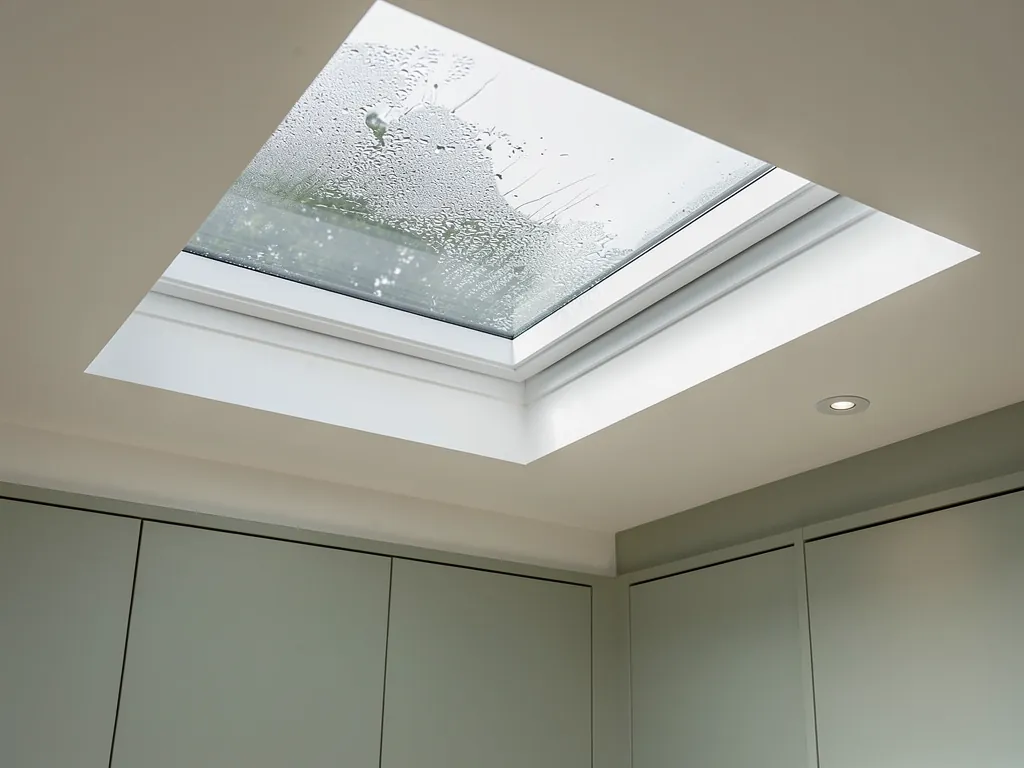
When the seal finally breaks, the first thing you see is the misting. The cause is explained in why rooflights mist between the panes. This page is about the second thing, the one you cannot see: what has happened to the warmth.
Why the gas goes before the glass shows it
A unit can lose some of its filling for years before any mist appears. Mist only shows once enough damp air has got in to condense on the cold face of a pane. The gas has been leaving, slowly, all that time.
A unit filled at the factory is then installed in a roof that is sometimes freezing and sometimes hot. The gas in the gap expands and contracts with each swing, so the unit breathes a little. A healthy seal keeps that breathing to a trickle. A tired one lets the gas out and the room air in, and the exchange never stops.
A few points follow from that, and they shape everything later on this page.
- A misted unit has almost certainly lost much of its argon, because the seal that let moisture in also let gas out.
- A unit that looks clear may already be part way there. Mist is the late symptom, not the first.
- The low emissivity coating can be damaged by damp getting to it, so the reflective benefit may be reduced as well.
- The desiccant in the spacer fills up, and once it is saturated it cannot protect the gap any more.
So the useful way to think of a misted skylight is as a unit that has retired from insulating and is now simply a pair of panes with a damp gap. That matters in winter, and it matters in a room you heat.
How much colder a failed unit really is
Heat loss through glazing is measured as a U-value, in watts per square metre per kelvin. A lower number means less heat escapes. The figures below are typical values for the centre of a pane, quoted from general industry knowledge rather than measured on your roof, so treat them as orders of magnitude.
| Glazing state | Typical U-value | What you feel |
|---|---|---|
| Single pane | About 5.0 to 5.8 | Cold surface, falling draught |
| Old sealed unit, air filled | About 2.7 to 3.0 | Better, still cool |
| Modern unit, argon, coating | About 1.1 to 1.4 | Glass near room temperature |
| Misted, gas gone | Drifts back towards the air filled figure | Cool pane, damp gap |
The direction is what to take from the table. A modern argon unit with a coating is a good deal better than an old air filled one, and a failed unit tends to slide back towards the older figure. It will not fall all the way to single glazing, because there are still two panes and a gap. It will sit clearly above where it was the day it was fitted.
Two more things make a rooflight different from a wall window. Warm air rises, so the ceiling is where the house wants to lose heat, and a glazed hole there gets more than its share of the work. And the glass faces the open sky at night. A clear winter night pulls heat out of a flat or pitched pane in a way a vertical window never experiences. That is why a failed unit in a rooflight can be noticed as a cold patch above the bed or the kitchen island, long before you would feel the same in a window.
Where the cold actually shows up in a room
People rarely notice a number. They notice a symptom, and the symptoms of a failed unit are quite consistent.
The glass itself feels cold to the hand, and a cold surface pulls the warmth from the air nearest to it. That air drops, and you can feel it as a slow, cool draught falling from the ceiling. There is no hole in the roof. It is convection, and it is a real effect in a room with a large rooflight.
Then there is the inside face. In a healthy unit the room-side pane sits close to room temperature and stays dry. In a failed one it runs colder, so the damp air in the room condenses on it more readily. That is the reason some owners see the room side streaming on a cold morning as well as the misting between the panes. If that is the pattern you have, read why a rooflight mists on the room side, because the cause can be separate.
Finally, the room becomes harder to heat evenly. A loft bedroom with a failed rooflight tends to lose its warmth upward all night, then needs a long run of the heating to catch up. The boiler is not the cause. The roof is taking the warmth back out.
Reading the clues without any instruments
You can learn a good deal about a unit with no thermal camera at all. A few careful looks will tell you a great deal, and the answer feeds straight into whether the whole rooflight or just the unit should be replaced.
- Look at the gap on a bright day. A milky haze, water beads, a fine white bloom or a tide line of dried residue between the panes means the seal has failed.
- Look at the spacer bar at the edge. Staining, a wet-looking edge or a darkened seal line is a sign that damp has been travelling along it.
- Hold a hand an inch from the glass on a cold morning and compare it with another unit on the same roof. A clear, working pane will feel noticeably less cold.
- Check the date stamped on the spacer, where there is one. A unit well past its first guarantee period is more likely to have gone, whichties into whether the original guarantee still applies.
The state of the coating is harder to judge by eye. On the survey we look at the reflections in the glass and note anything unusual, and it goes in the written notes that come with the quote.
What a replacement unit brings back
The honest pitch for replacement is that you get the original performance back, and often a better one. Glazing has moved on a long way from units made fifteen or twenty years ago, and a new unit in the same frame usually wins on three counts.
First, the gas fill is sealed in fresh. A new unit starts full and tight. Second, modern coatings are more effective than older ones, so the same two panes can reflect far more heat back into the room. Third, the spacer matters. Older units used aluminium spacer bars, which conduct heat around the edge of the glass. A modern warm edge spacer is made of a less conductive material, and that reduces cold bridging and the tendency for the edge of the glass to mist on the room side.
The result is that the glass sits much closer to the temperature of the room, the falling draught reduces, and the heating works less hard to hold a steady temperature. A saving in pounds depends on the size of the glass, the house and the way you live in it, so the honest claim is about direction. A failed unit loses heat, and a good replacement takes that loss away.
The decision between new glass in the existing frame and a whole new rooflight is covered in replacing the glass unit or the whole rooflight. The test is the state of the frame, the seals around it and whether the unit size is still made.
Using the replacement to improve the room, not just restore it
When a unit has to come out anyway, the glass can be chosen to suit the room as it is now. That is the real opportunity, and upgrading the glazing when a unit fails explains the options.
A room that was a spare bedroom twenty years ago may be a home office or a nursery today. A kitchen that once had a small dome may now have a large flat rooflight over the table. The same hole in the roof deserves a different answer.
The choices that affect heat loss are these:
- Low emissivity coating: standard on modern units, and worth checking that it sits on the correct face.
- Gas fill: argon is the usual choice. Other gases exist but suit only specific cavity widths.
- Warm edge spacer: reduces cold at the perimeter and helps keep the room-side pane dry.
- Triple glazing: adds weight and depth, and is only possible where the frame can take it.
- Solar control coating: a choice for south facing glass that overheats in summer, traded against winter gain.
Each of these is a trade. A heavier unit needs a stronger frame and sometimes a deeper rebate. A solar control coating can slightly cool the colour of the light. A triple unit can look a little darker from below. None is automatically right, which is why the choice is written down.
The same decision can also make the room quieter. A laminated inner pane adds mass and damps the drumming of rain, and it is a build we often specify for a loft bedroom. Laminated glass also holds together if it breaks, which is covered in whether a failed unit should be replaced with laminated glass. The link between glass and sound is set out in whether a replacement unit makes a rooflight quieter. One replacement, chosen properly, answers warmth and noise together.
What Building Regulations ask of replacement glazing
Replacing the glazing in a rooflight counts as controlled work. Part L of the Building Regulations covers the conservation of fuel and power, and it sets limits on the heat loss of new and replacement glazed elements in an existing home. Those limits have been tightened over the years, so a like-for-like unit from a decade ago is often no longer the standard you may install.
The exact limiting figure depends on the element and the edition of the approved document in force, so we check the current one at survey instead of relying on a number from memory. Our part of the job is to fit glazing that meets it and to handle the Building Control notification where the work is notifiable.
There is also a safety side. Part K covers protection against falling and impact, and some rooflights, especially those that can be reached or walked near, need glazing that does not shatter into sharp pieces. The position and the height of the glass decide it. Part F, on ventilation, comes in if the rooflight is an opening one that the room relies on for purge ventilation. Both are reasons to treat a failed unit as a specification decision, and not as a matter of finding the nearest matching pane.
The cost of waiting another winter
A failed unit does not become a crisis overnight. It does get worse slowly, and waiting has a few real costs worth weighing.
The heating works harder every cold night, and the gap does not get better with age. The mist can spread across more of the pane as the desiccant is overwhelmed. Staining on the inner faces can become permanent, and it cannot be cleaned off, because it sits in the sealed gap. The room is also less comfortable in exactly the months you use it most.
There is a practical point on timing too. A replacement glass unit is made to measure, so there is a wait between the survey and the fitting day, that can run to a few weeks. Ordering in late summer or early autumn means the new unit is in before the cold nights, rather than during them. A surveyed, ordered, planned job is far more comfortable for the household than one rushed at the first frost.
If the house is on the market or soon will be, the state of the glazing is something a buyer's surveyor may notice. Put that way, replacing it before a sale is an easy decision.
How the job runs, for a warm result
A replacement that recovers the heat is mostly about measuring and specifying well. The fitting is the short part.
At the survey we look at the unit, the frame, the seals around it and how the glass sits in the rebate. We measure the thickness of the unit, because a modern unit can achieve more in the same depth than an older one, and the frame rebate may limit what goes in. Every figure goes on the quote.
We then write the recommended build into the quiet spec that comes with the quote. It names the glass makeup, the coating, the gas fill, the spacer and the seals, and says what noise we heard at the survey and what the build is meant to do about it. You can see exactly what is being specified, and so can anyone who reads it later.
On the day, the old unit comes out, the rebate is cleaned and checked, and the new unit goes in on fresh gaskets and setting blocks. The room is left tidy. The work carries our 10-year workmanship guarantee, and the terms are on the guarantee page.
When a new frame is the better answer
Sometimes the glass is only half the story. If the frame has rotted, corroded or warped, a new unit in it will not hold its seal any better than the old one did, and the heat will escape round the edge of the glass however good the glass is.
A few signs suggest the frame is the real limit. The gasket has hardened and cracked. Condensation runs down and pools on the sill. Timber is soft or stained. A metal frame shows pitting or a white bloom. In that case, the efficient move is a whole new rooflight, and when the frame has failed too explains how that is decided.
For a wider view of how rooflight glazing is chosen for warmth, our page on energy efficient rooflights takes it further, including what to look for on the paperwork.
Questions about warmth and failed units
Does a misted rooflight always lose more heat?
Yes, as a rule. Mist means the seal has failed, and a failed seal means the gas fill is gone or going. The loss is usually gradual rather than sudden, so the room does not change overnight, but the trend runs one way.
Is a blown skylight unit worth replacing for energy alone?
Energy is one reason, and the glass also looks poor and the gap will not recover. Owners can find the comfort and the appearance weigh as heavily as the heating. The fuller picture of what a blown unit means is in what a blown double glazed unit in a skylight means.
Will a new unit stop the room-side condensation?
A unit with a warm edge spacer and a good coating keeps the inner pane warmer, which reduces condensation markedly. If the room is very humid, for example a kitchen or a bathroom, some moisture will still form on cold mornings, and ventilation helps.
Can I tell how bad my unit is from the outside?
Not reliably. The gap shows damp from a ladder on a dry day, but the gas fill cannot be seen at all. That is why the survey looks at the whole unit together with the frame and the seals, and not at the mist alone.
To talk through a particular rooflight, get a quote or message us on WhatsApp. The parent page, misted and failed rooflight replacement in Crawley, sets out the whole service.