A glass unit is only as good as the frame that holds it. When the timber has gone soft, the uPVC has split or the kerb underneath has warped, a new pane of glass would be sitting in a frame that cannot carry it, and within a few winters it would fail in the same way as the old one. In that situation the sensible job is a whole new rooflight: frame, glass, seals and, where needed, the kerb. This guide explains how a failed rooflight frame shows itself, how we judge it from the loft and from the roof, what a full replacement involves, and how the new build can be quieter and warmer than the one it replaces.
Why a sound-looking unit can still be the wrong thing to reglaze
The glass is the part you notice, but the frame is the part that decides the life of the rooflight. Sorting the two apart is the first job of any survey.
A rooflight frame has four duties. It holds the glass at the right angle. It carries the weight of the glass and any snow sitting on it. It forms the seal between the glass and the roof. And it keeps its shape as the seasons push it and pull it. A unit that has misted or a pane that has cracked can often be dealt with by changing the glass alone. A frame that has stopped doing any one of those four duties is a different case, because the new glass inherits the problem.
Think of a sash window in an old house with rotten bottom rails. You can fit the best double glazed unit on the market, but the putty line still moves, the rail still holds water and the joint still opens. A rooflight is the same, with two differences. It sits at a shallower angle than a wall window, so water lies against the frame for longer. And it faces straight up, so the sun, the frost and the rain all land on it at full strength.
Our page on replacing the glass unit or the whole rooflight sets out the wider choice. This page covers the far end of it, where the frame settles the question.
What a failed frame looks like, material by material
Each frame material fails in its own way, and each leaves its own marks. Knowing them helps you judge what you are looking at before anyone climbs a ladder.
Timber
Softwood frames, common on older roof windows and on many site-built rooflights, fail from the bottom edge upwards. The sill takes the water, so that is where the rot starts. Press a thumbnail or a screwdriver tip into the wood along the lowest rail. Sound timber resists. Timber that has started to go lets the point sink in, crumbles, or feels damp and spongy even in a dry week. Flaking paint that lifts in sheets, dark staining and a sour smell in the loft all point the same way. A hairline crack along the grain is normal. A split that runs through a joint, or a corner that has opened, is not.
uPVC
White uPVC does not rot, which tempts people to think it lasts for ever. It does not. Over many years of sun the surface chalks, the plastic becomes brittle and the corner welds can crack. Look for splits along a weld, a bowed top rail, hinges that have pulled through the profile and gaskets that have shrunk away from the glass. On a rooflight with a flat top, the profile can also sag in the middle of a long span, which leaves a dip where water collects.
Aluminium
Aluminium frames fail more quietly. The metal itself holds, but the thermal break can degrade, the corner cleats can loosen and the finish can corrode where the coating has worn through. White powdery pitting on the surface is corrosion. A frame that rattles when you press a corner has lost the fixing that holds its joints together.
The kerb underneath
On a flat roof, the frame sits on a kerb, a small upstand of timber or GRP that lifts the rooflight above the roof surface. If the kerb has twisted, sunk or softened, the rooflight above it cannot lie flat, however good the frame is. You may see a gap at one corner, a frame that looks out of square, or a membrane upturn that has pulled away from the timber.
| Material | First sign | Point of no return | Usual outcome |
|---|---|---|---|
| Softwood | Peeling paint on the sill | Soft timber at a joint | New rooflight |
| uPVC | Chalky, yellowed surface | Split weld or bowed rail | New rooflight |
| Aluminium | Pitting at corners | Loose cleats, rattling frame | New rooflight |
| Kerb | Gap at one corner | Soft or twisted timber | New kerb and rooflight |
The checks we make before we say the frame has gone
The word "failed" is easy to say and harder to earn. A frame is judged on what it does now, what it will do for the next winter, and whether anything stronger can be built into the same opening.
At the survey we work from the inside first, because the underside of a frame tells you things the outside hides. Shine a torch along the inner edge of the lining. Staining that follows the frame on the plasterboard splay suggests water has been reaching the structure. A tide line on the timber around the opening says the same thing in a different way. We look for daylight where there should be none, which shows a gap between the frame and the lining, and for any sag in the plasterboard that suggests the structure has taken on moisture.
Then the roof. We check that the frame sits square in its opening, whether the flashings or upstand are still bonded to it, and whether the fixings are sound. We press on the corners. We open any opening sash and watch how it closes, because a frame that has warped will not close evenly. On a flat roof, we check the level of the kerb with a spirit level, because a warped kerb shows up as a rocking or lopsided frame.
The test that matters most is the simplest. Would new glass in this frame last as long as the glass itself should? If the answer is no, reglazing is money spent twice. You will find a fuller account of how we take these readings in our guide to measuring a failed rooflight for replacement.
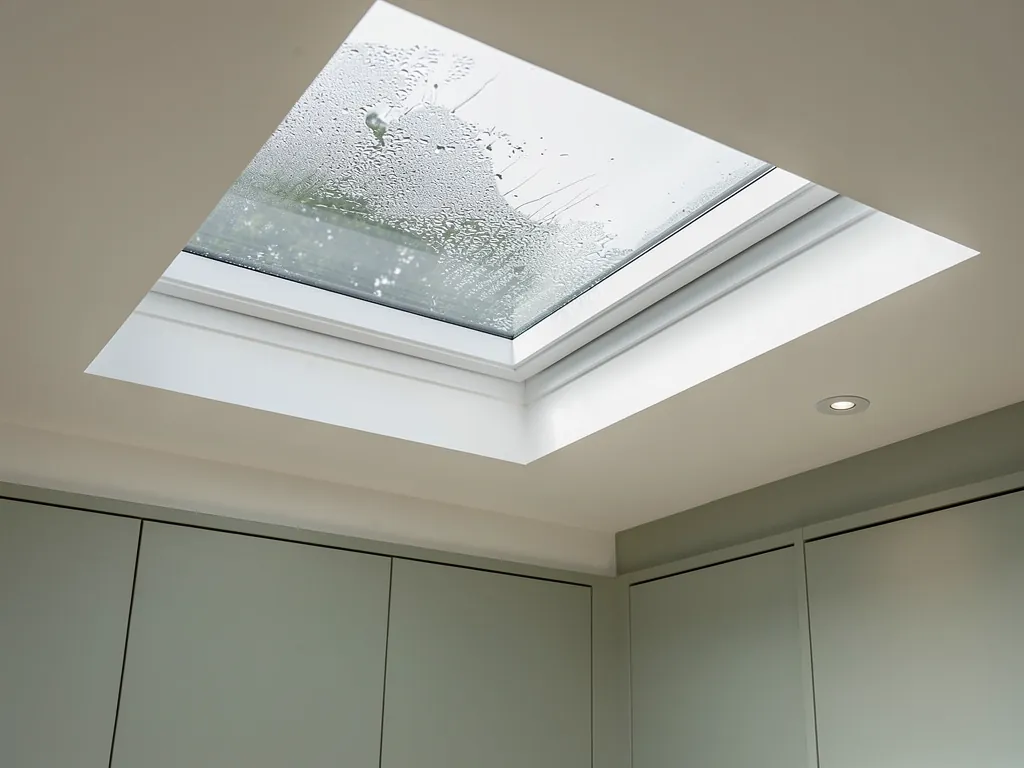
How damp behind the lining connects to the frame
Moisture in the frame is usually the cause of a failed frame, and it is also one of its symptoms. Understanding the loop explains why these jobs cannot be rushed.
Water reaches a frame in three ways. It runs down the glass and meets the lower rail. It gets in where the seal between frame and glass has aged. And warm, humid room air condenses on the cold inner face of a frame that has no proper thermal break. Timber drinks all three. Once the wood holds water, it swells, the paint blisters, the joints open and the next shower finds an easier route in. After that the cycle speeds up.
Plasterboard, insulation and joists around the opening can take on that moisture too. Before we fit anything new, we open up the lining and check what is behind it. If the surrounding timbers are sound, the job continues. If they are not, we say so in the quote and build the extra work in, because a new rooflight fitted into wet structure would begin its life in the same conditions that finished the last one. Our page on whether a misted rooflight can cause damp in the room covers the glass side of that question.
Reglazing against a new rooflight, compared plainly
Some frames are worth keeping, and that deserves a straight account. The choice follows the condition of the frame, not a preference for the bigger job.
Keep the frame and change the glass when the timber is sound through to the core, the profile is straight, the seals can be renewed, and the frame is a type a modern glass unit can sit in without being forced. In that case a new unit is often the economical answer, and the sibling page on failed seals on rooflights explains how to tell.
Replace the whole rooflight when any of these are true:
- The timber at a joint or sill is soft enough to take a fingertip or a screwdriver point.
- A uPVC weld has split or the profile has bowed.
- The kerb has twisted, sunk or softened.
- The frame is too shallow or too thin to take the thicker glass a quieter, warmer build needs.
- The glass has failed and the frame is at the end of its life as well, so the two would need work in the same year.
That last point is the one people overlook. If the glass has misted because the frame let water past a failed seal, the frame is often the cause and not a passenger. A new unit fitted into it simply restarts the same clock.
| Question | Reglaze | Replace whole |
|---|---|---|
| Frame sound to the core? | Yes | No |
| Profile straight? | Yes | Bowed or split |
| Kerb flat and firm? | Yes | Twisted or soft |
| Room for thicker glass? | Yes | Needs a new frame |
What a full replacement involves, step by step
A whole-rooflight replacement is planned as one piece of work with a clear order, so the room is exposed to the weather for as short a time as possible.
The new rooflight is ordered before the old one comes out. That is the rule that protects the house. We measure the opening, the kerb and the roof build-up at survey, order the unit to those sizes, and check it against the order on delivery. Only then do we strip the old one. Our page on how long a replacement glass unit takes to arrive explains the wait.
On the day, the sequence runs like this. The room below is protected with dust sheets and the furniture moved back from the opening. The old glass and sash are lifted out first, which lightens the frame and makes it safer to handle. The frame is then released from the kerb or the roof structure and taken out whole where it will come, and in pieces where it will not. We inspect what has been revealed: the kerb, the batten, the insulation, the lining. Anything soft is cut out and replaced with new treated timber.
The new kerb or the existing one, now proved sound, is checked for level and square. The new rooflight is set on it, packed where needed and fixed through the frame to the structure. The flashings or upstand go on next. On a pitched roof, that means new flashing kit and tiles or slates dressed back to it. On a flat roof, it means the membrane or GRP upturn is renewed, turned up the kerb and sealed at the corners. The inside is then made good: new lining, plaster splay and a clean finish, ready for the decorator.
A straightforward swap in a standard opening is commonly a day's work for an experienced crew, with a longer job where the kerb or lining needs rebuilding. Wet weather can delay it, because a roof is only opened when it can be closed again the same day.
Rules that apply when the whole unit is renewed
Changing a whole rooflight is classed as building work, which brings the Building Regulations into it. That is a good thing, because it is the point where an old build gets brought up to today's standard.
Part L covers the thermal performance of replacement glazing. A new rooflight has to meet the limiting value for its type, so a new frame and glass pack will normally be better insulated than the one that came out, with a warmer edge spacer and a frame with a proper thermal break. Part K covers safety glazing where people may walk into or fall against the glass, and good practice makes a laminated inner pane the usual choice overhead: if the glass breaks, it stays in one piece. Where the opening touches the roof structure, Part A comes into play, and where an opening sash or an escape window is involved, Part B may apply as well.
Where the work is notifiable, we handle the Building Control notification. We install to current Building Regulations, and the work carries our 10-year workmanship guarantee, set out on the guarantee page. The official guidance is published on gov.uk for anyone who wants to read the documents themselves.
Using the replacement to make the room quieter
The day a frame comes out is the best day to change how the room sounds. A like-for-like swap misses that chance, and it costs nothing in extra access.
A tired rooflight is usually a noisy one. Hardened gaskets let air and sound through. A frame that has moved leaves gaps. Thin glass, set in a thin frame, carries the drum of rain and the drone of a Gatwick departure straight down into a loft bedroom. When the frame is being replaced anyway, we can choose the build for the noise that room actually hears.
The levers are all ones we can name. A laminated acoustic inner pane damps the glass itself. A different pane thickness on the outer and inner leaves stops the two panes ringing together. A deeper cavity and a deeper frame hold the thicker unit without crowding the seals. New continuous gaskets close the air gaps. And a properly formed upstand or flashing stops rain hitting bare metal or a hollow surface and amplifying the sound. We set these out in the written quiet spec that comes with every quote, and the quiet spec page shows what it covers.
The upgrade guide, upgrading the glazing when a rooflight unit fails, goes into the glass choices in more depth.
Changing the type, size or position of the opening
A full replacement is the moment to ask whether the old rooflight was in the right form in the first place. The roof is already open, so the question is cheap to ask.
You can renew exactly as before, matching the old opening, which is the quickest route and keeps the ceiling and lining unchanged. Or you can change the glass type, for example from a fixed unit to one that opens, which gives ventilation in a loft bedroom or a kitchen. Any change to the size of the opening involves the joists, and possibly a trimmer or a beam, so it is planned at survey and not improvised on the day. For flat roofs, the sibling service, flat roof rooflight installation, covers the kerb and upstand side in detail. For pitched roofs, roof window installation covers the flashing and sizing of a new window.
Timing, weather and what to do while you wait
A failed frame does not need to be dealt with in a panic, but it does need to be dealt with. Waiting lets the damage spread from the frame into the structure around it.
In the meantime, keep an eye on the ceiling splay under the rooflight after rain. Wipe condensation from the frame on cold mornings and keep the room ventilated, because moisture in the air feeds the same problem. Do not climb onto the roof to seal or smear anything into the joints. A coat of sealant over a soft frame hides the trouble and traps water behind it, which makes the eventual job bigger. If a pane has cracked as well as the frame failing, the page on cracked rooflight glass and what replacing it involves explains what to do about the glass.
Spring and summer suit the work, since materials dry out and the crew can leave a roof open while they work. But a replacement can be done in winter, in a dry spell, if the old frame is making a damp room worse. The costs page explains what shapes the price of a full replacement compared with a glass-only change.
Questions people ask at the frame stage
These are the points that come up once someone has found soft timber or a split profile and is wondering what it means for the job.
Can I just fill a soft frame and keep the glass?
Filler on soft wood hides the damage but does not stop the rot, and it cannot hold a screw or carry a pane. The timber keeps taking water beneath it, and the filler usually lifts within a season. If the wood has softened, the honest route is a new frame, and the glass in it can only be reused if it is in good order and suits the new frame,.
Will the new rooflight match my old opening?
Yes, it is ordered to the measured opening, so it fits the existing ceiling and lining. If you want a different size or shape, that is agreed at survey because it involves the structure around the opening.
Does a new frame mean the ceiling has to be redone?
The lining and splay around the opening are renewed and made good as part of the work, so the inside is left tidy and ready for paint. Plastering further from the opening is not normally affected.
How do I know whether the frame or only the glass has failed?
Look at the frame, not the glass. If the wood is sound and the profile straight, it is likely a glass matter. If you can see soft timber, split plastic or a twisted kerb, the frame is involved. A survey confirms which, and you can get a quote that puts the answer in writing. The hub on misted and failed rooflight replacement sets out the whole range of cases.