Service · Crawley and 30 miles around

Energy efficient rooflights in Crawley, warm in winter and calm in summer

Energy efficient rooflights in Crawley, chosen for the room: the glass, the frame and the upstand set down in writing, with the quiet spec beside the thermal choices.

Get a quote What is a quiet spec?

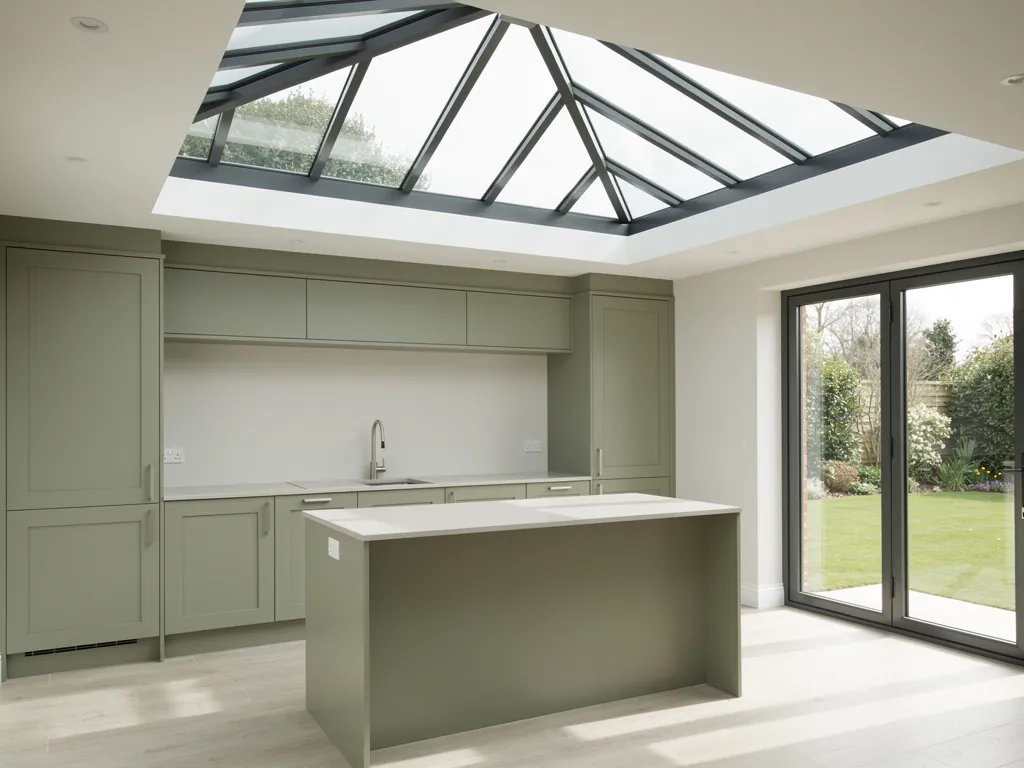
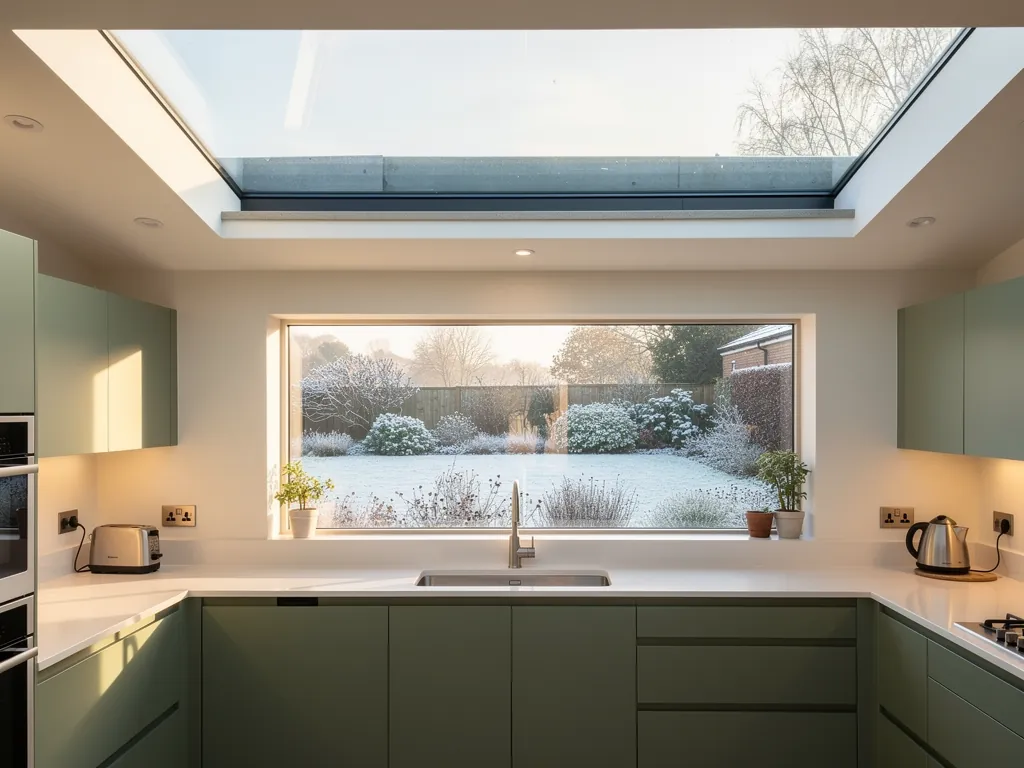
A kitchen extension with a roof lantern above the island
  • 10-year workmanship guarantee
  • Building Control notification handled
  • Fitted to current Building Regulations
  • A quiet spec with every quote
  • Crawley and 30 miles around

The cold spot

Why a rooflight is the coldest surface in the ceiling

Glass loses heat faster than any insulated roof, so a rooflight is the coldest spot in winter and the warmest in summer.

Glass loses heat faster than any insulated roof, and it faces the sky, which is the coldest thing your house ever meets. An energy efficient rooflight is one specified so that loss is small, the summer gain is managed and the edge detail does not undo the glass.

A well-insulated pitched roof or warm flat roof holds back heat through a thick build-up of board, quilt or foam. A rooflight replaces an area of that build-up with a few millimetres of glass and a cavity. Even the best glazing unit is a thinner barrier than the roof around it, so the rooflight will always be the coldest and the warmest spot in the ceiling, depending on the season. The job is not to pretend otherwise. The job is to make that spot as mild as the glass, the frame and the fitting allow.

You feel it in a few familiar ways. In January you sit under a skylight and the air above your head is cool, even though the radiator is working. Warm air rises, meets cold glass, cools and drops back down as a slow draught that has no gap to blame. Condensation gathers on the inner pane on still mornings. In July the same room can be too bright and too warm by mid-afternoon, because the glass lets solar heat in faster than a small room can lose it.

How a cold rooflight shows itself

  • Cool air overhead In January the air above your head is cool, even though the radiator is working.
  • A slow draught Warm air meets cold glass, cools and drops back down, with no gap to blame.
  • Condensation It gathers on the inner pane on still mornings.
  • Summer glare In July the room can be too bright and too warm by mid-afternoon.

Both complaints come from the same glass, and both can be designed out before a single pane is ordered. That is what this page covers. It sets out the parts of an efficient rooflight in the order they matter, then points you to a short guide on each. If you want the whole argument in one line, it is this: choose the glass for the orientation, choose the frame for the cold, and fit the edges as carefully as you chose the pane.

Crawley gives the subject a particular shape. The town was built quickly from 1947 onwards, and its neighbourhoods are full of 1950s to 1970s houses with modest roof insulation, loft conversions added later and flat-roofed kitchen extensions at the back. Those are the rooms where rooflights go, and they are often the rooms where an old rooflight of a previous generation is now letting warmth out. Across the 30 miles we cover, the same story repeats in every age of house. If you are weighing a new rooflight against the broader range of work we do, the main page for skylight and rooflight installation in Crawley shows where energy performance fits among the ten services.

A word on the other half of our brand. Quiet and warmth are not rivals. The same laminated glass and deeper cavity that soften rain and aircraft also tend to help a rooflight hold heat, and one glazing build for warmth and quiet explains where the two goals meet and where they need a choice. Every quote comes with a written quiet spec, and for this service it records the thermal choices beside the acoustic ones.
NextReading a U-value without being fooled by it

Reading the numbers

Reading a U-value without being fooled by it

A U-value is only useful when you know which part of the rooflight it describes, and at what size.

A U-value measures how much heat passes through a square metre of a building element for each degree of temperature difference across it. Lower is better, and the number is only useful when you know which part of the rooflight it describes.

Two different numbers circulate in brochures. One is the centre-pane value, which describes the middle of the glass and ignores the frame entirely. The other is the whole-unit value, which averages glass, spacer, frame and the junction between them for a named size. The centre-pane figure is always the more flattering of the two. A whole-unit value also changes with size: a small rooflight has proportionally more frame than a large one, so the same product scores differently at two different dimensions. The guide on the difference between a whole-unit and a centre-pane U-value walks through this with an example, and rooflight U-values explained covers the units and the arithmetic.

When you compare two quotes, compare like with like. Ask whether the figure is for the whole unit, at what size, and whether it is measured for the tilt the rooflight will sit at. A rooflight fitted flat loses heat differently from one fitted on a steep pitch, because the air inside the cavity moves differently. Values are also declared for a stated glazing build, so a change to laminated glass, a coating or the gas fill means a different number. That point comes up again in does acoustic laminated glass change a rooflight's U-value.

The numbers that matter most are these three, and a good quote names all of them.

  • The U-value of the whole unit at the size you are buying, which tells you about heat loss on a cold night.
  • The g-value, which tells you how much of the sun's energy gets through, and so how warm the room becomes in summer. See what a g-value is on rooflight glass.
  • The light transmittance, which tells you how much daylight reaches the room. See what light transmittance means on a rooflight.

These pull against one another. Coatings that cut heat loss tend to trim light a little, and coatings that cut solar gain trim it a little more. A specification is a compromise made on purpose, for a room you can describe, and that is why we write ours down instead of quoting a single headline figure. You get the build, the reasoning and the trade-offs, in words you can check against any other quote.

NextThe glass build: panes, coatings, gas and spacers

The glass build

The glass build: panes, coatings, gas and spacers

Four things inside the sealed unit set its performance: the panes, the coating, the gas and the spacer.

The insulating glass unit does most of the work, and four things inside it set its performance: the number of panes, the coating, the gas between them and the spacer around the edge.

Start with panes. A double glazed unit has two sheets of glass with a sealed cavity between them. A triple unit has three and two cavities. The third pane cuts heat loss further, and it adds weight, thickness and cost. On a rooflight the weight matters more than it does in a wall window, because it is carried by the roof structure and the frame at an angle. We take the decision one room at a time, and triple glazed rooflights: when the third pane earns its place sets out the questions we ask. If you are worried about the load, is a triple glazed rooflight too heavy for my roof answers it directly.

Next, the coating. A low-emissivity coating is a microscopically thin metallic layer on one glass surface inside the cavity. It reflects heat back towards the room in winter while letting visible light pass. A rooflight without one is, by modern standards, poor glazing. The placement of the coating matters too, and the guide on low-E coatings on rooflight glass explains which face carries it and what that does to the look of the glass.

Inside the sealed unit

  1. 1Panes Double glazing has two sheets and one cavity. Triple adds a third pane, with more weight, thickness and cost.
  2. 2Low-E coating A microscopically thin metallic layer inside the cavity that reflects heat back towards the room.
  3. 3Argon fill Denser than air, it slows the circulation of warmth across the cavity.
  4. 4Warm edge spacer A less conductive strip at the perimeter keeps the edge of the glass closer to room temperature.

Then the gas. Most efficient units are filled with argon, which is denser than air and slows the circulation of warmth across the cavity. It is invisible, it is inert and it is standard in a decent unit. It does slowly migrate out over the decades, which is one reason a failing seal shows itself in performance before it shows itself in fog. What argon gas does inside a rooflight answers the usual questions, and warm edge spacers and argon fill in rooflights covers the pairing.

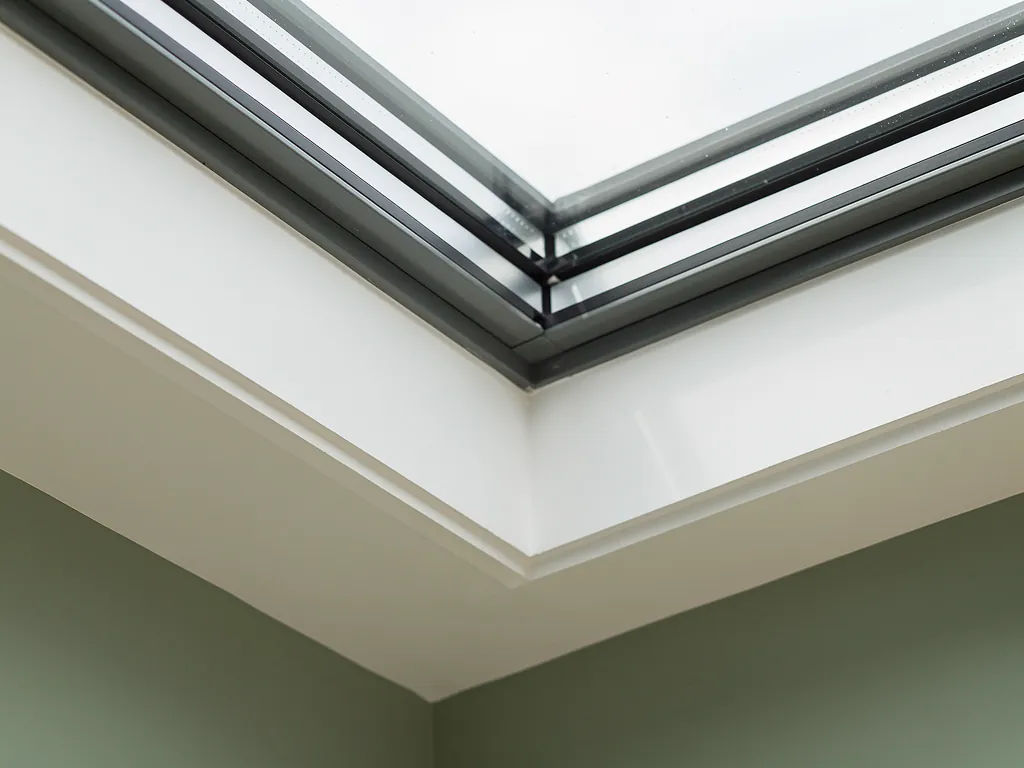
Finally, the spacer. This is the strip that holds the panes apart at the perimeter. A traditional aluminium spacer conducts heat straight across the edge of the unit, which is where condensation starts and where a cold line appears on the glass. A warm edge spacer is made from a less conductive material and keeps the edge of the glass closer to room temperature. On a rooflight, where the glass is at an angle and the perimeter is long relative to the area, a warm edge spacer is one of the cheaper ways to improve real-world comfort.

Put the four together and you have a sealed unit. Another question worth asking is whether glass is the only choice. It is not, and are glass rooflights more energy efficient than polycarbonate compares them. For a domestic room, the glazed unit wins on clarity, longevity and acoustic behaviour, and multi-wall polycarbonate has its place on the simplest utility roofs.

NextFrames that stop the cold at the edge

The frame

Frames that stop the cold at the edge

A frame can waste everything the glass achieves, unless a break in the metal stops the warmth running straight out.

A frame can waste everything the glass achieves. Metal carries heat very well, so an aluminium frame without a break in it becomes a cold bar around the warmest part of your ceiling.

A thermally broken frame puts a low-conductivity insulating strip between the inner and outer faces of the section, so the warmth inside the room cannot run straight out through the metal. The same idea applies to the timber, PVC and composite alternatives, each of which starts with a lower conductivity than bare metal. Which material suits which room is a matter of the roof, the look you want and how much upkeep you will accept, and thermally broken rooflight frames goes through them.

You see the difference in use. A frame with no break is the first place condensation forms on a cold morning, and the run of moisture down the inside face of the upstand is the sort of thing people mistake for a failed seal. A frame with a proper break stays closer to room temperature, so the same conditions leave it dry. That is one reason we treat the frame and the unit as a pair, never as separate shopping items.

Frames also set the limit on how large a rooflight can be before you need structural support and extra glazing bars. More bars mean more edge, and more edge means more heat loss per square metre. A single large pane in a narrow, well-insulated frame often beats a cluster of small panes. The trade is handling weight, which we plan for at survey. For a roof lantern, where the geometry is all edges, the frame performance sits at the centre of the specification, and the roof lantern installation page goes through the shape and the bars.

NextSolar control: a warm January and a calm July

Solar control

Solar control: a warm January and a calm July

Winter asks the glass to keep heat in and summer asks it to keep heat out, and solar control glass handles the second half.

Winter asks the glass to keep heat in. Summer asks it to keep heat out. One rooflight has to do both, and solar control glass is how it manages the second half.

Solar control glass carries a coating that reflects or absorbs part of the sun's infrared energy before it enters the room. The g-value tells you how much gets through. A lower g-value means a cooler room on a bright afternoon. It usually also means a slightly tinted or slightly reflective look and a small reduction in daylight, which is the price of the benefit. Does that make a room darker? Does solar control glass make a room darker gives the answer: a little, and far less than a blind drawn against glare.

The need for it depends on where the glass faces and how big it is. A large south-facing or west-facing rooflight over a small room will overheat without help. A north-facing one might never need it. A modest rooflight over a stairwell barely matters. Solar control glass for rooflights explains the options and stopping a rooflight room from overheating turns it into a practical plan that also includes ventilation, blinds and external shading.

There is a side benefit that customers sometimes ask about. The same coatings that manage heat also cut the ultraviolet and some of the visible energy that bleaches fabrics and timber. They reduce fading but do not stop it, and can rooflight glass stop furniture fading sets out what to expect.

A warm summer room is also a room where you want the rooflight open. If you plan to ventilate through it, the choice of opening mechanism and the position of the vent belong in the same conversation, and our electric and opening rooflight installation page covers the hardware. Opening glass in a room near a noisy road or flight path raises its own question, which we treat in the quiet spec.

NextWhich way the glass faces

Orientation

Which way the glass faces

Orientation decides how much of the sun's heat a rooflight collects and when, so each face needs its own specification.

Orientation decides how much of the sun's heat a rooflight collects and when. The right specification for a south-facing roof plane is not the right one for a north-facing one.

A south-facing rooflight meets the sun high in summer and lower in winter. It collects a large amount of energy in both, which helps in January and hurts in July. A west-facing one collects its heat in the late afternoon, exactly when the room is already warm from the day. An east-facing one warms the room early and then sits in shade, which tends to suit bedrooms. A north-facing rooflight collects almost no direct sun, so it gives steady, cool, even light and offers the least passive warmth, which puts the weight of the specification on insulation rather than on shading.

So the glass follows the compass. On a south or west plane we usually weigh solar control glass and a blind or shading option seriously. On a north plane we lean on the lowest heat loss we can get. On an east plane we look at the room itself. Choosing energy efficient rooflights by orientation gives each face its own guidance, and can a rooflight help warm a room in winter examines the genuine benefit of winter sun, which is real but smaller and shorter than people hope. Low winter sun through a rooflight is pleasant and it does offset some heating. It is rarely enough to justify leaving out a good coating.

Four faces, four answers

  • SouthCollects a large amount of energy in both seasons, which helps in January and hurts in July.
  • WestCollects its heat in the late afternoon, when the room is already warm from the day.
  • EastWarms the room early and then sits in shade, which tends to suit bedrooms.
  • NorthAlmost no direct sun, so the weight of the specification falls on insulation.

Roof pitch has its own effect. A steeply pitched roof window behaves more like a wall window. A flat or shallow rooflight faces more of the sky, so it gains more in summer and radiates more heat out at night. That is why a flat rooflight and a roof window are not interchangeable for energy purposes, and the pages on flat roof rooflight installation and roof window installation treat them separately.

NextThe upstand, the insulation and the thermal bridge

The edge detail

The upstand, the insulation and the thermal bridge

The upstand, its insulation and the reveal are the hardest part to see afterwards, and done badly they waste the glass.

Around the glass sits the part of the job that is hardest to see afterwards: the upstand or kerb, the insulation inside it and the reveal that joins it to the ceiling. Done badly, it wastes the glass.

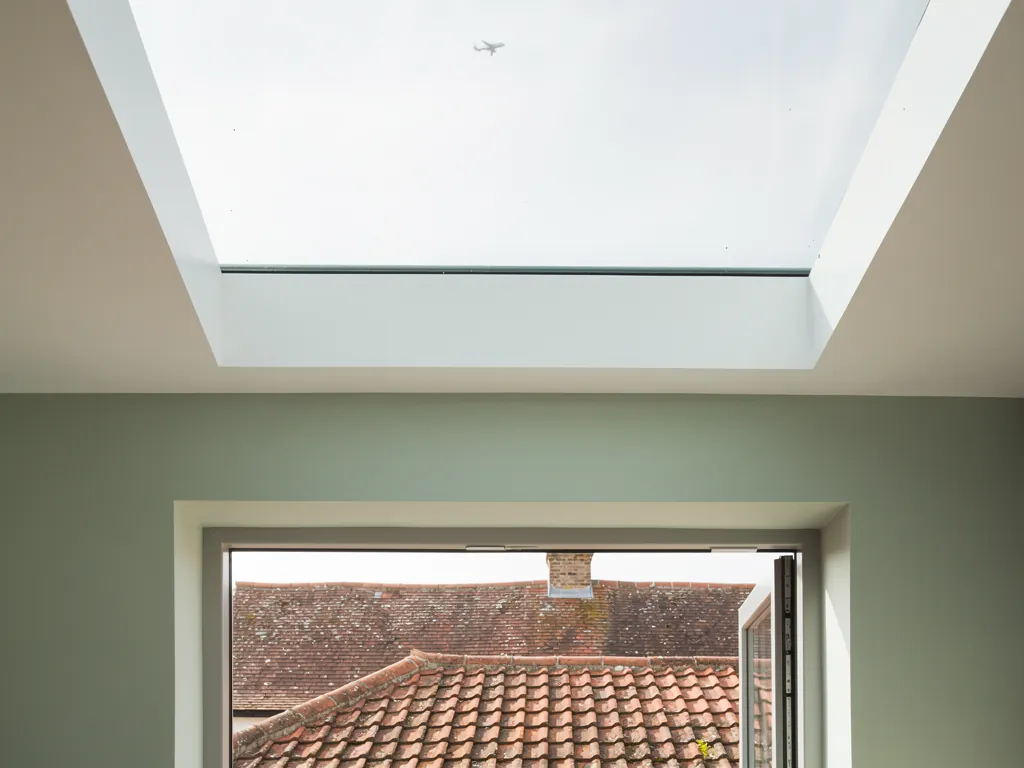
On a flat roof, a rooflight sits on a raised upstand so that water runs around it, not into it. That upstand is a hollow box of timber, concrete or a manufactured kerb, and if it is left uninsulated it becomes a chimney of cold air around the glass. We insulate the upstand on its faces and line the reveal so that the warm side of the ceiling meets the warm side of the unit without a gap. The detail is part of the thermal design and it is also part of the acoustic design, because a sealed, lined upstand is quieter than a hollow one.

A cold bridge is any path where heat travels around the insulation instead of through it. Around a rooflight the common ones are a bare timber upstand, a steel lintel that is not wrapped and a gap between the frame and the structure that is filled with whatever was nearby. You often notice one as a band of condensation or a line of mould on the ceiling around the opening. What is cold bridging around a rooflight explains how to spot it, and insulating around a rooflight: upstands and reveals shows how we close it.

Around the glass, outside to room

  1. 1Upstand or kerb A raised box so water runs around the glass, not into it.
  2. 2Insulation on its faces Left bare, the upstand becomes a chimney of cold air around the glass.
  3. 3Sealed junction The gap between frame and structure is otherwise a direct path for cold air.
  4. 4Vapour control layer Tied into the ceiling lining, so warm, moist room air cannot reach the cold structure.
  5. 5Lined reveal Joins the warm side of the ceiling to the warm side of the unit without a gap.

Airtightness is the companion to insulation here. A rooflight with perfect glass and an open perimeter will still draw cold air into the room, because the gap between frame and structure is a direct path. We seal the junction with a vapour control layer tied into the ceiling lining so that warm, moist room air cannot reach the cold structure. This also protects the timbers, which matters as much as the heating.

The question most owners of an existing rooflight actually ask is about feel. Why does my skylight make the room feel cold in winter deals with the usual causes in order: the glass itself, the frame, the reveal and the draught. Usually it is more than one, and finding out which is the point of a survey.

NextBuilding Regulations, Part L and what a replacement must meet

The regulations

Building Regulations, Part L and what a replacement must meet

Rooflights sit under Part L, which applies differently to new openings, replacements and extensions.

Rooflights sit under Part L of the Building Regulations, which governs the conservation of fuel and power. The rules apply differently to new openings, to replacements and to extensions, and the current Approved Document is the place to read the exact limits.

There are three common cases. A new rooflight in an existing roof is a new element and must meet the limiting value for one. A replacement rooflight is a controlled fitting, so it must meet the standard for a replacement. A rooflight that forms part of a new extension or a loft conversion is assessed along with the rest of that building work, and the designer may trade a little glazing performance against the wall and roof. Our page on Part L and rooflights explains the structure, and does a replacement rooflight have to meet current U-value rules answers the common follow-up.

Part L also sets a limit on how much glazing a building can have before the designer must compensate elsewhere. A large glass roof on an extension is not forbidden, but it has to be balanced by better insulation in the rest of the building. Is there a limit on rooflight area under Part L goes into the detail. We raise it at design stage, because it is easier to change a drawing than a finished roof.

Rules that touch a rooflight

  • Part LConservation of fuel and powerApplies differently to new openings, replacements and extensions.
  • Part KSafety glazing and fallingGoverns safety glazing and protection from falling.
  • Part BFire spreadCovers how fire can spread.
  • Part FVentilationRelevant when the rooflight is also a vent.
  • 13Conservation areas in CrawleyThe position is checked for the address before anything is ordered.

Other Approved Documents touch a rooflight too. Part K governs safety glazing and protection from falling, Part B covers fire spread, and Part F covers ventilation, which is relevant when the rooflight is also a vent. We install to current Building Regulations and we handle the Building Control notification where the work is notifiable, so you do not have to chase the paperwork. You can read the source yourself on the gov.uk Approved Document L page.

Planning is a separate matter from energy. A rooflight in an ordinary house is usually permitted development, with conditions, and Crawley has 13 conservation areas where the position is checked for the address before anything is ordered. If your home is in or near one, conservation rooflight installation is the page to read next.

NextOne glazing build for warmth and quiet

Warmth and quiet

One glazing build for warmth and quiet

The glass that keeps heat in and the glass that keeps noise out overlap further than people expect.

The glass that keeps heat in and the glass that keeps noise out overlap further than people expect. Where they do not, we explain the choice and write it down.

Laminated glass is two sheets bonded by a thin plastic interlayer. It is a safety glass, because it holds together if it breaks, and an acoustic glass, because the interlayer damps vibration. A thicker outer pane adds mass. A deeper or uneven cavity changes how the unit resonates. Every one of those choices affects thermal performance a little, for better or for worse, and the table below sets out how the common builds compare in plain terms.

Double, low-E, argon, warm edge

Warmth
Good baseline
Solar heat
Moderate gain
Quiet
Patter on rain

Same, with laminated inner pane

Warmth
Much the same
Solar heat
Moderate gain
Quiet
Softer, less ring

Triple, low-E, laminated inner

Warmth
Best of the three
Solar heat
Less gain
Quiet
Softest of the three

Double or triple with solar control

Warmth
As its base build
Solar heat
Least gain
Quiet
As its base build
BuildWarmthSolar heatQuiet
Double, low-E, argon, warm edgeGood baselineModerate gainPatter on rain
Same, with laminated inner paneMuch the sameModerate gainSofter, less ring
Triple, low-E, laminated innerBest of the threeLess gainSoftest of the three
Double or triple with solar controlAs its base buildLeast gainAs its base build

The table is a guide to direction, not a measurement. The exact difference depends on the pane thickness, the coating and the frame, and it is the quiet spec that fixes it for your room. The guide to are energy efficient rooflights quieter too explains what carries over and what does not. A triple unit is often quieter in rain because of the extra mass, but a poorly chosen thin third pane can ring. So we never assume, and we specify the thickness of each pane.

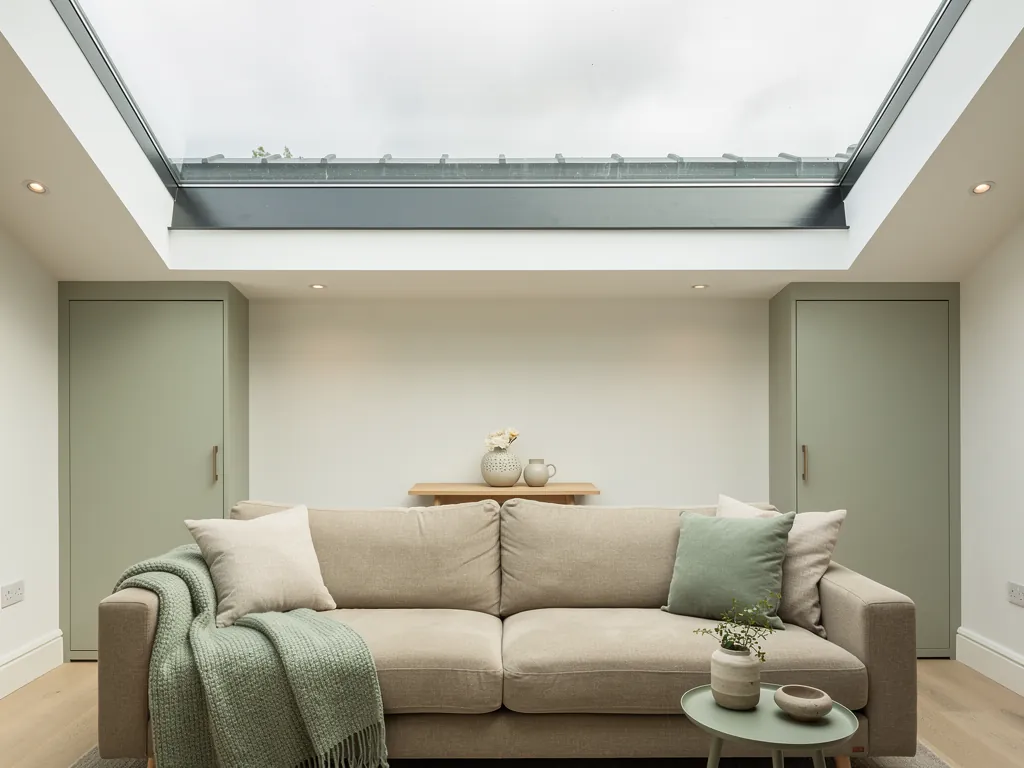
Crawley is where this matters most. Gatwick is in the borough, and the Local Plan itself treats the land between the town and the airport as heavily constrained by aircraft noise. The M23, the A23 and the Brighton main line add their own sound to other neighbourhoods. A loft bedroom in Langley Green and a kitchen extension in Maidenbower do not hear the same things, and they should not get the same glass. The rooflight is usually where that sound enters, so the warm build and the quiet build are best decided as one. One glazing build for warmth and quiet is the longer version of this chapter.

NextLoft conversions, where every choice is tighter

Loft conversions

Loft conversions, where every choice is tighter

A loft conversion has the least forgiving rooflights in the house, because the room is judged every night and every morning.

A loft conversion has the least forgiving rooflights in the house. The glass is overhead, the room is under the roof slope, and it is used as a bedroom or an office, so the rooflight is judged every night and every morning.

The roof is thin here, because the rafters set the depth of insulation, and the glass sits at a steep angle against a sloping ceiling. Heat rises into the room and meets the coldest surface it has, and a bedroom sleeps better when that surface is not dripping. The room is also small, so solar gain has less volume to spread through, and a south-facing roof window can make a bedroom too warm to sleep in on a July night. Those three facts push the specification towards a low whole-unit U-value, a considered solar control option and a blind that can be fitted from the start.

The practical points are these. Roof windows come in standard sizes that line up with rafter spacing, which keeps structural work modest. The insulation around the frame has to be continuous with the roof insulation, using a manufactured collar or a cut-and-fit detail. The lining returns need to be deep enough to avoid a cold shelf at the edge. And the choice of glass should be made with the flight path and the road in mind, because this is the room where the sky is nearest. Our guide to energy efficient rooflights for loft conversions covers all of it, and roof window installation and VELUX window installation cover the products.

A thermal blind is sometimes suggested as a cheaper substitute for better glass. It helps, but it is a supplement. Does a thermal blind help keep a rooflight room warm sets out what a blind can do: it reduces radiant loss at night and cuts glare by day, and it does nothing about a cold frame or a gap around the edge. Fit the best glass you can, and treat the blind as an extra.

NextUpgrading an old rooflight

Upgrading

Upgrading an old rooflight

Replacing a rooflight from a generation ago is one of the more direct energy improvements you can make to a ceiling.

A rooflight installed a generation ago is usually a single sheet, a basic double unit with an aluminium spacer, or a plastic dome. Replacing it is one of the more direct energy improvements you can make to a ceiling.

The question is always whether to renew the glass alone or the whole unit. If the frame is sound, thermally broken and in good order, a new sealed unit in the existing frame can be enough. If the frame is a simple metal section with no break, or the upstand is bare and cold, a glass-only change will disappoint, and we advise replacing the unit, the upstand finish and the lining together. Can an old rooflight be upgraded to be more energy efficient goes through the decision. Where a unit has already failed, with fog between the panes, our page on misted and failed rooflight replacement sets out the replacement route.

It helps to know what you are replacing. We look at the glass type and age, the frame material, the condition of the seals and the state of the upstand, and we record each one. That survey is the first page of the quiet spec. It also means the new rooflight is chosen against the real faults of the old one. A unit that was cold at the edge gets a warm edge spacer. A unit that overheated gets solar control. A unit that drummed in rain gets a laminated inner pane.

What the survey records

  • Glass type and age Often a single sheet, a basic double unit with an aluminium spacer, or a plastic dome.
  • Frame material A simple metal section with no break makes a glass-only change disappointing.
  • Condition of the seals A failed unit shows fog between the panes.
  • State of the upstand A bare, cold upstand means the unit, finish and lining are replaced together.

The replacement case also raises the EPC question, which owners ask often. Does an energy efficient rooflight improve my EPC is plain about it: the rating is a whole-house calculation, and one rooflight moves it by a small and variable amount. The better reason to replace is comfort, condensation and control of summer heat. The rating may shift a little, and that is a bonus.

NextWhat the bills, the price and the payback really depend on

Bills and price

What the bills, the price and the payback really depend on

Neither the saving on heating nor the cost has a single-number answer, and the comfort gain is usually the more noticeable result.

People ask two questions about money: will it lower my heating bills, and what will it cost. Neither has a single-number answer.

On the first, a better rooflight reduces heat loss through a small part of the roof, so the saving is real and modest. It depends on the size of the glazing, the old unit, how warm you keep the house and how your heating behaves. A large old rooflight replaced by a good one saves more than a small one. A replacement in a room that is barely heated saves little. The fuller treatment is in will energy efficient rooflights lower my heating bills, and we would rather you read a cautious answer there than hear a promise from us. The comfort gain, meaning the absence of a cold downdraught and the absence of condensation, is usually the more noticeable result.

On cost, the glazing build is one driver among several. The others are the size and shape of the unit, the frame material, whether the roof needs new upstands or structural work, the access, and how much internal finishing is needed. A triple unit costs more than a double, a laminated acoustic pane costs more than a plain one, and a large thermally broken lantern costs more than a small fixed rooflight. What affects the cost of an energy efficient rooflight explains each driver, and the rooflight and skylight costs page gives the general market picture. Every price we give you is for your room, written down, with the glazing build named.

What moves the price

  • Glazing buildA triple unit costs more than a double, and a laminated acoustic pane more than a plain one.
  • Size and shapeA large thermally broken lantern costs more than a small fixed rooflight.
  • Roof workWhether the roof needs new upstands or structural work.
  • Access and finishingAccess to the roof, and how much internal finishing is needed.

Think of the spend in layers. The baseline is a double unit with a low-E coating, argon and a warm edge spacer in a thermally broken frame. On top of that you choose what the room needs: a third pane, solar control, a laminated acoustic inner pane, an electric opener or a blind. Not every room needs every layer, and we will say so. A utility room with a small north-facing rooflight and a quiet street does not need a triple unit with solar control.

Do rooflights carry an energy rating of their own, the way windows do? That is covered in do rooflights have energy ratings like windows. The reality is that the labelling is less uniform than for wall windows, which is one more reason to ask for the whole-unit figures in writing.

NextHow a fitting is planned and finished

Planning the fitting

How a fitting is planned and finished

The survey is where an efficient rooflight is won or lost, because the specification comes from what we measure and listen to.

The survey is where an efficient rooflight is won or lost, because the specification comes from what we measure and listen to in your house.

We visit, look at the roof, the ceiling and the room, and note the orientation. We check the existing insulation, find the joist or rafter runs, look at any old rooflight and its upstand, and listen. A room under a flight path, beside the A23 or at the back of a terrace on the Brighton line tells us something the drawings will not. We then write the specification: the glass build, the frame, the upstand and the finish, with the reasons. That document is the quiet spec, and it comes with the quote.

The fitting itself is kept tidy. The old unit comes out, the structure is checked, and the new upstand is built and insulated. The unit goes in, sealed against the structure with the vapour control layer tied into the ceiling. The reveal is lined and made good inside. The work is installed to current Building Regulations, we handle the Building Control notification where it is required, and the job carries our 10-year workmanship guarantee, which you can read on our guarantee page.

From survey to finished reveal

  1. 01SurveyWe look at the roof, ceiling and room, note the orientation, check the insulation and listen.
  2. 02Written specificationThe glass build, frame, upstand and finish, with reasons. It comes with the quote.
  3. 03Old unit outThe structure is checked and the new upstand is built and insulated.
  4. 04New unit inSealed against the structure, with the vapour control layer tied into the ceiling.
  5. 05Reveal linedThe reveal is lined and made good inside.
  6. 06Building ControlWe handle the notification where the work is notifiable.

A few things you can do before we arrive help the survey. Note the times of day the room is too warm or too cold. Note where condensation appears. Note what you hear in rain and at the quietest and busiest hours. Those notes are more useful than any product list, and they turn straight into the specification. When you are ready, ask for a quote and we will arrange the visit, or message us on WhatsApp. The get a quote page explains what happens next.

NextQuestions about warmth, light and glass in a Crawley rooflight

Common questions

Questions about warmth, light and glass in a Crawley rooflight

The points that come up most often when an owner is choosing between builds, with the direction in a few lines each.

These are the points that come up most often when an owner is choosing between builds. Each has a longer guide, and the answers here give the direction.

Is a triple glazed rooflight always better?

No. It loses less heat, and it is heavier, thicker and dearer. In a small room with a modest rooflight and a quiet street, a good double unit with a low-E coating, argon and a warm edge spacer does much of what a triple would. A large lantern, a north-facing roof plane or a noisy location make the third pane more persuasive. We decide it room by room.

Can I have solar control glass on a north-facing rooflight?

You can, though it rarely earns its place. A north plane receives little direct sun, so the coating trims light without solving a heat problem. We would rather spend that part of the budget on a lower heat loss build.

Will a laminated pane make my rooflight warmer?

Not by itself. Laminated glass is chosen for safety and sound, and its thermal effect is small. It does no harm to warmth when combined with a low-E coating and a warm edge. That is why the two goals usually sit together in one build.

How do I tell a failing rooflight from a cold one?

A failing sealed unit shows fog or a stain between the panes, which cannot be wiped away. A cold one shows condensation on the room side, which can. The two can occur together, and a survey separates them. A failed unit is replaced, and a cold one is improved by a better build, edge and reveal.

Should the rooflight and the roof insulation be done together?

Whenever the roof is open, yes. Continuous insulation around the frame is easiest to fit while the structure is exposed, and it makes the new glass perform as designed. If you are planning other work on the same roof, tell us early so the sequence is right.

What do I ask a fitter before accepting a quote?

Ask for the whole-unit U-value at your size, the g-value, the glass build in layers, the frame material and how the upstand will be insulated. A quote that names these is one you can compare. If the answer is a single headline number, ask what it describes.

Guides and answers on energy efficient rooflights

Written for homeowners around Crawley: the plain answer first, then the detail.

All guides All answers

Get a quote

Tell us about the room

  • No obligation
  • Quiet spec included
  • 10-year guarantee

Prefer to message? WhatsApp us or call 01293 974093, or email info@clearskylightscrawley.co.uk.