Solar control glass is ordinary rooflight glazing with a very thin coating that turns back a large share of the sun's heat while letting most of the daylight through. It is the quiet fix for a south-facing extension that is bright at breakfast and uncomfortable by two in the afternoon. This guide explains what the coating is, where it sits in the unit, what it does to colour and brightness, and how to pick a tint level for a room in Crawley without ending up with a dim box. It also covers what solar control glass cannot do, so that the money goes where it helps. Call the product a solar control rooflight or a solar control skylight, the glass behind the name is the same.
What the coating actually does
Sunlight arrives as visible light and as invisible heat. A solar control coating is chosen to admit the first and reflect or absorb much of the second before it reaches the room.
The coating is a stack of microscopic metal and metal oxide layers, applied to the glass in a factory, far thinner than a human hair. It is selective. Visible wavelengths pass through with a slight loss. Near-infrared wavelengths, which carry a great deal of the solar heat, are mostly rejected. The glass looks clear, or very slightly neutral, blue or green depending on the product.
Older tinted glass worked differently. A body-tinted pane is coloured all the way through, so it absorbs both light and heat, then warms up and passes some of that warmth inward. It darkens the room and heats the glass itself. A modern coating does most of its work by reflection, which means less heat gets into the pane in the first place. That is why coated glass can be both brighter and cooler than a bronze or grey tint.
Two measurements describe the result, and both are on the manufacturer's data sheet. The g-value tells you how much of the sun's total energy gets through. Light transmittance tells you how much daylight gets through. Our answers on what a g-value is on rooflight glass and what light transmittance means on a rooflight explain each one. For choosing glass, the useful thing is the gap between them. A good solar control unit keeps its light figure high while the g-value drops a long way.
Why rooflights need it more than windows do
A roof faces the sky, and the sky is where the sun spends its day. That single fact makes a rooflight a bigger solar collector than a wall window of the same size.
In summer the sun is high. A vertical window is shaded by the eaves and the wall thickness, while a horizontal or gently pitched pane takes the sun almost square on for hours. The glass area is also usually large, because the point of a lantern or a flat rooflight is to fill a deep room with light. More glass facing the sky means more heat gain, and heat rises to meet the ceiling of a room that may already sit under a flat roof with little ventilation.
The effect is strongest in rooms where the glazing is a big proportion of the roof:
- a kitchen or dining extension with a lantern over the table, where the heat collects at head height;
- a loft room where a roof window sits in a south or west slope and the roof space behind it has little thermal mass to soak up the gain;
- a home office, where a warm afternoon also means glare on a screen.
Heat gain is welcome in winter, when the low sun through a rooflight warms a room for free. That is why solar control is a choice of balance, not a rule for every room. Our guide to choosing energy efficient rooflights by orientation sets out how the compass direction shifts the answer.
Where the coating sits and why it matters
In a double glazed unit there are four glass surfaces, and the coating has a fixed position among them. Getting the position right is part of the specification.
Surfaces are numbered from the outside in. Surface one is the outer face of the outer pane, the weather side. Surface two is the inside face of that pane, facing the cavity. Surface three is the cavity face of the inner pane, and surface four is the face you see from the room. A solar control coating normally sits on surface two, because there it is protected from weather and cleaning, and it intercepts the heat before it crosses the cavity.
A low-emissivity coating, which keeps heat in during winter, usually sits on surface three. Many solar control units combine the two, so the heat is turned back at the outer pane and the room's own warmth is kept in at the inner pane. Our page on low-E coatings on rooflight glass covers that second coating in detail. On a quote the combination may appear as a single line reading something like "solar control outer, low-E inner, argon filled".
The order matters for a practical reason. If a unit is fitted the wrong way round, the solar control coating faces the room and does a fraction of its job. On a rooflight this is a real risk, because the pane is flat or pitched and the orientation is easy to mistake on site. We check the surface marking on the unit before it goes in, and the build is written into the quiet spec that comes with every quote.
Reading a tint level from the data sheet
There is no single scale for how strong a coating is, so you compare units by two figures and the way they trade against each other.
| Glass type | Heat let in | Daylight let in | Suits |
|---|---|---|---|
| Clear double glazing | Highest | Highest | North slopes, shaded roofs |
| Light solar control | Reduced | Close to clear | East, west, part shaded south |
| Medium solar control | Clearly reduced | Slightly lower | Open south, large lanterns |
| Strong solar control | Lowest | Noticeably lower | Unshaded glass, hot spots |
As a rough guide, a typical clear double glazed unit lets through somewhere around six to seven tenths of the solar energy, and a good solar control unit can bring that down to around a third to four tenths. Light transmittance drops far less, which is the whole point of a selective coating. Those are general ranges. The figures on the exact product we propose are the ones to rely on, and we quote them from the manufacturer's data sheet for that unit.
The temptation is to choose the strongest coating on offer. That is usually a mistake. Strong solar control costs you daylight, and the rooflight was the reason for the project. A room that stays cool and needs the lights on at midday has swapped one problem for another. Our answer on whether solar control glass makes a room darker looks at the brightness side more closely.
A south-facing extension, worked through
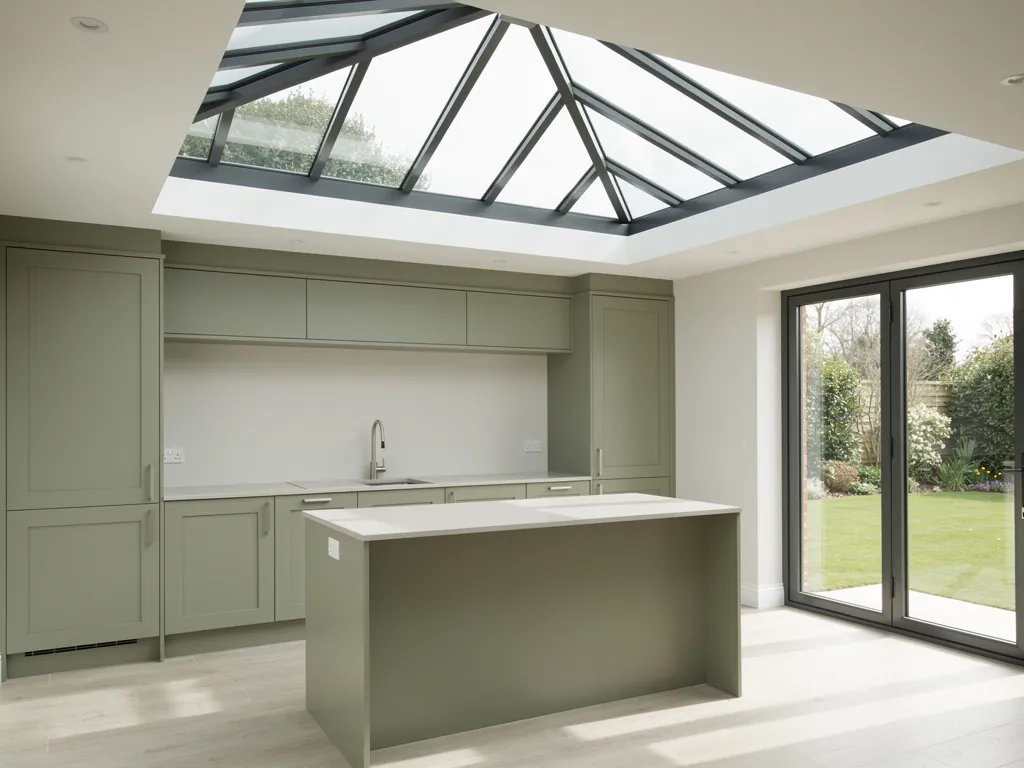
Take a 1970s brick semi in one of Crawley's planned neighbourhoods, with a flat-roofed rear extension added later. The garden runs south. The family wants a lantern over a dining table, and they have stood in the room on a July afternoon with the bifold doors open and felt the warmth press down from above.
The first question is how much of the day the glass sees direct sun. A lantern with a mature tree to its south-west behaves differently from one with open sky all round. A neighbour's two-storey flank to the east takes the early sun out of the equation. We stand in the garden at the survey and note what shades the roof, because that shade is free solar control.
The second question is how the room is used. A dining room used in the evening gains little from extra winter sun, since it is in use after dark. A kitchen used all day gains more. A home office needs steady light without a hot patch on the desk.
For this room, a medium coating is a sensible starting point. It keeps the lantern bright over the table and it cuts the afternoon load noticeably. If the survey shows almost no shade, and the room has large glazed doors to the south as well, the lantern takes a stronger coating, balanced by opening roof vents so the heat has somewhere to go. If there is a tree or a high wall nearby, a lighter coating does the job and keeps more of the winter light.
Colour, reflection and how the glass looks
The coating changes how the glass looks from both sides, and it is worth seeing a real sample before ordering.
From inside, a good coating shifts colour only a little. You may notice a faint cool cast, often a touch of green or blue in daylight, and it is most obvious in a white-walled room next to a clear window. Colours seen through the glass remain true. A heavier tint has a stronger cast and dims the whole scene.
From outside, coated glass reflects a little more than clear glass. On a bright day a lantern can show a soft sheen, which is worth thinking about if neighbours look down onto the roof from a loft window. On an overcast day, the glass looks dark in a neutral way. Some people like the look. Others prefer a very low reflection product. Hold a sample outside and compare it against the sky and against your roof tiles or membrane.
Where a street has a consistent look, reflection can come into planning conversations too. We check the planning position for the address before anything is ordered, and where a conservation area applies, the glass choice is one of the points we raise early. Our hub on conservation rooflight installation explains that side.
Fading, glare and what else the coating helps with
Heat is only one thing that sunlight carries into a room. Ultraviolet and strong visible light do their own work on floors, fabrics and screens.
Solar control coatings reduce the ultraviolet reaching the room as a side effect, and laminated glass reduces it further, because the interlayer absorbs a large portion of it. That helps wooden floors, rugs and upholstery. It does not stop fading completely, since visible light also fades dyes, and a bright room will always be a bright room. We set out what to expect in our answer on whether rooflight glass can stop furniture fading.
Glare is a separate matter. A coating lowers the total light by a modest amount, which takes the edge off strong sun on a worktop or screen. It does not diffuse the light. If a hot bright patch on a dining table is the complaint, look at where the patch falls through the day and whether a blind or a slightly different lantern position would serve better. A coating is one tool. A fabric blind under a lantern is another, and on some roofs the two together work far better than either alone.
Laminated glass, solar control and the noise question
The glass you choose for heat is also the glass you choose for sound, so the two decisions should be made together on the same unit.
For any rooflight over a place where people stand or sit, good practice expects the glass to behave safely if it breaks, and the usual answer is a laminated inner pane: two layers of glass bonded by a plastic interlayer. That same inner pane is what gives a room a calmer sound when rain falls on the roof or an aircraft passes over. The interlayer damps vibration that a single sheet of glass would pass straight through.
The solar control coating goes on the outer pane of the unit. The laminated pane sits inside, where it is protected and where it does its sound job. The two features do not compete. A single build can have a solar control outer pane, a cavity filled with argon, a low-E coating on the cavity face of the inner pane and a laminated inner pane of a chosen thickness. That is the build described in one glazing build for warmth and quiet.
Around Crawley the two jobs often land on the same pane. A loft bedroom under a roof window may hear the Gatwick departures, and the same glass faces the afternoon sun. A home office near the A23 wants cool air and less traffic noise. A kitchen lantern on a rainy evening wants neither drumming nor heat. The quiet spec we write for every quote lists the noise we heard at the survey, the glass build proposed and the reason for each layer. The quiet spec shows what that one page contains.
What the energy and safety rules say about sun-facing glass
Overheating is something the regulations now ask designers to consider, and a rooflight is one of the main ways it happens.
Approved Document L covers the energy performance of new extensions and replacement glazing, including limits on the area of glazing in an extension and on the U-value of the glass. We install to current Building Regulations and handle the Building Control notification where the work is notifiable. A solar control coating helps a design stay inside the limits, because it lets a generous area of glass be used without building a greenhouse.
Approved Document O, which deals with overheating, applies to new residential buildings only, not to extensions or replacement glazing. Its approach limits glazing area in the most exposed rooms and expects either cross ventilation or shading. Most extensions to an existing house sit outside its scope, but its thinking is a fair guide for any design. The government's Approved Documents collection is the place to read the current wording. Our page on stopping a rooflight room from overheating goes through the full set of measures, from glass to vents to blinds.
Ventilation and blinds work with the glass
Glass alone rarely carries the whole load. The best results come from a coating, plus a way for hot air to leave, plus a way to shade the glass on the hottest days.
Warm air collects at the highest point of a room, so an opening rooflight or roof vent at the top of a lantern drains heat faster than any open door below. A rain sensor and a motor let that vent work when nobody is home. Our hub on electric and opening rooflight installation describes the options, and roof lantern installation covers specifying vents in a lantern from the start.
Blinds sit under the glass and take the last of the direct sun. They work best when the fabric is reflective on the glass side. They are a second layer, not a replacement for the coating, and they help in winter too, when a blind drawn at night slows heat loss through the glass. We look at that side in our answer on whether a thermal blind helps keep a rooflight room warm.
Replacing the glass in an existing rooflight
A rooflight that already overheats can often be improved by fitting a better unit, and the glass is the quickest lever to pull.
On an older aluminium lantern or a timber roof window, the glazing unit can sometimes be swapped for a solar control unit of the same overall thickness, keeping a sound frame and upstand. We measure the rebate, the weight the frame can carry and the condition of the seals at the survey. A heavier laminated unit needs a frame that can hold it, so a tired frame may be a reason to renew the whole rooflight instead. A unit that has already failed and misted is a natural moment to upgrade the specification, and our hub on misted and failed rooflight replacement explains that route.
What to ask for on a quote
A quote for solar control glass should name the product, not just the word "solar". A few lines on the paperwork tell you whether the choice was made for your room.
- The coating product name and the surface it sits on.
- The g-value and the light transmittance, from the manufacturer's data sheet for the exact unit.
- The whole-unit U-value, with the spacer type and gas fill.
- The inner pane build, including whether it is laminated and how thick the glass is.
- The reason for the tint level, tied to the orientation and shade you described.
If a quote gives a tint name and nothing else, ask for the data sheet. The g-value and light figures are what separate a sensible choice from a guess. We put all five items in writing with the quiet spec, so you can compare our proposal against any other on the same terms. When you are ready, get a quote and tell us which way the roof faces. The full set of energy topics sits in our energy efficient rooflights hub.
Doubts about heat, tint and glass
Most of the doubts come back to one worry: paying for heat control and losing the light. These answers deal with the points that come up at a survey.
Will a coated rooflight look tinted from inside?
Only slightly. Modern coatings read as clear glass with a faint cool cast, noticeable mainly beside a clear window. Stronger products look a little greyer or greener. Always look at a physical sample in your own room light before ordering.
Is solar control glass worth it on a north-facing roof?
Seldom. A north slope gets little direct sun, so heat gain is small and clear glass lets in the most daylight. Put the money into a good U-value and an acoustic glazing build instead.
Can I add a solar control film to old glass instead?
A film can reduce glare, but it is a different product from a factory coating and can add thermal stress to a sealed unit. Renewing the unit, or the whole rooflight, is the cleaner route.
Does solar control glass work in winter too?
It turns back heat in every season, so it takes a little of the free winter warmth too. A low-E inner coating and a good U-value more than make up for it in most rooms. Where winter sun matters, choose a lighter coating.