A rooflight overheats a room because sunshine arrives through glass faster than the room can shed it. Nothing is wrong with the idea of a skylight. The trouble is a particular combination: a large pane, facing the wrong way, with no shade outside it and no route for warm air to leave. Change any one of those and the room improves. Change all four, in the right order, and a loft bedroom or a kitchen extension stays comfortable through a July afternoon. This guide puts the fixes in order of how much difference each one makes, so that you spend effort where it counts and leave the small gains until last.
Where the heat in a rooflight room comes from
The bulk of the warmth comes straight through the glass as sunshine, not through the glass as heat leaking in from outside. That single fact explains why a rooflight room can feel stuffy when the air outside is merely mild.
Sunlight passes through clear glass, lands on the floor, the furniture and you, and turns into heat. The room then holds that heat, because the same glass that let the sun in is poor at letting the warmth back out. Builders call this solar gain. In winter it is useful. In summer it is the whole problem.
A rooflight collects more of it than a wall window of the same size, for a plain geometric reason. The summer sun is high in the sky. It strikes a horizontal or gently sloping pane almost square on, which is the angle at which the most energy gets through. A vertical window in the same room sees the sun at a glancing angle for much of the day and lets far less in. So a square metre of rooflight behaves like a good deal more than a square metre of window.
There is a second effect in lofts. Warm air rises, and a loft bedroom sits at the very top of the house. Heat from the ground floor, from the roof covering and from the sun through the glass all collect under the same ceiling. The room is hot for several reasons at once, and the rooflight is only one of them.
That is why the order of the fixes matters. Some of them stop the sun arriving. Some of them help the room to get rid of what arrived. The first kind is worth much more than the second.
Orientation and size come before any product
If the rooflight is not yet installed, the cheapest cooling you will ever get is choosing where it goes and how big it is. Nothing you add afterwards is as effective.
In the northern hemisphere, a pane facing south or west collects the strongest summer sun. South sees the sun high and long through the middle of the day. West catches the low, hot sun of late afternoon and early evening, which is the worst time for a bedroom, because the heat arrives just as you want to go up and the room has no chance to cool before bed. A pane facing north gets almost no direct sun and stays cool, although it also brings less warmth and less brightness in winter. East faces the morning sun, which is gentler and gives the room the whole day to recover.
On a pitched roof you usually cannot turn the house around, but you can choose which slope takes the glass. A roof window on the east or north slope will give even daylight with a fraction of the heating. If the loft has to take its light from a west slope because of the layout, the glass specification and the shading matter all the more. Our guide to choosing energy efficient rooflights by orientation walks through each compass direction in more detail.
Size is the other lever. Doubling the glass roughly doubles the sun coming in. A loft conversion that needs daylight across a deep floor plan is often better served by two modest roof windows, spread apart, than by one very large one. The light reaches further into the room, and each pane can be shaded or opened on its own. Where the room has a lot of glass already, such as wide glazed doors, there is also a regulatory reason to think about total area, which we come to below.
Solar control glass does the heavy lifting
For a rooflight that already faces the sun, the glass itself is the biggest single change you can make. A solar control coating lets the bulk of the daylight in and turns a large share of the heat away.
The figure that matters is the g-value, sometimes called the solar factor. It is the fraction of the sun's energy that gets through the glass, expressed as a number between zero and one. A plain double glazed unit lets a large share through. A unit with a solar control coating lets through a much smaller share, which is why a room under it feels different within minutes of the sun coming round. Our answer on what a g-value is on rooflight glass explains how to read the number on a data sheet, and the guide to solar control glass for rooflights covers how the coatings are built.
Two trade-offs come with it. The first is light. A solar control coating is a filter, so it cuts some daylight as well as some heat, and the glass can have a slight tint, usually a faint blue or green cast. Good modern coatings keep the effect gentle, and the tint fades from notice quickly. If the worry is a gloomy room, read our answer on whether solar control glass makes a room darker before you decide.
The second is winter. A coating that turns sun away in July also turns some of it away in January, when the free warmth would be welcome. For a south-facing rooflight over a living space, that is a real cost. For a west-facing loft bedroom that is barely used in daytime in winter, it hardly matters. The right choice depends on the room, which is why we ask how the space is used before we specify the glass. Our page on how a rooflight can help warm a room in winter sets out the other side of this trade.
A few points are worth knowing when you compare quotes:
- Ask for the g-value and the light transmittance of the glass as two separate numbers, for the whole unit and not only the centre of the pane.
- Check which pane surface carries the coating, because the position decides how it balances heat against winter warmth.
- Treat a thin film stuck to existing glass as a different thing from a coating applied in the factory. A factory coating is part of the sealed unit and is covered by the manufacturer's warranty.
- Expect the coating to be specified per rooflight, not per house. A north slope and a west slope should not carry the same glass.
Shade outside the glass beats shade inside it
Once sunshine has passed through the glass, its heat is already in the room. A blind can only do so much. Shade that stops the sun before it reaches the glass is far more effective.
An internal blind sits in the warm room. It absorbs or reflects the sun that has already come through, and a light coloured blind reflects a good part of it back out. That helps. But the pane itself has already warmed, and the blind is now sitting in a pocket of hot air trapped between itself and the glass. An external blind, louvre or awning intercepts the sun outside, where the heat it absorbs stays outside as well. On a pitched roof window, an external roller shutter or awning blind made for the window can cut the heat dramatically. It is also the option that keeps the room brightest, because a raised external blind costs no light at all.
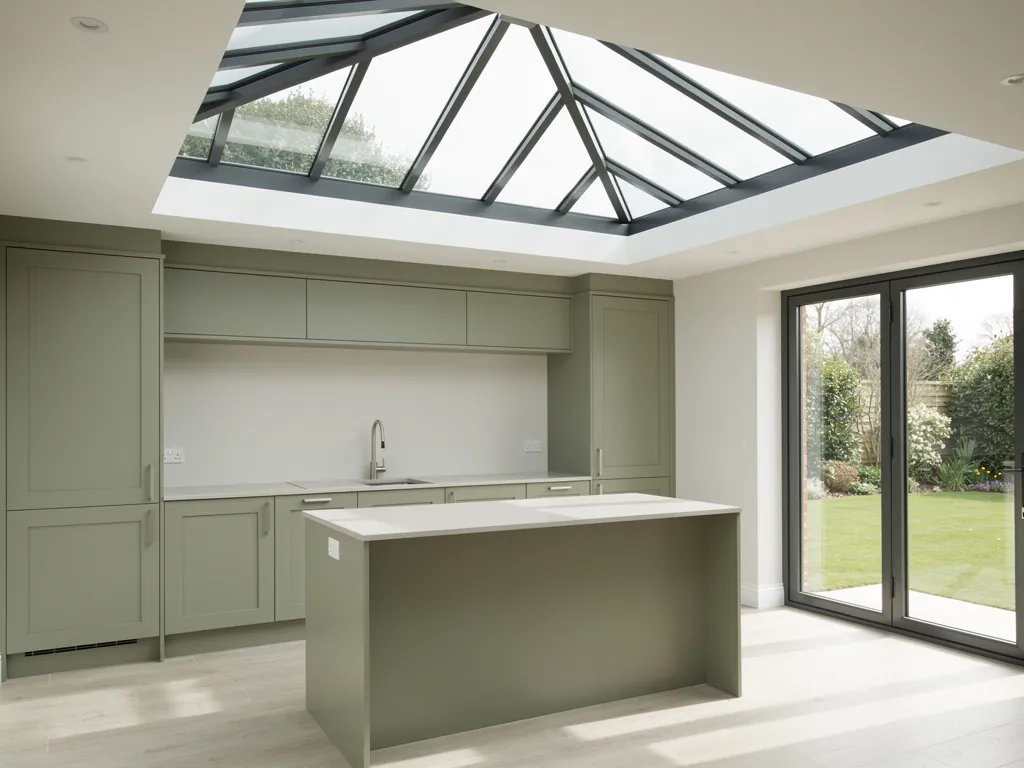
Flat rooflights and lanterns are harder to shade from outside, because there is nothing to mount onto and the wind loads are different. That is where solar control glass earns its place, since the shading is built into the pane. A lantern over a kitchen extension is a good example. The roof is flat, the glass is large, and an external awning is awkward. The sensible answer is to get the glazing specification right from the start.
Inside the room, a few kinds of blind are worth choosing between:
- A pleated or cellular blind running in side channels, close to the glass, traps the hot air against the pane and leaves less of it in the room.
- A reflective, light coloured roller or pleated blind turns a good share of the sun back out of the glass.
- A dark or fully blackout blind is best for sleep, and worse for heat, because it absorbs what it blocks and warms up.
A powered blind set on a timer or linked to a sun sensor is very good on rooflights you cannot easily reach. It closes before you notice the room getting warm and opens again when the sun moves off. Some blinds do double duty in winter, and our answer on whether a thermal blind helps keep a rooflight room warm looks at that side.
Let the warm air out at the top and in at the bottom
Ventilation will not stop the sun coming in, but it decides how hot the room gets once it has. The trick is to give warm air a way up and out, and cooler air a way in at a lower level.
Warm air is lighter than cool air, so it rises and collects at the highest point of the room. An opening rooflight sits at exactly that point. Open it, open a window or a door lower down on another side, and the room sets up its own draught. Warm air leaves through the top, and cooler air is drawn in below. Builders call this the stack effect. The greater the height between the two openings, the stronger the flow, which is why a loft window high in the roof and a stairwell window or front door on the floor below work so well together.
A rooflight that does not open helps with none of this. If the room is prone to overheating, an opening unit gives you the one thing that glass coatings and blinds cannot, which is a way to remove heat that has already built up. Our hub on electric and opening rooflight installation explains the choices between a manual pole, an electric motor and a solar powered opener.
Some practical points make a difference:
- Ventilate in the evening and overnight, when the air outside is cooler than the air inside, and close up and shade the room in the morning before the sun reaches it.
- Choose a rooflight that can open a little, and stay open safely, without rain coming in. A rain sensor will close an electric unit on its own.
- Give the air a second route. A single opening high in the roof has nothing to replace what leaves, so pair it with a door or window elsewhere.
- In a loft conversion, check that the eaves and the stairwell are not blocked, since they are often the quiet supply of cooler air.
Ventilating a room that hears the sky
An open rooflight lets in air and it also lets in sound. Around Crawley that matters, because the thing that cools the room and the thing that keeps you awake can be the same gap.
The best time to flush heat out of a loft is overnight. The same hours are when quiet matters most. Gatwick sits inside the borough, and a bedroom under a rooflight near the flight paths will hear early departures and late arrivals through open glass. Near the A23, the M23 or the Brighton main line, the noise comes from the ground instead. If you open the window to cool the room, you open the room to whatever is outside.
That is one reason to lean on the glass and the shading first, and on open ventilation second. A room whose glass keeps out a good share of the sun needs less night flushing, so the window can stay closed on more nights. A rooflight built with a laminated acoustic inner pane is quiet with the unit shut. A solar control coating and a laminated inner pane can be specified in the same sealed unit. Our page on one glazing build for warmth and quiet explains how the two choices fit together.
For a bedroom that needs both cooling and quiet, there are sensible compromises. A rooflight set to open only a narrow gap reduces the direct path for sound. Ventilation taken from the side of the house facing away from the airport or the road is quieter than ventilation taken from the side facing it. And where the rooflight is the only opening, the choice between a quiet room with the window shut and a cool room with it open is better settled by specification than by daily compromise. The written quiet spec that comes with every quote sets out which of those applies to your room. There is more on it at the quiet spec.
The fixes side by side
The table lists each measure with the kind of job it does, so you can see which ones apply to a rooflight you already have and which only apply before it is fitted.
| Measure | What it does | When you can do it | Effect on light |
|---|---|---|---|
| Facing north or east | Avoids strong summer sun | Before fitting | Softer, even light |
| Smaller or split glazing | Reduces the sun coming in | Before fitting | Less daylight overall |
| Solar control glass | Turns heat away at the pane | At fitting or replacement | Slightly filtered |
| External blind or awning | Stops sun before the glass | Pitched roof windows | None when raised |
| Internal reflective blind | Reflects part of what got in | Any time | Reduced when closed |
| Opening unit plus low vent | Flushes warm air out | At fitting or replacement | None |
Read from the top, the first rows stop the sun arriving and the last ones deal with what got in. The measures that stop sun are the stronger ones. A room that still overheats after the last two rows was probably never going to be fixed by them alone.
What to do when the rooflight is already in
If the glass is fitted and the room is too hot, you cannot change the compass direction, but you can still cut the heat. Start with the measures that are quickest to try and move up.
First, deal with the blinds. A well fitted, light coloured internal blind, closed before the sun arrives, is the quickest improvement. Second, add ventilation if the unit is capable of it, and use it overnight. Third, look at where the room is losing the battle. If the rooflight faces west and is large, and the glass is a plain double glazed unit from an earlier decade, the glass is the weak link.
That is the point at which replacement makes sense. An older unit can be swapped for one with a solar control coating, modern warm edge spacers and better seals, often in the same opening and with the same frame size. The same visit can also put in an opening or motorised unit if the old one is fixed. Our page on upgrading an old rooflight to be more energy efficient explains what can and cannot be reused. A replacement is also the moment to put a laminated inner pane in, which brings safety and quiet with it.
It helps to be realistic about what a room needs. A loft with poor roof insulation will stay warm in the evening even with perfect glass, because the roof covering and the loft build-up are holding heat from the day. If the ceiling and slope insulation are thin, the glass is not the only culprit. A surveyor looking at your loft will check the glass, the insulation and the ventilation route together.
Where Approved Document O and Part L touch a hot room
Approved Document O covers overheating in new homes in England. A rooflight added to an existing house is not assessed against it, but the same principles apply and they are useful.
Part O was added to the Building Regulations in 2021 and applies to new residential buildings only, not to extensions. It asks the designer to limit solar gain and to provide a way of removing heat, and it sets out a simple method based on glazing area, orientation and cross-ventilation. The approach is exactly the one this guide follows: limit what comes in, then provide a route out. An extension or a loft conversion is treated differently, but the thinking carries over, and it is a good guide to what a well designed room looks like.
Part L matters more to a rooflight fitted to an existing house. It sets limits on the thermal performance of glazing and on the total area of glazed openings in an extension, and a large rooflight can use up much of that allowance. For the detail, see our guide on what the energy rules ask for. Overhead glass should also be safety glazing where people may be below, as good practice advises, and a laminated inner pane meets it. Where the work is notifiable, we handle the Building Control notification, and the job is installed to current Building Regulations.
Sequencing a cool room, from first decision to last
If you are planning a new rooflight, the order of decisions should follow the order of effect. It saves money and it avoids undoing work.
Start with the room and how it is used. A bedroom wants coolness at night and quiet. A kitchen wants brightness by day and needs to cope with cooking heat. A home office wants even light with no glare on a screen. Each of those points to a different answer, so it is worth deciding the use before the product.
Next, pick the slope or the position, and the size. Then specify the glass, with a solar control coating where the pane faces the sun, and a laminated inner pane where noise matters. Then decide whether the unit should open, and where the second air route will be. Last of all, choose the blind, because it is the easiest thing to change and the least important of the four.
When we come to write the quote, each of those decisions appears in the quiet spec, along with the noise we heard at the survey. If you would like that for your own room, ask for a quote and we will come and look. The parent page for this topic, energy efficient rooflights in Crawley, covers the wider picture of warmth, glass and efficiency.
Questions about a hot rooflight room
These are the things people ask once the first hot spell has shown them what their glass can do.
Will a blind alone be enough?
For a small rooflight facing north or east, often yes. For a large west or south facing pane with ordinary glass, a blind is a partial answer. It reduces the heat but leaves much of it in the room, because the sun has already passed through the glass. Pair it with solar control glass or a way to ventilate and the result is much better.
Does opening a rooflight at night really cool the room?
It does, provided the air outside is cooler than the air inside and there is a second opening lower down for fresh air to enter. Without that second route, very little moves. The catch is sound, so think about which way the opening faces and what it hears.
Can I add solar control glass to a rooflight I already have?
The coating is applied at the factory, inside the sealed unit, so it cannot be added to glass that is already made. The route is to replace the unit, or the whole rooflight, with one built with the coating. A film applied to the surface is a separate product, with its own limits.
Is a north facing rooflight always cool?
It is the coolest option, because it gets almost no direct summer sun. A room under it can still warm up if the rest of the house is hot, since warm air collects at the top. It is usually the easiest place to put glass without a cooling problem, and the light is gentle and steady.