A triple glazed rooflight has three panes of glass in each sealed unit instead of two, with two gaps between them instead of one. It loses less heat than a double glazed unit of the same size. It also weighs more, costs more, lets in slightly less daylight and asks more of the frame and the roof. Whether the third pane earns its place depends on the room under it, the roof above it and the heat you are trying to keep in. This guide goes through those three questions in the order we ask them at a survey, and ends with the noise side, because a third pane does less for sound than the weight suggests.
What the extra pane changes and what it leaves alone
A third pane adds a second gas-filled cavity, and that second cavity is where the extra insulation comes from. Nothing else about the unit is promised by the pane itself.
In a double glazed unit, heat has to cross two sheets of glass and one cavity. Add a third sheet and it has to cross three sheets and two cavities. Each cavity slows the heat down, so the centre of the glass gets noticeably better. Think of it as one more layer of still air, held in place by a coating, a warm edge spacer and a gas fill.
What the pane does not change is the rest of the rooflight. The frame still conducts heat. The spacer bar around the edge is still a weak line. The joint between the kerb and the roof still has to be insulated and sealed. A triple glazed skylight set in a thin, uncut aluminium frame can lose more heat round its edge than you gain across its middle. That is why we treat the glass, the spacer and the frame as one specification, never as three separate upgrades.
It also helps to keep the physics in proportion. Going from double to triple improves the centre of the glass by a good step. Going from poor double glazing to well-made double glazing, with a low-E coating, argon and a warm edge spacer, is often the bigger jump. Our pages on low-E coatings on rooflight glass and warm edge spacers and argon fill cover what a good double unit already contains. The third pane is the next layer on top of those, not a substitute for them.
Reading the U-value on a triple glazed quote
A number on a quote only means something when you know what it measures. Two figures get quoted, and they are not interchangeable.
The centre-pane U-value describes the middle of the glass, away from any edge. It is the flattering figure, and it is the one that appears in most brochures. The whole-unit U-value includes the frame, the spacer and the edge of the glass, weighted by area. That is the figure Building Regulations care about, and the one that tells you what the installed rooflight will actually do. The gap between the two is larger on a small rooflight, because the frame takes up a bigger share of the total area. A triple glazed unit in a slim roof window can show a very good centre figure and a whole-unit figure that is only a little better than a good double.
When we compare two products, we ask for the whole-unit figure from the maker's published data, for the exact size being priced. Our answer on the difference between a whole-unit and a centre-pane U-value sets this out, and the guide to rooflight U-values explains the scale itself. Lower is better, and the units are watts per square metre per degree of temperature difference.
As a rough guide only, good double glazing with a coating and gas fill sits in a middle band for whole-unit figures, and triple glazing sits clearly below it. Exact numbers vary with size, frame and maker, so we never promise one before we have the data sheet for your opening in front of us.
Weight, frames and the roof underneath
Glass is heavy, and a third sheet adds roughly half as much again to the glazed weight. On a rooflight that is lifted into place over a bedroom or a kitchen, that matters more than the brochure suggests.
Annealed or toughened glass weighs about 2.5 kilograms per square metre for every millimetre of thickness. A pane of 4 millimetre glass is therefore about 10 kilograms per square metre, and a unit with three such panes carries about 30 kilograms of glass for every square metre of opening, before the frame and spacers are counted. A laminated pane is heavier again, because it is two sheets and an interlayer. A large triple glazed lantern can reach a weight that changes how the unit is delivered, how many hands lift it and whether the opening needs stronger trimming. Our answer on whether a triple glazed rooflight is too heavy for the roof goes through the structural side in more detail.
Weight also shapes the frame. Heavy glass needs a stiffer frame with deeper sections, and deeper sections cost more and look chunkier from inside. Some roof window and rooflight ranges are only offered as double glazed because the hinge, the balance or the motor was designed around a lighter sash. If the rooflight opens, the extra weight falls on the hinges and on any electric operator. Our hubs on electric and opening rooflights and roof windows show where that choice arises.
- Fixed units over a flat roof carry the extra weight most easily, because the frame never has to move the glass.
- Opening roof windows in a pitched roof are the most sensitive to sash weight, because the hinge and the balance are sized for a particular unit.
- Large lanterns are the most demanding on the structure, because the weight sits at the top of the kerb and the span is wide.
A survey measures the opening, checks the joists or rafters, and asks whether the structure was designed with a heavier unit in mind. A 1970s flat roof extension built to carry a simple double glazed dome may need more than a like-for-like swap. When it does, that is better learned on the roof with a tape measure than on delivery day.
What the third pane costs you in daylight
Every sheet of glass absorbs and reflects a little light. Three sheets with two coatings let through less than two sheets with one, and that difference is visible in a dim room.
The drop is modest, and it depends on the coating and the glass. You can see it in a room that depends on one rooflight for most of its daylight, such as a windowless landing or an internal bathroom. In a bright south-facing kitchen with bifold doors, you will not notice it. The figure to ask for is the light transmittance, and our answer on what light transmittance means on a rooflight explains how to read it.
Solar heat is a separate matter. The g-value says how much of the sun's energy gets through, and a third pane usually lowers it a little. That helps a room that overheats in July and works against a room that relies on winter sun to take the chill off. Our answer on what a g-value is on rooflight glass covers the trade in detail. A rooflight facing due south with a high g-value behaves very differently from one facing north, and the pane count is only one of the levers.
The point for choosing is simple. Daylight is the reason to fit a rooflight in the first place. If a third pane makes the room meaningfully darker and the heat saving is small, the trade is poor. If the room is already bright and cold, the trade is good.
Rooms where three panes pay their way
The third pane does its best work where a room is heated for long hours, where the glass is a large share of the roof and where the cold side of the glass is very cold.
| Room or roof | Third pane? | Reason |
|---|---|---|
| Loft bedroom, north slope | Often yes | Little winter sun, long nights of heating |
| Large kitchen lantern | Worth pricing | Big glass area, heated all day |
| Home office in a garden room | Worth pricing | Used daily, cold glass above the desk |
| South-facing living room | Often no | Winter sun gives back heat |
| Small landing rooflight | Usually no | Tiny area, light matters more |
| Bathroom or utility | Usually no | Short use, good double is enough |
A loft conversion is the classic case. Warm air rises into the room under the roof, and a rooflight there is the coldest surface the air touches. The glass radiates cold downwards on a winter evening, and people sitting beneath it feel it on their heads and shoulders, even when the thermostat is satisfied. Our answer on why a skylight makes the room feel cold in winter describes that effect, and the guide to energy efficient rooflights for loft conversions puts it in the context of the whole conversion.
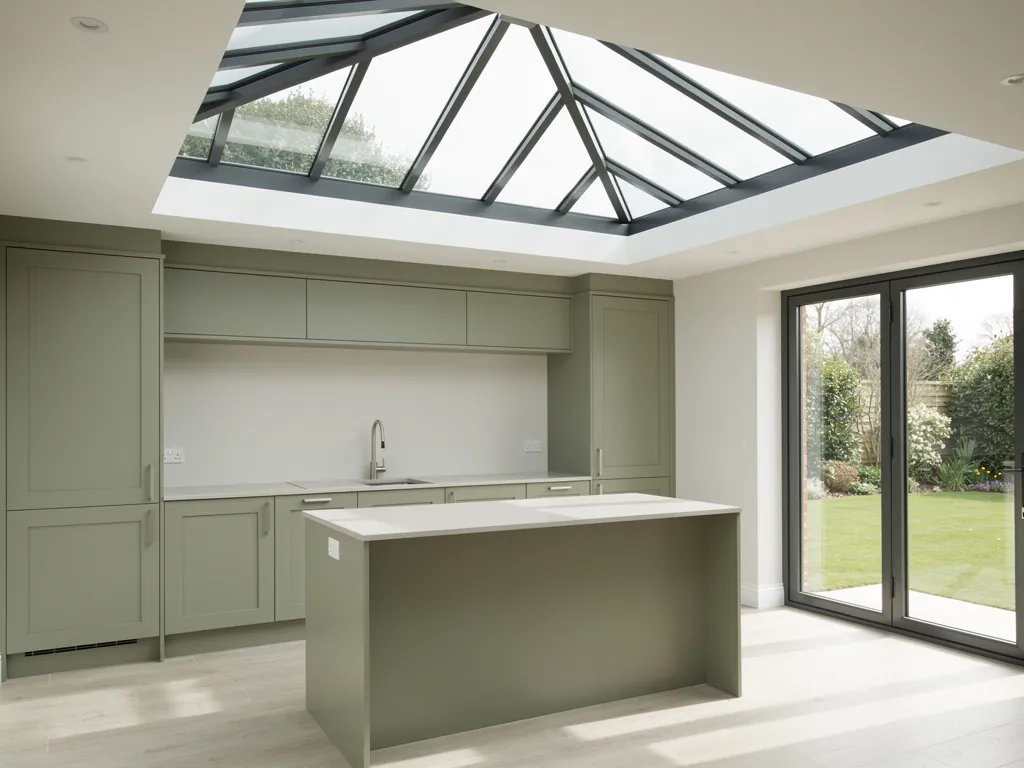
A large kitchen lantern is the other obvious case. A lantern is mostly glass, and a kitchen is warm for most of the day. Here the third pane is worth pricing, and it is worth weighing against the heavier structure and the larger glass units involved. Our roof lantern installation hub shows how those choices fit into a whole lantern project.
Orientation changes the answer more than people expect. A south-facing rooflight collects winter sun, and that free heat offsets some of the loss through the glass. A north-facing one collects almost none. Our guide to choosing energy efficient rooflights by orientation treats that in full.
When good double glazing is enough
A well-specified double glazed rooflight meets current Building Regulations and does a sound job in a typical home. Triple glazing is a choice, not a requirement.
The regulations set limiting figures for new and replacement rooflights in Approved Document L, and a double glazed unit with a low-E coating, argon and a warm edge spacer in a thermally broken frame can meet them. Where a design needs to do better than the limit, for example to balance a large area of glazing in an extension, triple glazing is one of several ways to do it, alongside better insulation elsewhere or a smaller glazed area. Our guide to Part L and rooflights explains the rules, and we install every rooflight to current Building Regulations and handle the Building Control notification where the work is notifiable.
A few situations point firmly towards good double glazing:
- A small rooflight where the glass is a tiny share of the room's surface, so the saving from a third pane would be small in real terms.
- A pitched roof opening window where the sash is designed around two panes and the extra weight would strain the hinge.
- A room that gets strong winter sun, where free heat already offsets the loss.
- A dim room that needs every bit of daylight it can get.
- A roof that was not built for extra load, where adding structure would cost more than the glass saves.
Money matters too. A third pane adds to the price of the unit, and it may add to the frame, the lifting and the structure. The saving in heating is real, but on a small rooflight it is small. Our answers on whether energy efficient rooflights lower heating bills and rooflight and skylight costs are the places to weigh it up. As a guide only, the extra for a third pane is usually a modest percentage of a glazed unit, and a larger share on a small one.
Condensation, dew and the cold outer pane
A triple glazed rooflight keeps more heat inside, which leaves the outer pane colder than it would be on a double unit. That has one consequence that surprises people.
On clear, still nights, the outer surface of a rooflight can fall below the dew point of the outside air, because the glass radiates heat to the open sky. When it does, moisture settles on the outside of the glass. On a triple unit the outer pane is better insulated from the warm room, so it cools further and may mist on the outside more often than a double unit would. It is harmless, it is a sign that the glazing is working, and it clears as the morning warms. It is easy to mistake for a failed seal, which shows as moisture trapped between the panes.
A sealed unit that has failed is a different matter, and the answer is to replace the unit. Our hub on misted and failed rooflight replacement explains how we tell the two apart at a survey and what a new unit involves.
Inside, the reverse is usually true. A warmer inner pane means less condensation on the room side, which matters in a bathroom, a kitchen or a loft bedroom where the air carries moisture. That is one of the quieter benefits of a third pane, and it is most useful where the rooflight sits over a humid room.
What a third pane does for sound
A third pane does less for noise than its weight suggests. Sound is stopped by mass, by different thicknesses of glass and by the way the panes are built, and a third sheet of identical glass can make little difference.
The reason is resonance. Two panes of the same thickness, set a fixed distance apart, respond to the same frequencies, and adding a third of the same thickness adds the same weakness a second time. What helps is variety: panes of different thicknesses, a laminated pane with a sound-damping interlayer, and cavities of different widths. Laminated acoustic glass is therefore the most useful upgrade for quiet. It is usually specified on the inner pane of a double glazed unit, and it can sit inside a triple unit as well.
In Crawley and the towns around it, that matters in several ways. Aircraft on the Gatwick routes pass over the borough. Road and rail noise comes off the A23, the M23 and the Brighton main line. Rain on a flat roof lantern can drum on thin glass, and a kitchen under a lantern hears it at dinner. A loft bedroom under a rooflight hears aircraft and rain more clearly than any other room in the house. For those rooms, the question is less whether to add a third pane and more what mix of glass types, seals and upstand will keep the noise down.
The two aims can be combined. A triple glazed rooflight can carry a laminated acoustic pane, so one unit can insulate and quieten together. Our guide to one glazing build for warmth and quiet shows how, and our answer on whether energy efficient rooflights are quieter too explains what to expect. We never quote noise figures. We describe the build, and the written quiet spec that comes with every quote sets out the glass, the seals and the upstand we propose for the noise your room actually hears. You can read how that document works on the quiet spec page.
The frame and the joint around the glass
The best glass in the world cannot make up for a cold frame. The third pane only pays off when the frame, the spacer and the upstand are good enough to keep up with it.
Start with the frame. A thermally broken frame has a layer of low-conductivity material between the inner and outer metal, so cold does not run straight through to the room side. Our guide to thermally broken rooflight frames covers the construction. Without that break, a triple glazed unit can grow a cold, wet line of condensation along the inside of the frame, even though the middle of the glass is warm.
Then the spacer. The bar around the edge of each cavity is the weakest part of the glass, and a warm edge spacer cuts the loss along that line. A triple unit has two spacers, so the edge gets twice the attention it would on a double.
Finally the upstand and the reveals. A rooflight on a flat roof sits on a kerb, and the kerb needs insulation and an airtight seal where it meets the ceiling. A gap there wastes more heat than the third pane saves. Our guide to insulating around a rooflight covers upstands and reveals, and the answer on cold bridging around a rooflight explains where the loss happens.
A sequence for deciding, and what to ask the installer
The decision comes down to five checks, taken in order. Each one can end the question early.
- The room. Is it heated for long hours, and does it sit under the roof? If it is a bathroom or a landing, a good double unit is usually enough.
- The orientation. Does the glass face south and collect winter sun? If so, the third pane gives less back.
- The structure. Will the roof and the frame carry the extra weight without extra work? If the answer is no, weigh the cost of strengthening.
- The daylight. Can the room spare a few points of light transmittance? If not, stay with double.
- The noise. Is the room exposed to aircraft, road, rail or rain on the glass? If so, specify a laminated acoustic pane first, whatever the pane count.
When the answers come out mixed, the best route is usually to price both options for your exact opening and compare them on whole-unit U-value, weight and cost. You can get a quote for both, or message us on WhatsApp with the room, the roof type and a photo of the opening. The energy efficient rooflights hub has the rest of the guides on glass, frames and heat loss if you want to read further before deciding.
Triple glazing questions from homeowners
These are the points that come up most often when a third pane is on the table. Each one links to a fuller answer if you want more detail.
Does a triple glazed skylight fit in an existing opening?
Often it does, but not always. A triple unit is thicker than a double, so it needs a deeper frame rebate or a different frame, and the opening must carry the extra weight. We measure the opening, the kerb or the rafters, and the depth available before we confirm a like-for-like swap. Where the existing frame cannot take the thicker unit, the frame is replaced with the glass.
Will a third pane improve my EPC?
It can help, because a better U-value reduces the modelled heat loss. The effect depends on how much of the roof is glass and on what else in the house is weak. Our answer on whether an energy efficient rooflight improves an EPC explains how rooflights feature in the assessment.
Is triple glazing worth it on a replacement rooflight?
That depends on the old unit and the room. Replacing a tired, single glazed or failed unit with good double glazing delivers most of the benefit. Stepping up to triple adds a smaller gain, and it makes the most sense in a heated room with a large glass area. See the answer on whether a replacement rooflight has to meet current U-value rules for the regulatory side.
Can I combine a third pane with solar control glass?
Yes, though the two pull in different directions. Solar control glass cuts the sun's heat, and a third pane cuts heat loss, so a south-facing roof that overheats in summer and loses heat in winter may want both. The g-value and light transmittance both fall, so the room needs enough daylight to spare. Our guide to solar control glass for rooflights sets out the trade.