A sealed glass unit is two or three panes held apart by a metal or composite spacer, with a bead of sealant running round the whole perimeter. That bead is the only thing keeping damp air out of the cavity, and it is the first part to give. This guide explains what the seal is made of, what wears it down on a roof, how to read the signs that it has gone, and how to choose a replacement that does not repeat the failure. A failed rooflight seal is rarely a mystery once you know where the stress comes from.
What the edge seal is and what it is asked to do
The seal is a thin line of material, and it carries a heavy brief: keep moisture out for decades while the glass around it expands, contracts, flexes and gets soaked.
A modern unit is built in layers at the edge. Against the glass sits a primary seal, usually a butyl strip, which is the vapour barrier. Outside that, in the channel formed between the spacer and the pane edges, sits a secondary seal, often silicone or polysulphide, which bonds the panes together and gives the unit its strength. Inside the spacer is a desiccant, a drying agent that takes up the small amount of moisture trapped at manufacture. Some units also hold a gas fill in the cavity, which slows heat flow.
So the cavity is dry at the start, and the desiccant has a fixed capacity. While the seals hold, that capacity is never tested. Once vapour starts creeping past them, the desiccant takes it up for a time, then fills, and the first sign appears on the glass. The life of a unit is decided largely by how long the edge stays sound.
On a wall window the edge sits in a rebate, sheltered by a frame and drained by a sill. A rooflight is harder on it. The glass faces the sky, takes every hour of sun, and sits at a low angle where water runs off slowly or not at all. The same seal, in the same unit, lives a rougher life up there.
Four forces that work on the edge of a roof unit
Seals do not fail for one reason. They fail because several slow stresses act on the same few millimetres of sealant, and the weakest detail gives first.
Heat and cold, every day
Glass in full sun heats faster than the frame around it. A dark spacer or a dark-tinted pane takes more heat again. Overnight the roof loses heat to a clear sky, and the glass drops below the air temperature. Each cycle makes the pane grow and shrink against a bead that has to stretch with it. Sealants are elastic, but not without limit, and the repeated movement opens hairline gaps at the corners first, where the stress is greatest.
Standing water at the lower edge
On a steep unit, water leaves quickly. On a low pitch, or a flat rooflight that has settled, it lingers on the lower edge of the glass where the seal is. The edge of the unit then sits under a film of water in every wet spell, and water is what the seal exists to keep out. A rooflight set too flat, or bedded on a kerb that has dropped, puts the seal to work all winter.
Sunlight on the sealant itself
Ultraviolet light breaks down some sealant chemistry over the years. Where the edge of the unit is exposed, for example beyond the frame cover strip, the secondary seal takes the UV directly. Where it is buried in a deep rebate and covered by a cap, it is shielded. Frame design makes a real difference to how long that edge lasts.
Load and movement in the frame
A heavy unit that is poorly supported twists the frame a little each time the wind gusts or the roof takes weight. Packers that have been set wrongly, or have slipped, leave the pane hanging on one corner. A unit that is under constant load at one point will crack the bond there. This is the cause behind one corner misting before any other.
| Force | Where it bites | What makes it worse |
|---|---|---|
| Temperature swing | Corners of the bead | Dark tint, south aspect |
| Standing water | Lower edge | Low pitch, settled kerb |
| Ultraviolet light | Exposed outer seal | Shallow rebate, no cover cap |
| Frame load | One corner or side | Wrong packers, weak support |
How a failed seal shows itself
Once vapour is in the cavity, the evidence is on the glass. The signs arrive in a fairly fixed order, and each one tells you something about how far things have gone.
The first is a faint, cloudy film that appears on cool mornings and clears by midday. That is moisture condensing on the coldest inner surface when the glass is at its lowest, then evaporating as the sun warms it. Next come fine beads or streaks that stay longer. Then a permanent haze, frequently in one corner or along one edge first, which spreads inwards. In time, a white mineral bloom can form on the inner faces, left behind when the trapped water has dried and deposited what was dissolved in it. That bloom does not wipe off, because it is inside.
The clue that separates a failed seal from ordinary condensation is the position. Condensation on the room side comes from the room: steam, drying washing, a bedroom full of sleepers. You can wipe it, and it returns when the air is damp again. Moisture between the panes cannot be wiped, since it is sealed into the cavity. If you run a finger over the surface and the marks stay, the trouble lies inside the unit. Our guide on why rooflights mist between the panes goes through the mechanism in more detail, and the answer on new rooflights misting on the room side covers the other case.
A blown unit tells you one more thing. When the cavity has let air in, the gas fill has gone with it, so the pane no longer insulates as it was designed to. The page on what a misted rooflight means for heat loss explains the effect on the room, and the question what does a blown double glazed unit in a skylight mean gives the plain summary.
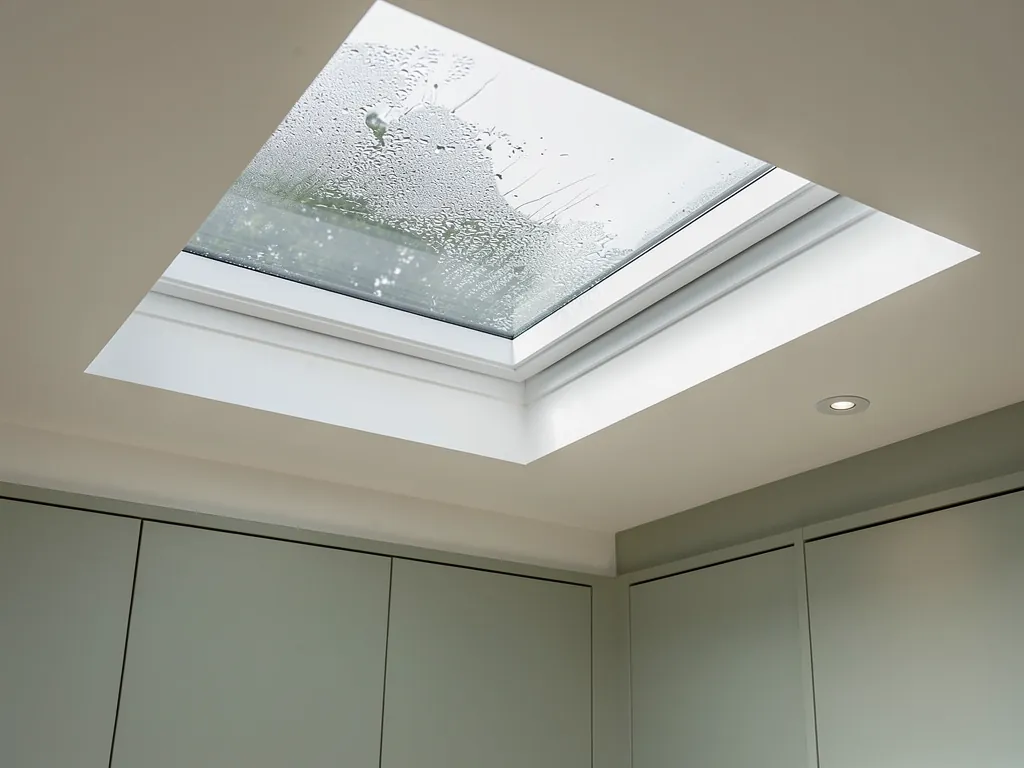
Why a failed seal cannot be closed up again
Once the cavity is open to the air, nothing applied from outside can close it, because the failed seal is buried inside the edge of the unit and the moisture is already in the space between the glass.
Two approaches are offered in the market. The first is drilling small holes in the glass, drying the cavity and capping the holes. The second is wiping or fogging the outer faces. Neither rebuilds the sealant that has failed. The cavity fills again, because the route that let the vapour in is still there, and a drilled pane carries holes through the glass face for good. A pane that has been drilled is also weaker at the hole, and on a rooflight that takes thermal stress every day, that matters.
The straight approach is a new sealed unit. It arrives dry, with fresh seals and fresh desiccant, and is fitted into the existing frame where the frame is sound. Our page on whether misted skylight glass can be demisted gives that reasoning in short form, and will a misted rooflight clear up by itself answers the related hope.
Reading the cause before choosing the replacement
A new unit in an unchanged setting will meet the same forces. The value of working out why the old one went is that you can change what is changeable.
At a survey we look at four things before anything is ordered.
- Which part of the unit clouded first. A lower edge suggests standing water. One corner points to load. Clouding all round, evenly, points to plain age.
- The pitch and the kerb. A rooflight laid almost flat, or sitting on a kerb that has sagged, gets a new kerb or a packing correction on the way in. Otherwise the same water returns to the same edge.
- The exposure of the edge. If the old frame left the seal open to the sky, we choose a frame with a cover that shades it.
- The condition of the frame itself. Soft or split timber, corroded aluminium or a perished gasket means the seat for the new unit is not sound.
That last check decides the scope. A sound frame takes a new glass unit and nothing else. A tired one makes a new unit a poor investment, because the next seal will sit in the same weak detail. Both routes are compared in replacing the glass unit or the whole misted rooflight, and when the frame has failed too covers the case where the answer is a full replacement.
Only one pane, or only one panel in a lantern
A roof lantern is made of several sealed units, and each has its own edge. One can fail while the others are sound, and it is natural to ask whether that one can simply be swapped.
Usually it can, where the lantern bars are built to accept a unit from outside and the replacement is made to the same size and thickness. The practical questions are access, the profile of the bars and whether the unit is still made to that measurement. On a double-pane rooflight with a single clouded pane, the question is really about the unit as a whole, since the two panes are sealed as a pair. The pages on replacing one misted pane in a roof lantern and why only one pane of a rooflight is misted explain which case you are in.
Where glass units are not interchangeable with today's sizes, or the original product has gone off the market, the choice widens to a wholly new rooflight made to the existing opening. That situation has its own page: a replacement unit for a skylight that is no longer made.
What a longer-lasting replacement looks like
A replacement is a chance to correct the things that shortened the first unit's life, and to specify the glass for the room beneath it.
The design choices that affect the seal are practical ones. A warm-edge spacer, made of a composite rather than bare aluminium, reduces the temperature difference at the glass edge and so the movement the seal has to absorb. A deeper rebate with a cover cap shades the outer seal from ultraviolet. A correct fall on a flat unit, with the kerb set to shed water rather than hold it, keeps the lower edge out of standing water. And the packers are set to the glass manufacturer's positions, so the unit hangs evenly.
The glass itself is a second decision. A unit with a laminated inner pane is held together by an interlayer if it is struck or cracks, and the interlayer also damps vibration, which is why the same pane is the core of a quiet specification. The article on whether a failed rooflight unit should be replaced with laminated glass weighs that choice, and will a replacement glass unit make a rooflight quieter explains what changes in the room when you do.
Rain is the noise people notice first. Thin, tired glass on a flat roof or a lantern carries the sound of a downpour straight into the room, and a unit whose seals have failed and whose panes have loosened in the frame carries it worse. A new unit with a thicker, laminated pane and fresh gaskets settles that rattle. It is also why the written note that comes with every quote, the quiet spec, records the glass build, the seals and the upstand together, not as separate items.
Regulations, guarantees and the paperwork
Replacing a sealed unit sits under the Building Regulations only in certain cases, but when a whole rooflight is replaced, the rules for thermal performance apply.
Approved Document L sets limits for the thermal performance of replacement windows and rooflights, and a new rooflight in an existing roof has to meet them. When the work is notifiable, we handle the Building Control notification. Because the replacement glazing is usually better insulated than the failed unit, the upgrade helps the room and meets the requirement at the same time. If the rooflight is in a home within a conservation area or is listed, permission may be a separate question, so it is checked for the address before any order is placed. The page on upgrading the glazing when a unit fails has the detail on how the new build compares with the old.
People ask whether the original manufacturer or installer still stands behind the unit. A sealed-unit guarantee is given for a stated period, and it usually depends on how the unit was installed and whether the failure is one the guarantee names. Read the paperwork from the original supply, and see whether a misted rooflight is covered by its original guarantee for what to look for. Our own work is covered by a 10-year workmanship guarantee, described on the guarantee page.
What to have ready when you ask for a quote
A few minutes of preparation means the survey goes straight to the point, and the new unit is ordered to the right size the first time.
- Photographs of the whole rooflight from inside, and of the clouded area in daylight.
- A note of which corner or edge clouded first, and when you noticed it.
- Any paperwork from the original installation, including the supplier's name if you have it.
- A word on whether the room has a sound problem you would like dealt with at the same time, such as rain on the glass or aircraft overhead.
The measurement itself is taken from the glass and the frame, not from the clouded surface. That process is set out in how a failed rooflight is measured for its replacement, and the lead time for the unit is on the page about how long a replacement glass unit takes to arrive. The full range of options sits in our misted and failed rooflight replacement section, and you can send photographs through the quote form or by WhatsApp.
Questions about a failing seal
These are the points that homeowners raise once they have seen the haze and started to wonder what comes next.
Is a failed seal a safety problem?
Not on its own. The glass is still held in the frame, and the unit still keeps the rain out. What changes is insulation and clarity. The wider question is covered in is a misted rooflight dangerous.
Will the haze spread?
Generally, yes. Once vapour has a route in, it keeps arriving with every change in weather. The cloud tends to grow from where it started, and the desiccant cannot recover.
Does the clouding cost me light?
A little, and it changes the look of the light. Haze scatters it, and the room looks flatter at midday. The page on whether a misted skylight lets in less light goes through what to expect.
Can a failed seal cause damp in the room?
The moisture stays in the cavity, so it does not wet the ceiling directly. Cold glass, however, is a place where room air condenses, and that can leave a damp patch at the rooflight edge. See can a misted rooflight cause damp in the room.