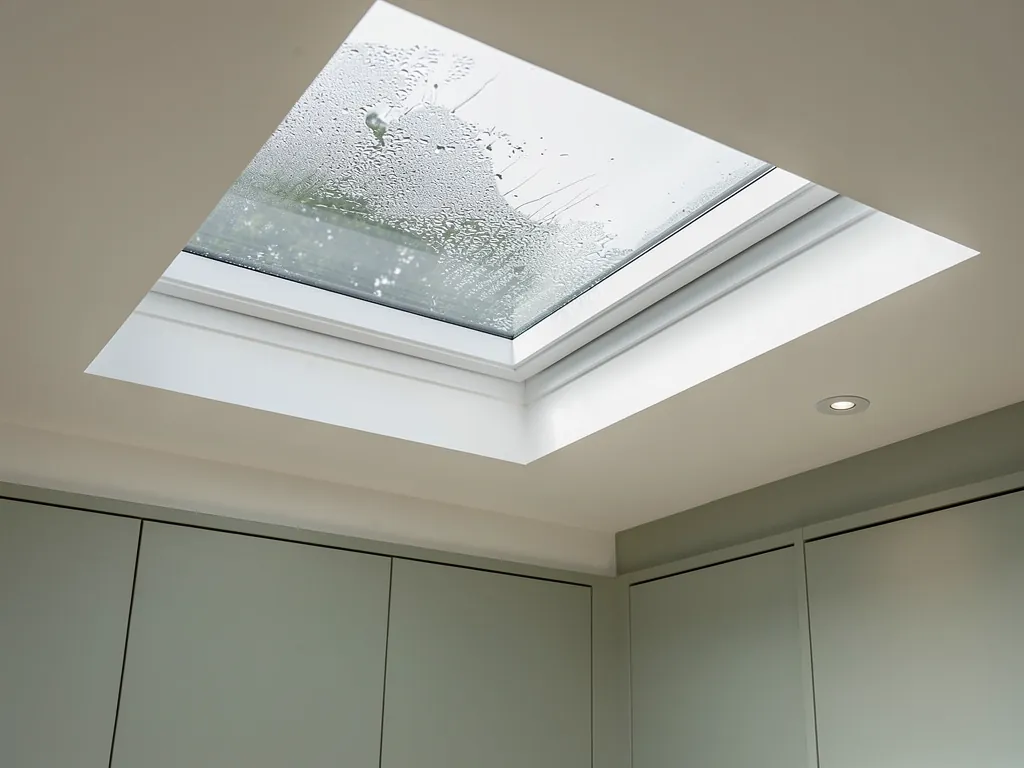
A rooflight that mists between the panes has not got a cleaning problem. It has a sealing problem. The glass unit was built as a closed sandwich, and somewhere round its edge that closure has opened. Damp air from the room or the roof has found its way into the gap between the panes, the moisture has condensed on the cold glass, and there is now no route back out. This guide explains how a sealed unit is put together, the ways the seal gives up, why condensation between skylight panes behaves so differently from the film you wipe off a bathroom window, and what the sensible next step looks like when a unit in a flat roof, a lantern or a pitched roof window has started to cloud.
A sealed unit is a sandwich with a dry middle
Two sheets of glass sit a short distance apart, and the gap between them is closed all the way round. The whole performance of the unit depends on that gap staying dry and staying shut.
Start with the parts. Each pane is cut to size. Between them, round the perimeter, runs a hollow strip called the spacer bar. It is usually aluminium, or a warm-edge alternative in better units, and it holds the two sheets apart at a fixed distance. The cavity is commonly somewhere around 16 to 20 millimetres, though it varies by maker and build. The spacer bar is hollow, and inside it sits a drying agent, a desiccant, in tiny perforated channels that open to the cavity. Its job is to take up the small amount of moisture that was trapped in the gap when the unit was made.
The spacer is glued to each pane by a primary seal, a thin line of a sticky, flexible compound that stops vapour passing through. Outside that, filling the shallow channel between the two sheets at the very edge, sits the secondary seal. That is a thicker band of a structural sealant which bonds the glass sheets together, holds the whole unit as one piece and takes the knocks of wind and temperature.
Many units are also filled with an inert gas, most often argon, which conducts heat a little less readily than air. That gas is the reason a good unit keeps a room warmer. It is also one more thing the seal has to hold in.
So a healthy unit has three defences against damp: the primary seal, the secondary seal, and the desiccant that mops up any remainder. All three are working when the glass is clear. A misted unit tells you the first two have been breached and the third is full.
How damp gets past the edge
No sealant is perfectly impermeable, and every unit breathes a tiny amount over its life. Mist appears when the slow leak becomes a faster one, and several things speed it up.
Roof glass has a harder life than a wall window. It faces the sky, so it takes the full swing from a frosty night to a hot afternoon. The outer pane expands in the sun while the inner pane stays cooler, and the sealant at the edge is pulled and pushed every day. Over years that flexing can open a hairline gap, or let the bond between sealant and glass release.
Ultraviolet light is the second cause. The edge of the unit is exposed where the glazing bar or frame does not shade it, and sunlight slowly breaks down some sealants. A unit set in a lantern or flat roof lights gets far more sky than a window in a wall.
The third is standing water. A rooflight laid almost flat, or a kerb where the falls are poor, can leave the edge of the glass sitting in a film of water after rain. Sealant that spends hours wet, again and again, ages quicker than sealant that dries between showers. The same is true of a glazing gasket or bead that has hardened and shrunk, letting water sit in the rebate where the unit rests.
Then there is the frame. If the rebate that holds the unit has no way to drain and ventilate, moisture collects round the edge of the glass. Good frame design lets the rebate breathe to the outside so that the unit's edge stays as dry as possible. Where that path is blocked by paint, debris or a poorly fitted bead, the unit stays damp.
Finally, a unit can simply be poorly made, or have been handled roughly. A small flaw at the corners, where the spacer is bent or joined, is a classic weak point. A sealed unit that carries a long guarantee from its maker will usually have been built with care at those corners. We return to guarantees further down, because they matter when a unit clouds.
Why the moisture cannot leave once it is in
People hope a misted unit will dry out in a warm spell. It will not, and the reason is the construction itself.
Water vapour moves in and out of the cavity through the same faulty seal, but it does not travel in both directions equally. On a cold day the air in the cavity cools, its pressure drops slightly and outside air is drawn in through the gap. Each warm day pushes a little of that air out again. Every cycle of breathing carries in fresh moisture, because the air outside is rarely dry. The desiccant, meanwhile, has only a limited capacity. Once it has taken up all it can, the cavity air is left to condense wherever the glass is coldest.
That is why the mist tends to appear at the edges first, often at the lowest corner, and spreads inwards. It is also why it comes and goes with the weather. On a bright dry afternoon the cavity may look almost clear, and on a cold damp morning the whole pane clouds. The fault has not healed. The moisture has only moved between vapour and droplets.
Over a longer period, mineral deposits can form on the inner faces of the glass as the water evaporates and leaves whatever it carried behind. Those marks are etched into the surface that faces the cavity and cannot be reached from either side. No cleaning product, however strong, gets between two sheets of glass that have been bonded shut. A unit that has reached this stage looks stained rather than merely foggy.
The difference is easy to test. Wipe the outer face with a cloth, then the inner face. If the cloud stays put after both, it is inside. Our answer on whether a misted rooflight will clear by itself covers what to expect, and the page on whether misted skylight glass can be demisted explains why drilling and drying methods do not bring back what the unit was built to do.
Reading the pattern on the glass
Where and how the mist appears tells you a good deal about what has failed. It is worth looking before you call anyone.
| What you see | Likely cause | What it suggests |
|---|---|---|
| Cloud along one edge or a corner | Seal breached at that point | Often standing water or a blocked drain path there |
| Whole pane hazy in the morning, clear by afternoon | Desiccant full, seal open | The unit is breathing in and out |
| Permanent milky film or drip marks | Long-standing water in the cavity | Deposits now etched inside |
| One pane of several misted | That unit alone has failed | A neighbouring unit may follow in time |
| Fog on the room side only | Indoor humidity on cold glass | Not a seal failure |
The last row matters. Not every hazy rooflight has a broken seal. A bathroom or a kitchen puts a lot of moisture into the air, and a cold pane will collect it on the warm side. That condensation wipes away and returns with the next shower. Between-the-panes mist never wipes away.
The fourth row also deserves a note. When only one unit is misted, it is natural to wonder why the others are fine. Units in the same lantern or bank of glazing were usually made and installed together, so they share the same age and the same sun. One that fails first is often simply the one with the weakest corner or the wettest edge. Our page on why only one pane of a rooflight is misted goes into this.
What different roofs do to a unit's edge
The type of rooflight changes how the seal is stressed and what a replacement involves. The mechanism is the same, but the weak points are not.
Flat roof rooflights and skylights are the most exposed to ponding. A flat rooflight on a low upstand, particularly one whose kerb was set where water collects, spends a lot of time with wet edges. The outer pane is also the coolest surface in the house, so the temperature difference across the cavity is large in winter.
Roof lanterns carry many units in one structure. The panes are held by glazing bars with gaskets and caps, and the ridge and hips shed water in several directions. A failure in one pane often comes down to a gasket that has dried and shrunk at its corner. Because lantern units are individually sized and sometimes oddly shaped, replacement is more of a measured job than an off-the-shelf swap. See misted roof lantern panels for the detail.
Pitched roof windows such as a VELUX have the advantage of a steep fall, so water runs off quickly. Their units still fail, usually because of age and sun, and the answer depends on whether the maker still supplies the pane for that model. Our page on misted VELUX windows explains when a new pane is enough and when the whole window is the better choice.
Polycarbonate domes are not glass, and they do not have a spacer bar, but twin-skin domes can still take in damp between their skins. The cure is a new dome, which is covered on the page about replacing failed polycarbonate domes like for like.
What a clouded unit is costing you
A misted unit does not stop being glass, and nothing falls on anyone's head. It is a quiet failure, and the effects are slow. They are still worth weighing.
The first loss is clarity. Cloud between the panes scatters light, so the room gets a flatter, greyer daylight than the rooflight was bought to give. It also shows as a blemish when the sun comes through at a low angle. If you are thinking about selling, it is one of the things a buyer or surveyor will notice from the landing. Our page on misted rooflights when selling a house deals with that side of it.
The second is warmth. The gas and the still air in a sealed cavity are what slow heat moving through the glass. Once damp air replaces them, the unit performs as a thinner, poorer pane than it was designed to be. That is a matter of physics, not of any figure we would quote, and what a misted rooflight means for heat loss sets it out in full. Where the old unit is being taken out anyway, it is a natural time to choose better glazing, which is the subject of energy efficient rooflights.
The third, for a few households, is sound. The original glass may have been thin, and when a unit has failed the room often sounds more exposed, with rain on the glass a little sharper than before. A replacement is the moment to consider a laminated inner pane, which adds mass and damping to the build. Whether it is worth it depends on what the room hears: aircraft in and out of Gatwick, the A23 or M23, the Brighton main line, or simply a downpour on a flat roof. That judgement is written into the quiet spec that comes with our quotes, and the quiet spec explains how. For the narrower question, see whether a replacement glass unit will make a rooflight quieter.
Finally, a failed seal is also an early sign. The same conditions that opened the unit's edge, such as ponding, a tired gasket or a blocked drain path, may be working on the frame and the kerb. That is why we look at the whole rooflight and its roof at the survey, not only at the cloudy pane.
Replacement, not a rescue
Once the cavity has taken in damp, the honest route is a new glass unit, or where the frame has gone as well, a new rooflight. The middle options sound tempting and do not deliver.
A sealed unit cannot be reopened and dried in a way that restores it. Its edge seal was formed in a factory, under clean, controlled conditions, and it bonds the two panes permanently. Drilling a hole through the glass to let the damp out, then fitting a vent, leaves an open cavity with no gas fill and a permanent path for dust and moisture. It is a cosmetic measure that shortens the time before the cloud returns, and it leaves the thermal job undone. Our page on whether a misted skylight can be put right or needs replacing weighs the options in plain terms.
What we do instead follows a simple order.
- Look at the whole rooflight. We check the frame, the gaskets, the kerb, the falls and the drain path round the unit, and we note what the room hears, so the new unit is specified for that room.
- Measure for the new unit. An accurate size matters, because a unit made a few millimetres out will not seat properly. The process is set out in how a failed rooflight is measured for its replacement.
- Decide between a unit and a whole rooflight. If the frame is sound and the unit is the only failure, a new glass unit in the existing frame is often enough. If the frame is tired, its seals are hard, or the old product is no longer made, the whole rooflight is the sounder investment. The page on replacing the glass unit or the whole rooflight explains how we weigh it.
- Choose the glazing build. Because the old unit is coming out, this is the time to set the pane thickness, the cavity, the gas, the edge spacer and whether one pane should be laminated. Our page on upgrading the glazing when a unit fails covers the choices.
- Fit, and make good. The new unit is bedded, the gaskets and seals are renewed to suit it, and the rebate is left able to drain. Where the work is notifiable, we handle the Building Control notification, and we install to current Building Regulations.
Fitting a whole new rooflight, rather than a unit, changes the paperwork. Replacing a rooflight can be notifiable under the Building Regulations, and the new product has to meet the thermal standard in Approved Document L for the work carried out. We deal with that as part of the job, and the same applies to glazing that affects safety in a walk-on or low position, where Approved Document K and the glass type come into play.
Who pays: the original guarantee
Before any work is ordered, check what paperwork exists. A maker's guarantee on a sealed unit can be long, and a misted unit is exactly what it is written for.
Look for the invoice, the certificate or the handover pack from whoever installed the rooflight. Note the maker and the date. Many guarantees are tied to the unit and pass with the house, but the terms differ, and they often depend on the unit being installed and drained correctly. A claim may need photographs of the mist and a record of the date on the spacer bar or the unit label, which is sometimes visible along one edge.
If a claim is possible, it is worth making before replacing anything, because the maker may want to see the unit in place. Our page on whether a misted rooflight is covered by its original guarantee walks through what to check. If there is no paperwork, or the guarantee has run out, the replacement goes ahead on our terms, which include a 10-year workmanship guarantee on the installation. That guarantee covers our workmanship, is not insurance-backed, and sits alongside whatever the glass maker offers on the unit itself. More detail is on our guarantee page.
Keeping the next unit dry at the edge
A new unit will last longer if the conditions that shortened the old one are dealt with at the same visit. Most of them are about water and sun at the edge of the glass.
The first is drainage. The rebate that holds the unit must be free to drain to the outside, so any bead, gasket or cap that was blocking it is renewed, and the path is left clear. On a flat rooflight, the kerb and the roof fall are checked so that water is not left sitting against the glass. A fall of 1:80 or better across the roof is the usual target for the deck, and the rooflight should not stand in the way of it.
The second is the spacer and seal. A warm-edge spacer keeps the edge of the inner pane warmer, which reduces condensation round the rim of the glass on the room side and is gentler on the sealant. A better secondary seal gives the unit more tolerance for movement. These are choices made at order, and they belong on the written spec.
The third is the pane itself. A laminated pane has a plastic interlayer between two sheets. It is held together if cracked and adds damping against sound, and as a safety measure it is often the right choice in a rooflight over a room people use. Our page on whether a failed rooflight unit should be replaced with laminated glass helps you decide.
The fourth is the room. A bathroom or kitchen under a rooflight needs working ventilation so that indoor moisture is taken away, since damp air on the warm side of the glass stresses the inner seal just as much as rain does on the outer one.
What to do this week
Check and record first, then decide. None of it needs a ladder.
Take clear photographs of the misted unit in the morning and again in the afternoon, from inside. Wipe both faces to confirm the cloud is inside. Look round the frame for a label, a date stamp or a name, and find any paperwork from the original installation. Note whether other units in the same rooflight are clear, and whether the room feels colder or noisier than it did. Then send the photos to us through the quote form, or by WhatsApp, and we will tell you what the survey needs to cover. If you would like to see the pieces that make up the work, our parent page on misted and failed rooflight replacement sets out how the service runs.
A misted rooflight is not urgent in the way a failed roof covering is. It is a unit that has finished its working life. The quicker you know whether it is one pane or the whole frame, the better you can plan the replacement, the timing and the choice of glass. Our page on how long a replacement glass unit takes to arrive helps with that planning.
Questions people ask about a clouded unit
Is the mist between the panes the same as condensation?
It is condensation, but it forms in a place no one can reach. Ordinary condensation collects on a surface that is open to the room and wipes away. This collects in the sealed gap, where the damp has been let in through a broken seal and cannot leave.
Does a misted rooflight let rain in?
Not by that failure alone. The seal that has gone is the one between the two panes, not the weathering round the frame. A cracked outer pane is a separate matter, and our page on whether a cracked outer pane lets rain into a rooflight explains the difference.
Will the mist spread to the other panes?
Each unit is sealed on its own, so one failing does not pass damp to its neighbour. Units of the same age and exposure may fail in time, which is why we look at every unit in the rooflight at the survey.
Can a misted rooflight cause damp in the room?
The moisture is inside the sealed gap and does not normally drip into the room. If there is damp on the ceiling or the lining around the rooflight, the cause is more likely the frame, the kerb or indoor humidity. The answer on whether a misted rooflight can cause damp in the room goes through what to look for.