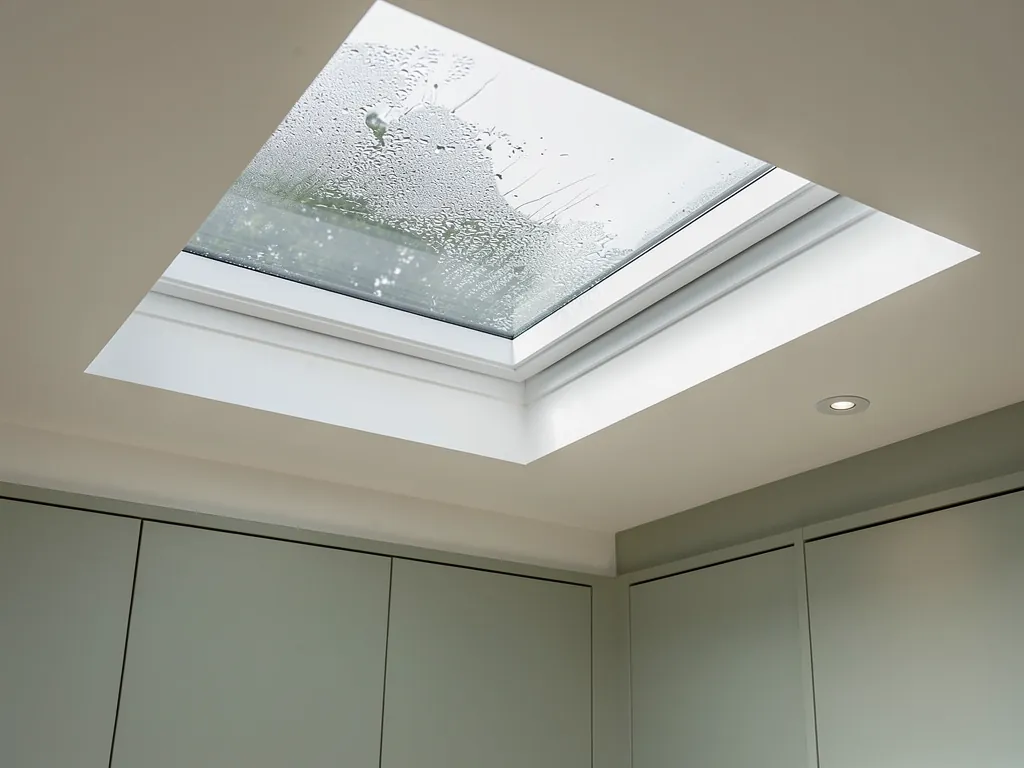
A misted VELUX window is one where moisture or a milky film has appeared inside the glass, between the two panes, where no cloth can reach. It is a sealed unit that has stopped being sealed. Whether the answer is a new pane in the existing sash or a new window altogether depends on the window itself, and the window tells you. Somewhere on the frame or sash there is a plate, and the type code and date on that plate decide what can be ordered, what will fit, and whether a pane swap is worth doing. This page explains how to read that plate, which sashes suit a new pane, which are better replaced whole, and how to use the moment to make the loft room quieter as well as clearer.
What a misted roof window is telling you
The mist is a symptom of a failed edge seal, and it never reverses. The glass itself is fine. The barrier that held dry gas between two panes is what has given way.
A sealed glass unit is two sheets of glass held apart by a spacer bar around the edge, with a sealant that bonds the glass to the spacer. The spacer contains a desiccant, which keeps the cavity dry. On a roof window that edge lives a harder life than it does in a wall. The glass lies at a pitch, so rain and meltwater sit along the lower edge. The sun heats the pane from above, and on a clear night the same pane is exposed to the sky and drops cold quickly. That daily swing of expansion and contraction works on the sealant for years. Eventually a hairline opens, damp air moves in and out as the pressure changes, the desiccant fills up, and water vapour starts to condense on the inner faces of the glass.
People call this blown VELUX glass, or a blown unit, and the phrase describes what you see well enough. There is nothing to blow. You will notice a haze in the morning that thins by afternoon, then a permanent cloud, then a tide line of mineral marks where droplets have dried. Our page on what a blown double glazed unit in a skylight means goes through the stages. A stain that wipes off is on the outer or inner face, which is a cleaning job. A stain that stays put when you wipe both sides is inside.
Two points are worth settling early. A misted window is a failed component, and it is not a sign that the loft is about to come apart, so there is time to choose well. And the mist will not clear by itself, however dry the summer. Plan the replacement rather than waiting for the weather to decide.
The plate on the window
Every VELUX roof window carries an identification label, and the information on it narrows the question faster than any measuring tape. Photograph it before you ring anyone.
The label is usually on the sash or on the frame, in a spot you can see with the window open. The position has changed between generations of window, so if it is not on the first edge you check, try the top of the sash, the frame head and the side of the frame. On some older windows the paper label has worn away, and the information then has to be read from the measurements and the frame profile instead. Four things on the plate matter.
| On the plate | What it tells you | Why it matters |
|---|---|---|
| Type code | Opening style and frame material | Sets which glazing exists for it |
| Size code | Nominal frame width and height | Sets the pane or window to order |
| Date or batch mark | Approximate year of manufacture | Sets how likely parts are still made |
| Glazing or spec code | The pane build it left the factory with | Sets what a like-for-like pane must match |
Read together, those four codes answer most of the question before anyone climbs a ladder. A window with a clear plate, a current type code and a moderate age is a candidate for a new pane. A window whose type code no longer appears in any current range, or whose plate is unreadable, tells a different story. The codes themselves are a short system of letters and numbers, and we decode them at the survey rather than expecting you to. Where a window has been discontinued, our answer on getting a unit for a skylight that is no longer made explains the options.
Record two more things while you are up there. First, whether both panes of the unit are clouded, or only part of one. Second, whether the room side of the frame has condensation or staining on the timber or paint. Both help the survey. Our answer on why only one pane of a rooflight is misted covers the first, and it is less of a worry than it looks.
When a new pane is the sensible answer
A new pane makes sense when the sash and frame around the glass are in sound condition and the unit is of a type that is still made. You keep the window you have and renew only the part that failed.
The conditions are fairly specific. The plate must be legible and the window must belong to a range for which a matching or compatible pane exists. The timber or polyurethane sash must be straight, with no soft spots, no open joints at the corners and no rot showing at the bottom rail, which is where water lies. The frame must be firmly fixed to the rafters and the flashing around it must be intact and sitting cleanly. And you must be happy with what the window already does for you: its size, its opening action, its position in the roof.
When those boxes are ticked, the job is tidy. The sash is opened, the old unit is taken out of its seating, and the new pane is fitted and finished to match. Nothing on the roof outside is disturbed beyond the sash, and the plaster and lining inside stay as they were. There is less mess in the room, less time with the window out, and a smaller bill than a full swap. It also keeps a window whose proportions you chose on purpose, which matters in a loft bedroom where the position was settled long ago.
A new pane is also a chance to change the build. The replacement does not have to copy the failed glass. If the old unit was a plain pair of panes, the new one can carry a laminated inner sheet and a better edge. We write that choice into the quiet spec that comes with the quote. The page on upgrading the glazing when a rooflight unit fails explains what can change and what has to stay the same for the sash to accept it.
There is a limit on that freedom. The sash was designed to carry a certain weight of glass on certain hinges or pivots. A much heavier unit can strain the hardware and make the window hang badly, so the upgrade has to be one the sash was built for. When we specify a pane we check the weight against the window, and where the sash cannot carry the glass you want, that is one of the reasons to go for a whole window instead.
When the whole window should go
A whole window is the better answer when the failure is not only in the glass, or when the glass cannot be matched. The pane is the cheapest part to swap. It is not always the part that is holding the window back.
Several situations point that way. The first is age with no parts. If the plate shows a window from a generation that has been out of production for a long time, a pane may simply not exist, and a made-up one rarely sits well in a sash that was cut for something else. The second is condition. A sash with a soft bottom rail, swollen joints or a finish that has failed will not hold a new pane for long, and fitting fresh glass into tired timber spends money on the wrong part. The third is hardware. If the hinges sag, the ventilation bar is broken and the handle is loose, the window is wearing out as a whole, not just at the glass. Our page on when the frame has failed too lists the signs we look for in the frame.
The fourth is the thermal standard. A window made a few decades ago was built to a lower insulation standard than one made today, and so was its flashing and the way it was packed into the roof. Fitting a modern pane into an old frame does improve the glass, but the frame, the insulation collar and the lining stay as they were. Replacing the whole window brings all of those up together. The fifth is a change of mind about the window. Some people find the old one too small for the room, or want a different opening style, or a top-hung where they had a centre-pivot. That is a reason to replace, and the work then becomes a window installation in its own right, covered under VELUX window installation.
The sixth is cost of the pane set against the cost of the window. Where a pane and the labour to fit it approach the price of a new window with a new build, the new window is the better value, since it resets the clock on everything at once. We set out both figures in the quote so you can judge. General ranges are published for the trade, and your own quote puts real numbers against your own window.
Pane or window: how the plate points
This table sets out the usual reading. It is a guide to the conversation we have at the survey, and the survey can overturn it.
| What you find | Leans towards | Reason | Check at survey |
|---|---|---|---|
| Clear plate, current type, sound sash | New pane | Part exists, sash holds it | Bottom rail and corners |
| Clear plate, older type, sound sash | Either | Pane may need a special order | Lead time and match |
| Plate gone or unreadable | Measure first | Type must be proved | Frame profile and size |
| Discontinued type | Whole window | No matching pane likely | Opening size in rafters |
| Soft timber or failed hardware | Whole window | Glass is not the weak part | Extent of the damage |
| Wanting a different size or action | Whole window | A new pane cannot change the frame | Rafter spacing |
The same pane-or-whole question applies to every kind of rooflight, and the answer follows the same logic: what the glass is, what holds it, and whether it can be matched.
What sits around the glass matters as much as the glass
The glass is one part of a small assembly. The frame, the flashing, the insulation collar and the lining all affect how the new pane or window performs, and they are where a neat job is won or lost.
When a whole window comes out, the flashing has to be considered alongside it. The flashing is the metal and sealing set that dresses the window into the roof covering, and it is made to suit the tile or slate profile. A Crawley loft under concrete interlocking tiles, which suits the 1950s to 1970s housing around the neighbourhoods, takes a different flashing from a tile-hung Weald cottage with handmade clay tiles. The flashing kit has to match the roof covering as it is today. Each kit is designed to run with the window's own frame, so it is good practice to renew it with the window and not to hope the old one will lie down again.
The insulation collar and the lining inside also come into play. An insulation collar wraps the frame and fills the gap between frame and rafters so that the window does not become a cold bridge in the roof. If the collar was missing or squashed when the old window went in, this is the moment to put it right. The lining, the boxed reveal that finishes the opening on the room side, is sized to the window, and a new window of the same code will usually take the existing one. A different size will mean the lining is remade, with plaster made good around it.
Two parts of the Building Regulations have something to say here. Part L covers the thermal performance of replacement windows and roof windows, including the glazing, and current work has to meet the limits set for it. Part K covers safety glazing in critical locations such as doors and low panes, and overhead glass in a room where people live is safety glazed as good practice. A laminated inner pane meets that comfortably, because if it breaks it holds together. We install to the current regulations, and we check whether the work is notifiable and handle the Building Control notification where it is. You are not left to do the paperwork.
The same thinking applies to a pane swap, because the replacement glass has to meet current thermal limits for the unit as fitted, not the limits of the year the window was made. That is a further reason why a pane order is checked against the plate and not placed off a guess at the size. The measuring step has its own page, how a failed rooflight is measured for its replacement, and it explains why the glass is taken from the window and not from the room.
Using the replacement to quieten the room
A roof window is a thin part of the roof, and what it lets into a loft bedroom is sound as well as daylight. A replacement is the moment to decide what the room hears.
In and around Crawley the noise comes in several kinds. Aircraft on the Gatwick routes pass over parts of the borough and the villages around it, and a loft room under a rooflight hears the sky more than a room below it does. The A23, the M23 and the Brighton main line send a low, steady sound across many neighbourhoods. And anywhere at all, rain on glass sets up a patter that grows in a heavy shower. A failed unit can make all three worse. A seal that has let go of its edge usually means a pane that is not held as firmly as when it was new, and a fogged unit with a thin cavity and thin glass passes sound through with little resistance.
The quiet choice is a matter of build, not of one magic ingredient. A laminated pane, made of two sheets of glass bonded with a soft interlayer, damps vibration better than a single sheet of the same total thickness. Different thicknesses in the two panes make the unit less likely to ring at one pitch. The cavity and the edge seal also count. On the frame side, the quality of the seals where the sash closes against the frame decides how much sound leaks round the glass instead of through it. A whole-window swap lets all of those be set together. A pane swap lets the glass change and leaves the frame seals as they were.
We do not quote decibel figures, because the sound that matters is the sound your room actually hears, and a number from a laboratory does not describe that. We describe the build instead, and the quiet spec we write with every quote records what we heard at the survey and which glazing we propose. You can read how it works on the quiet spec page. If you want to know whether new glass alone will change how a room sounds, our answer on whether a replacement glass unit makes a rooflight quieter goes through it without overpromising.
Time, guarantees and what to have ready
Two practical questions come up after the choice between pane and window. How long will it take, and does the original guarantee still apply? Both are answered by the plate.
Sealed units are made to order for the size and build, so the pane does not come off a shelf. The wait depends on the type and on whether it is a standard build or a special one. A pane for a current window is the quicker case, and the main driver of delay is whether the build is a standard one or a special order. A whole window may be quicker or slower, depending on the size. We give you the time in the quote, not as a hope.
On the guarantee, a window that misted within the manufacturer's stated period may have a claim against it, and a new window may come with its own cover. Check your paperwork and the date on the plate before anything is ordered, because a claim made on the wrong assumption wastes weeks. Our answer on whether a misted rooflight is covered by its original guarantee explains the questions to put to the maker. The work we carry out is covered by our own 10-year workmanship guarantee, which is a guarantee of the installation and not an insurance policy, and the terms are on our guarantee page.
The simplest preparation is a short list sent with your request for a quote:
- A photograph of the plate, close enough to read, with the window open.
- A photograph of the whole window from inside, showing the lining and the ceiling around it.
- A photograph from the garden or street of the roof around the window, if you can take one safely from the ground.
- A note of which panes are clouded, and since when.
- The room's use, so that the quiet spec is written for the right room.
Send those through the quote form or on WhatsApp, and the survey can start from the right question. Do not climb onto the roof to take a picture. The plate is nearly always readable from inside.
What people ask once the plate is photographed
These are the points that come up once the plate has been photographed and the decision starts to feel real.
Can I just have the glass swapped and keep everything else?
Yes, where the window is of a type for which a matching pane exists and the sash, frame and flashing are sound. The plate confirms the first point and the survey confirms the rest. Where either fails, a new pane goes into a window that will need attention soon, and the money is better spent on the whole window.
Will a new pane look different from the old glass?
The outline is the same, because the sash is unchanged. The tint and reflection of the glass may differ slightly if the build changes, for example with a laminated inner pane or a modern coating. In a bright room it is hard to notice, and the change is written into the quote so nothing surprises you.
Does a whole new window mean opening up the ceiling?
A window of the same size code usually sits in the same opening, so the lining can often stay. A different size means the rafters and the lining are altered, with plaster made good afterwards. The survey tells you which case you are in before you commit.
Is it worth waiting until more windows fail?
Replacing two or three roof windows at the same visit saves on access and setup, and the new windows match. It is a fair thing to raise at the survey, but there is no need to hold off a room that is being affected now. We can quote the one room and the others as options.
If you have a misted roof window in Crawley or within 30 miles, send the plate photograph through the quote form and we will tell you which way it points. The wider picture of failed glazing sits on the misted and failed rooflight replacement page.