An opening rooflight is a moving part fixed to a roof, and moving parts wear. Hinges stiffen, stays slacken, motors tire and seals stop meeting the frame. This guide covers how a failed opening rooflight is judged, when a new unit with fresh gear is the calmer answer, and what the replacement involves from the first visit to the last wipe of the glass.
What failing gear looks like from the room
A rooflight rarely stops working in one go. It gives warnings for a season or two: a handle that needs a shove, a motor that hesitates, a sash that sits a few millimetres proud of the frame. Reading those signs early gives you time to choose a replacement rather than have one forced on you.
The common signs fall into two groups. The first is mechanical: the sash will not open, will not close fully, or will not stay where you put it. The second is about the seal: you feel a draught on a still day, you hear the wind whistle round the edge, or you see a line of dirt where the gasket no longer touches the frame. Both point the same way. The unit has stopped doing the two jobs it was bought for, which are letting air in when you ask and keeping weather out when you do not.
On a manual rooflight the usual culprits are the hinges, the friction stays and the locking handle. Hinges in a damp loft can corrode, and a rooflight in a steamy bathroom or over a kitchen hob takes more moisture than one in a bedroom. On an electric or solar-powered unit, the list adds the motor or chain actuator, the control unit, the wall switch or remote, the rain sensor and the wiring back to the supply.
A sash that jams part open needs attention the same day, because a gap you cannot close is a gap for rain. You can cover the opening from inside with a sheet while you arrange the work. Do not force a stuck motor. Forcing a chain actuator against a binding sash can bend the sash, which turns a gear problem into a frame problem.
Why the gear wears out before the glass does
The glass in a good rooflight outlasts almost everything bolted to it. The hinge, the motor and the seal do not. That imbalance is the reason opening units are the ones most often judged for replacement, even when the pane itself is still clear.
Think about what a rooflight sash goes through. It lives in the hottest and coldest place in the house. In summer the frame can be too hot to hold. In winter it carries condensation, frost and sometimes a film of ice on the hinge side. Every open and close cycle flexes the gasket, pulls on the stays and loads the motor. A roof window over a stair may open every day for years. A rooflight over a spare room may open twice a summer and sit seized the rest of the time, which is its own kind of wear.
Gaskets are made of rubber or a soft synthetic, and they harden with age and sun. A hard gasket no longer springs back, so it stops sealing. Once that happens the sash can look perfectly square and still let the weather in and the noise through. This is also why a rooflight with a worn seal tends to sound louder in rain: the glass is unchanged, but there is now a thin path for sound round the edge. Our page on failed seals on rooflights goes through what the seal does and how it is judged.
Motors are the other common casualty. A rooflight motor is a small electric drive pushing or pulling a sash that may weigh a fair amount once it carries a double or triple glazed unit. Dust, damp and age take their toll on the gearbox and the control board. When a motor fails on a unit that is many years old, the matching part may no longer be made, which is where the decision between new gear and a new unit begins.
Keeping the old unit or fitting a new one
The honest question is not whether the old rooflight can be coaxed back into use. It is whether doing so serves you better over the next ten or fifteen years than a new unit would. We weigh five things.
- Age and availability. If the maker has moved on to a new range, matching a motor, a hinge set or a gasket profile to the old frame may not be possible at all.
- The state of the frame. A sound frame can take new gear. A frame that has twisted, rotted or corroded cannot hold a new sash square.
- The state of the glass. If the unit has also misted or cracked, you would be renewing half the rooflight and keeping the other half, and the work on the sash is then best done once.
- What the room needs now. Rooms change. A spare room becomes a bedroom, or a bedroom becomes a home office, and the original specification no longer suits the use.
- Current standards. A rooflight fitted decades ago will not match today's thermal and ventilation expectations.
When several of those point the same way, a new unit is the calmer answer. You get new hinges, new seals, new glass and a guarantee that starts from the day of installation, all in a single visit. You also get the chance to change what the rooflight does, which is covered further down.
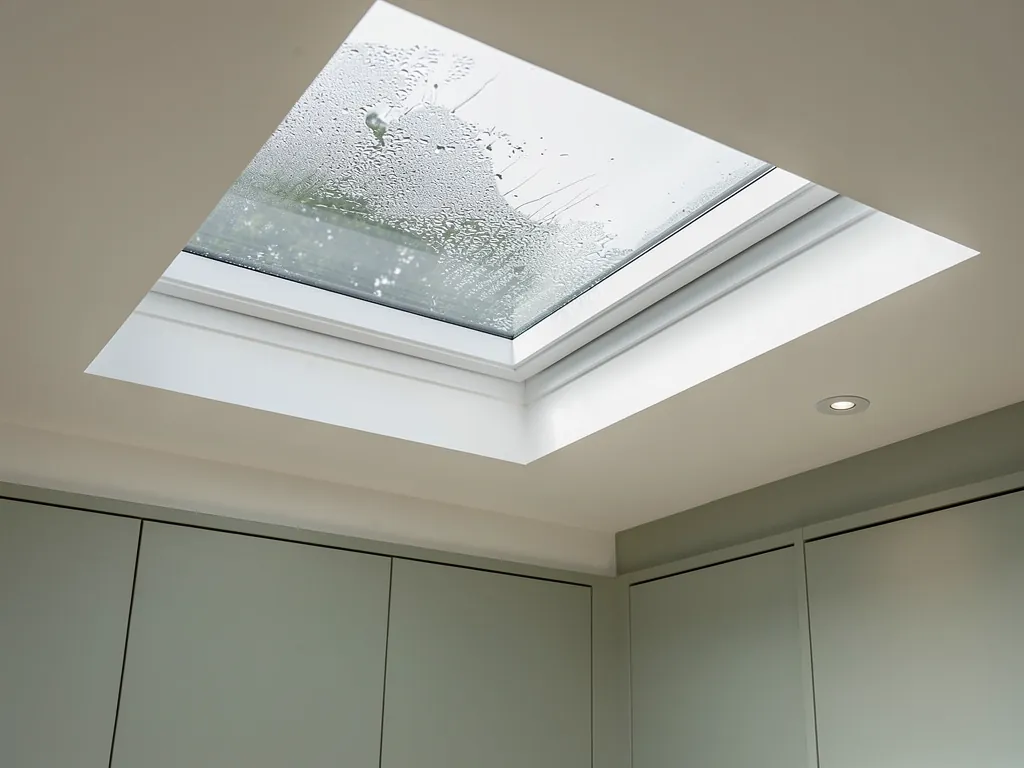
Electric and solar rooflights: the motor, the sensor and the control
An electric rooflight has three parts that can fail independently: the actuator that moves the sash, the control that tells it what to do, and the sensor that closes it when it rains. Knowing which one has gone shapes the decision about a broken electric skylight replacement.
The actuator is the motor and its arm or chain. Its signs are a humming with no movement, a grinding note, a sash that moves only part of the way, or a sash that drifts open after closing. The control is the small box that takes the signal from your switch or remote and sends power to the motor. A failed control often shows up as nothing at all: no sound, no movement, no light on the keypad. The rain sensor is usually a small pad on the outside of the frame. When it fails, the rooflight may stay shut on a fine day or, worse, stay open in a shower.
On a powered unit, the wiring and supply matter as much as the parts. A rooflight wired to a spur that has since been moved, or fed from a transformer hidden behind a plasterboard ceiling, takes longer to trace than one with an accessible control box. In a new installation we place the control where it can be reached without a ladder and we note its position in the paperwork handed over.
Solar-powered units remove the mains connection and run from a small panel on the frame and a rechargeable battery. The battery is the part that ages. After several years of daily cycling it holds less charge, and a rooflight that once opened with a tap now needs several. On a north-facing slope or under heavy tree cover the panel may never have had enough light in winter, which is one reason we check orientation before proposing solar.
If the existing rooflight is a VELUX roof window with an electric or solar option, the control system matters as well. Modern VELUX products use a radio control system that pairs windows, blinds and rain sensors with a wall pad or remote. Changing one window in a set can mean re-pairing the others, which is planned at the survey rather than found on the day. Our page on VELUX window installation sets out how those windows are fitted, and electric and opening rooflight installation covers the powered options in full.
Mains wiring and the Building Regulations
Replacing a rooflight is building work, and several parts of the Building Regulations touch it. Knowing which ones helps you judge any quote, ours included.
| Part | What it governs | For an opening unit |
|---|---|---|
| Part L | Energy efficiency | A replacement rooflight is a controlled fitting with a heat loss limit |
| Part F | Ventilation | Opening area can serve as purge ventilation |
| Part K | Impact and falling | Safety glazing where glass is low enough to be hit |
| Part B | Fire safety | A loft room's escape window must open wide enough |
| Part P | Electrical safety | New mains wiring to a motor is notifiable in a home |
The table is a summary, and the detail is in the Approved Documents published on gov.uk. Two points deserve a word here.
The first is the loft escape. If the failed rooflight serves a loft bedroom, it may be the escape route from that floor. The Approved Document sets a minimum clear opening for such windows, and a rooflight that opens only a crack, or that no longer opens at all, may not meet it. A replacement is a chance to put that right, and we check the clear opening against the requirement as part of the survey.
The second is electrical. Adding or altering the fixed wiring that feeds a motor is notifiable electrical work in a dwelling, so it is handled and recorded accordingly. Where the work is notifiable, we handle the Building Control notification, and the replacement is installed to current Building Regulations.
Changing what the rooflight does
A replacement is the one moment at which the function of an opening rooflight can be changed without extra disruption, because the roof is open and the frame is being replaced anyway. There are four common changes, and each is worth a thought before you order.
Manual to electric. A rooflight out of reach over a stair or a double-height space is one you stop opening. Fitting a motor and a wall switch brings it back into use. The extra is the wiring, which is easier to plan in now than to add later.
Fixed to opening. Sometimes the failed rooflight was never an opening one. A sealed unit over a kitchen or bathroom has no way to shed heat and steam, and you may prefer a unit that opens. We set out what that involves on the page about replacing a failed fixed rooflight with an opening one.
Size and position. Where an old unit sat in a rafter bay of a certain width, a new one may be able to fill the bay better, or a different product may suit the pitch. The measurement process is described in how a failed rooflight is measured for its replacement.
Glazing. A new sash is the ideal time to choose a better pane. A laminated inner pane, a wider cavity and warm-edge spacers change both the warmth and the sound of the room. We cover the options in upgrading the glazing when a rooflight unit fails.
A quiet room is partly a matter of closing properly
Noise comes through an opening rooflight in two ways: through the glass and round the edge. Only one of those is improved by better glass.
In Crawley, the noise that homeowners talk about is often aircraft on the Gatwick routes, along with the A23, the M23 and the Brighton main line. A loft bedroom under a rooflight is the room that hears the sky most. On a shut, well-seated sash, the sound has to pass through the glazing build, so a laminated acoustic inner pane does real work. On a sash that no longer closes evenly, the sound takes the easier route round the gasket, and no pane, however good, will help.
Rain works in a similar way. Raindrops on a flat pane sound like drumming, and a loose sash can add a rattle. A new unit seated on a fresh upstand with new seals gives the glazing the chance to do what it was specified to do. The quiet spec that comes with every quote records the glazing build, the seals and the upstand we propose for the noise that room actually hears. You can read how it works on the quiet spec page.
There is a practical point here for anyone deciding whether to keep the old sash. If it has worn so that it no longer closes flat, changing the glass alone alters the sound less than you would hope. The sash, the seals and the frame need to be seen as one system.
When the frame has gone as well
A frame that holds a failed sash is often a frame with its own troubles. Timber can swell or soften where water has sat in a corner. Metal frames can corrode at the fixings. Plastic frames can distort in heat. A sash cannot close square in a frame that is no longer square.
The test is simple and we make it at the survey. With the sash closed, we look at the gap all round, press on the corners and check the diagonals. We look inside the frame at the lining, the flashing and the plaster for stains, and we check the upstand or kerb that the frame stands on. A twisted frame or a soft upstand means the answer is a full replacement rather than new gear in the old shell. That case is described in when the frame has failed too.
It helps to see this as a chance, not a setback. A full replacement lets the flashing, the upstand insulation and the internal lining all be set out properly in one go. The result is a unit that sits true, closes evenly and keeps its seal, in a roof that has been detailed for it.
How the replacement runs on the day
A rooflight replacement is a short job, and done in the right order it is a tidy one. A typical opening rooflight is taken out and replaced in a day, though a larger unit, a new kerb or new wiring can add time.
- Protect the room. Dust sheets go down and the furniture under the rooflight is moved or covered.
- Disconnect. On a powered unit the supply is isolated and the motor is disconnected before anything else is touched.
- Remove. The sash and frame come out, and the flashing is lifted carefully so it can be reassessed.
- Prepare. The opening and upstand are checked, dried and made ready for the new unit.
- Install. The new rooflight is set level and square, fixed and flashed into the roof covering.
- Connect and test. A powered unit is wired and run through its full range, including the rain sensor where fitted.
- Make good. The internal lining is finished, the room is cleaned and the old unit is taken away.
The order of work depends on the weather, and we choose the day with that in mind. The roof is closed in before we leave.
Lead times depend on the unit. Stock sizes are quick, and a made-to-measure unit takes longer. How long a replacement glass unit takes to arrive sets out the stages between order and delivery, and the same logic applies to a whole unit.
What you can do before we visit
A little preparation makes the survey faster and the quote more exact. None of it needs a ladder.
- Note the make and model from the label on the sash edge or the frame, if you can reach it safely.
- Photograph the rooflight from inside, open and closed, and any stain or gap you can see.
- Write down what it does and does not do: which way it fails, and when it began.
- Find any paperwork, remote, keypad or manual that came with the unit.
Please stay off the roof while you look. A wet or mossy slope is dangerous, and the survey covers the roof side properly. When you are ready, use the quote form or message us on WhatsApp. Every replacement is covered by our 10-year workmanship guarantee, and the wider picture of this work sits under misted and failed rooflight replacement.
Questions about opening rooflights that have stopped working
These are the queries that come up when a rooflight no longer opens or closes as it should.
My electric rooflight opens but will not close. Is that the motor?
It may be the motor, but a sash that will not close can equally be a jammed hinge, an obstruction in the frame or a fault in the rain sensor. A sash that stays open is a rain risk, so close it by hand if it is safe to do so and note what happened. We identify the actual cause at the survey, then propose a new unit or new gear to suit.
Can I just replace the motor?
Sometimes, if the model is still supported and the frame and glass are sound. Often the motor is one of several tired parts, and a new unit is the better long-term choice. We explain the reasoning in the quote, so you can compare like with like.
Will a new rooflight fit my existing opening?
Usually a replacement is chosen to match the existing opening, which keeps the work tidy. Sometimes the old opening was an odd size, or the roof has changed since. We take measurements and confirm the fit before anything is ordered.
Does a new opening rooflight need Building Control?
A like-for-like replacement is a controlled fitting, and new electrical work to a motor is notifiable in a home. Where the work is notifiable we handle the Building Control notification for you. What drives the cost is set out on our costs page.