A roof lantern is not one piece of glass. It is an aluminium or timber frame holding a set of separate sealed glass units, usually one for each roof face plus the small end panels, and each unit lives or dies on its own. When one of them mists, the lantern has not failed. A single unit has, and in most cases that one unit can be lifted out and replaced with a new one while every other panel stays where it is. This guide explains how a lantern is put together, how to read which panel has gone, what replacing a unit involves from the scaffold tower to the last gasket, and when it makes sense to use the opportunity to change the glass build rather than copy the old one.
Why a lantern can lose one panel and keep the rest
Every pane you can see in a lantern is a factory-sealed double glazed unit sitting in a gasketed frame. The units are independent of each other, so the condition of one says very little about its neighbours.
The frame is a skeleton of glazing bars. Bars run up each roof face from eaves to ridge, a ridge member joins the faces, and hip bars run down the corners on a hipped lantern. Between the bars, each sealed unit is bedded on a rubber or EPDM gasket and held by a pressure plate and a snap-on cap on the outside. Sometimes there is an internal bead as well. Nothing in that arrangement ties one unit to the next. The glass does not carry the structure, and the frame does not depend on any single pane for its strength.
That is what makes a lantern a friendly product when glass fails. A flat fixed rooflight is usually one large unit, so a failure there means the whole sheet of glass comes out. A lantern spreads the same area across many smaller units, and the job shrinks to match. You can read more about the wider question on our page about replacing a single misted pane in a roof lantern, and about the whole topic in misted and failed rooflight replacement.
The same independence works in the other direction too. A lantern with four roof faces has four chances for a seal defect to appear at different times. Units made in the same batch, fitted the same day and exposed to the same weather often reach the end of their sealed life in different summers, because the tiny differences in how each edge seal was made and how each gasket sits add up over the years.
Recognising a misted roof lantern glass unit
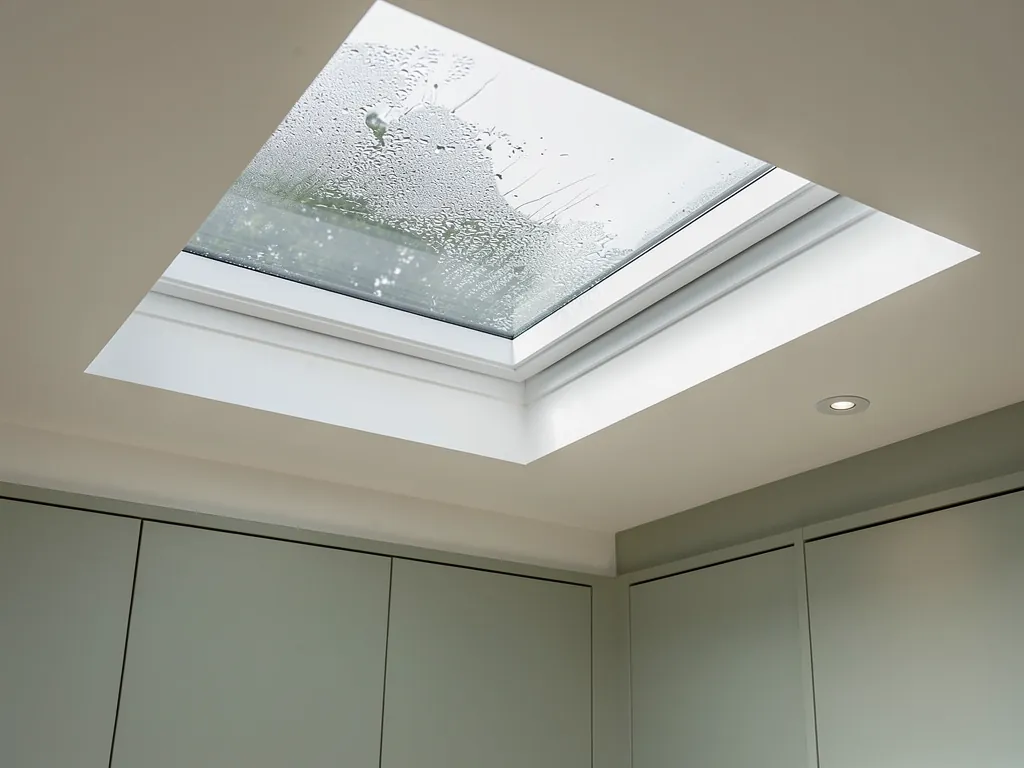
Misted roof lantern glass shows as cloud, film or water beads between the two panes of a unit. It never appears on the room face or on the outer face of the glass, because those surfaces can be wiped, and the fog does not wipe.
A sealed unit is two sheets of glass separated by a spacer bar around the edge, with a gap between them filled with dry air or argon. The spacer contains desiccant, a drying agent that keeps the cavity clear. When the edge seal loses its grip, damp air passes in and out as the temperature swings. The desiccant absorbs what it can for a while. Once it is saturated, moisture condenses on the coldest inner surface as a haze, and later as droplets and mineral staining. This is the unit described on our page about a blown double glazed unit. Builders also use the phrase blown roof lantern unit for the same fault.
How to tell a failed unit from ordinary condensation is worth a minute of your time. Wipe the pane you suspect on the room side, then look at the outside from the ground or a safe vantage point. If the mark stays put, it is inside the sealed cavity. A few other habits give it away:
- Fog that comes and goes through the day, worst on cold mornings, and leaves a faint ring of residue along the edge of the pane.
- One panel clouded while the panel beside it stays crystal clear, which is the normal pattern and no sign of something larger.
- A dull, milky patch that looks like breath on a mirror but does not clear when the room warms.
- A coloured shimmer or fine white dust inside the glass, which shows the coating or the desiccant has been attacked.
When only one panel shows it, the explanation is usually local, and our answer to why only one pane of my rooflight is misted goes through the common causes.
What makes the seal on a lantern unit give up
A lantern unit has a harder life than a window in a wall. It faces the sky, so it takes the full swing of temperature, the full weight of rain and the full dose of ultraviolet, and it often sits under a slope where water lingers on the glass.
Three forces do most of the damage. Heat builds inside the cavity on a bright day and pushes outwards on the edge seal, then contracts at night. Water lies on the lower edge of each pane after rain, pressing against the gasket and the seal below it. Sunlight slowly ages the organic sealant holding the spacer to the glass. None of that happens quickly, which is why a unit can run clear for many years and then cloud in a single season.
Installation matters as well. A unit that sits in a frame with blocked drainage slots keeps its edge standing in water, and that shortens its life. Gaskets that have hardened and shrunk let the pane move slightly under wind load. A pane that has been stressed at one corner by a setting block in the wrong place can tip a perfectly sound seal into failure. We cover these in more depth in failed seals on rooflights.
A new unit fitted into a tired frame will meet the same conditions. That is why the survey looks at the gaskets, the drainage path and the bars, and not only at the glass that has clouded.
Lifting one unit out: how the work runs
Replacing a single unit is a short, controlled job. It needs the new glass made to size in advance, access to the roof, and a steady hand with a glazing vacuum lifter. The lantern stays on the roof throughout.
- Survey and measure. We measure the unit itself, not the opening around it, and record the thickness, the spacer and the glass build. The steps are set out in how a failed rooflight is measured for its replacement.
- Order the new unit. Sealed units are made to order to the millimetre, so the glass is ready before anyone goes up. The wait is covered on the page about replacement glass unit lead times.
- Protect the room. Floors, furniture and the ceiling edge are covered, because there will be glazing tools and a little dust from the old sealant.
- Remove the cap and pressure plate. The outer capping along the two bars beside the unit is unscrewed or unclipped and set aside, in order, so it goes back in the same place.
- Lift out the old unit. Two people and a vacuum lifter take the weight. A lantern unit is heavy for its size, and the roof pitch works against a clean lift, so this is a two-person job.
- Clean and check the rebate. The gaskets, setting blocks and drainage paths are examined and renewed where they have aged, so the new unit sits on a sound bed.
- Set the new unit. It goes onto fresh setting blocks, centred in the frame with an even margin on each side.
- Refit the caps and gaskets. The pressure plates are tightened evenly, to the maker's sequence, so the unit is gripped without being squeezed.
- Clean the glass and clear up. The new unit is cleaned inside and out, and the protection comes up with the dust sheets.
A single-unit swap is usually a matter of hours on site for a lantern of ordinary size, although the weather, the access and the number of panels being done on the same visit all change the length of the day. Work at height is planned around the forecast, and a dry spell is chosen for the day the old unit comes out, so that the frame is never open to rain.
Checking that the unit will fit the frame that is already there
A replacement unit has to match the old one in size and in thickness, or the frame will grip it badly. Both are measured on site, because lantern frames vary more than the catalogues suggest.
The width and length of the glass are taken from the old unit, and squareness is checked on both diagonals. Lantern panes are often trapezoids on hipped and gabled roof faces, and an error of a couple of millimetres on the long edge is enough to pinch the glass against the bar. The overall thickness is checked against the depth of the rebate in the bar. A unit that is too thin will rattle in its gaskets. One that is too thick will stop the pressure plate closing. A thicker glass build therefore cannot simply be dropped into an old frame. If you would like a quieter or better performing unit, the build has to work within the rebate, or the bars need to change. That point is picked up in the section on quiet below.
Some older frames were made by manufacturers who no longer trade, and the question becomes where matching gaskets and sections can be found. For lanterns of this kind we check the profile carefully, and our page on replacement units for a discontinued skylight explains what can be matched and what cannot.
Panel by panel: what each position asks for
Each panel of a lantern sits in a different position, so the effort and the choices are not identical. The table below sets out the usual differences.
| Panel | Access | Glass note | Matters most |
|---|---|---|---|
| Main roof face | From the flat roof or a tower | Largest unit, heaviest lift | Lifter, setting blocks |
| Hip or end face | Often narrow to reach | Trapezoid shape, cut exactly | Diagonal checks |
| Top panel beside ridge | Ladder or tower reach | Smaller, lighter unit | Ridge cap alignment |
| Vertical side glazing | Often from inside as well | Sometimes a different build | Drainage slots |
Most lanterns carry one build across all the sloping faces, which is why a single order sheet can cover a whole job. A few lanterns on orangeries and conservatories have a different specification on the vertical panels, often toughened rather than laminated, and the order needs to reflect that.
Safety glass and what sits overhead
Glass overhead is chosen with the fall of a broken pane in mind. The inner pane of a sloping lantern unit is normally laminated, because laminated glass holds together when it cracks, while toughened glass breaks into small granules that drop.
A replacement unit follows the same logic. The outer pane is commonly toughened for strength against hail and thermal stress, and the inner pane is laminated, with an interlayer that keeps the pieces in place if something cracks. If the existing lantern has been built to that pattern, the new unit copies it. If you are unsure what the glass currently is, there are easy ways to find out, and we set them out in our answer on telling if rooflight glass is laminated. Any change of build is written into the quote, so you know which glass is going overhead.
Using the change to quiet the room
When a unit has to come out anyway, the glass build is open to choice. The new unit does not have to be a twin of the old one, and for a kitchen lantern the most useful change is usually to the sound.
Rain on a lantern is a drumming that the room hears directly, because the sloping glass is thin compared with a tiled roof. The glass build is the main lever. A laminated acoustic inner pane, different pane thicknesses inside and out so the two do not ring at the same pitch, and a well-chosen cavity all change what reaches the room. The gaskets and the way the pressure plates are tightened matter too, because a rattling pane is louder than any rainfall. We choose the build to suit the noise the room actually hears, and we write it down in the quiet spec that comes with the quote. One point belongs here. A single upgraded panel beside three unchanged ones will sound different from its neighbours, so if the room is used for music, work calls or sleep under the glass, a full set of matching units is worth asking about.
For a lantern in Crawley, the noise can be Gatwick departures overhead, traffic on the A23 or the M23, or a simple downpour on the extension roof. A kitchen at the back of a house beneath the flight paths will hear something different from a garden room in a quiet cul-de-sac in Horsham, and the glass is chosen accordingly.
Keep the limit of the frame in mind. A thicker acoustic build has to fit the rebate in the bars, and that is the reason to decide on an upgrade before the order is placed. Our page on upgrading the glazing when a rooflight unit fails goes through what is possible.
Warmth and light from the new unit
Modern sealed units hold heat better than those made a generation ago, and a lantern that has lost a unit to age is likely to have older glass throughout. A new panel with a warm edge spacer, a low emissivity coating and a gas fill can carry a noticeably higher specification than its neighbours.
A warm edge spacer is a low-conductivity spacer that reduces cold at the perimeter of the glass, where the old aluminium spacers sat. A low emissivity coating is a thin metallic layer on the inner face of one pane that reflects heat back into the room. Both are standard in current units. Solar control coatings are an option on lanterns that face south or west, and they reduce summer glare and heat gain without turning the glass dark. Self-cleaning coatings are also available on the outer pane, though they suit some roof pitches better than others. The wider choices are set out on our roof lantern installation page.
New and old panels can differ slightly in tint, because each generation of coating has a slightly different colour. With the coatings on the inside of a unit the difference is usually small, and from the room it is hard to see. On a bright south-facing lantern you may see it on a sunny afternoon, and if that matters to you, it belongs in the survey conversation.
Where the work is notifiable under the Building Regulations, we handle the Building Control notification, and anything we fit is installed to current Regulations. We confirm at the survey what applies to your roof, because it depends on whether only the glass is changing or the lantern as a whole.
When the whole lantern should come out instead
A panel swap suits a lantern whose frame is sound. If the frame itself is tired, the money is better spent on a new lantern than on another unit in a failing one.
The signs that point to a bigger job are plain enough when you look for them:
- Several units misting at once, across different faces, which suggests the whole lantern is at the end of its sealed life and each unit will follow in turn.
- Corroded or chalky aluminium, or soft and swollen timber, at the bars and the sill, where water has been lying.
- Gaskets that have shrunk away from the glass, leaving daylight at the corners of the units.
- Bars that have bowed or opened at the ridge, so that new units would not sit true.
- A kerb or upstand that has moved, cracked or lost its waterproof turn-up beneath the frame.
If two or three of those are present, a full lantern is the sensible route. It lets us correct the kerb, choose the glass build across all the faces at once, and give you one spec for the room. Our pages on replacing the glass unit or the whole misted rooflight and when the frame has failed too help you weigh the two routes. A survey gives the plain answer for your lantern, and you can ask for one from the quote form.
What you get when the work is done
A replaced unit leaves the lantern clear between the panes and quiet in the rain, with the frame tidy and the room made good inside. There is nothing for you to do afterwards except enjoy the light.
The new unit carries the maker's warranty for the glass seal, and the installation is covered by our 10-year workmanship guarantee, which you can read in full on our guarantee page. The written quote says exactly what each covers. Keep the quote, the spec and the glass label details together, since they make any future order simple.
Questions about one misted lantern panel
Will the new panel look different from the others?
Slightly, in some cases. Coatings change over the years, so a new unit beside a decade-old one can differ in tint. From inside the room the difference is usually small, and it is one reason to consider a full set where the lantern is the feature of the room.
Can a misted panel be cleared without replacing it?
The fog is inside a sealed cavity, so the surface cannot be reached. Some firms offer to drill and clear the cavity, but the seal has already failed and the moisture returns. A new unit is the lasting answer. Our page on whether misted skylight glass can be demisted explains why.
Is the original guarantee likely to cover it?
It depends on the age of the lantern and the wording of the maker's terms, and most glass seal guarantees run for a limited number of years. Check the paperwork from the original installation first. The answer on whether a misted rooflight is covered by its original guarantee shows what to look for.
Does a misted panel let in less light?
Yes, a little, because the cloud scatters some of the light before it reaches the room, and the staining can build up with time. The loss is gradual, and the room owner notices it only when the new unit goes in and the room brightens.