A misted rooflight shows up at a sale in the same way a cracked gutter does: someone looks up, notices it, and writes it down. A buyer spots cloudy glass on the second viewing. A surveyor records a blown sealed unit in the roof glazing. The solicitor's enquiries then ask what the guarantee position is. None of it is dramatic, and none of it has to delay you. This guide is for the homeowner with a misted skylight and selling house plans already under way. It explains what the note in the survey means, what a replacement involves, and how to choose between renewing the glass before you list and leaving it to the negotiation. We treat it as a replacement and upgrade job with a paper trail, because a paper trail is what a buyer wants to see.
What a surveyor actually writes about a rooflight
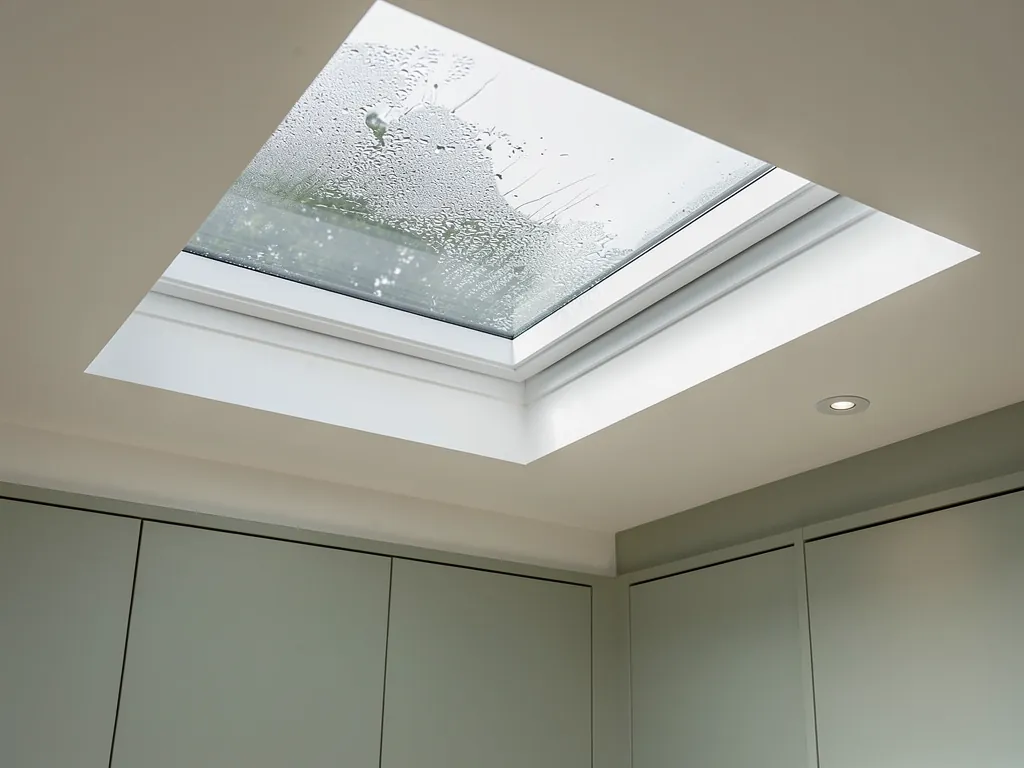
A surveyor looks at the roof glazing from inside and outside, and records what they can see. A sealed glass unit that has failed is easy to spot, because moisture or a hazy film has formed between the two panes and cannot be wiped away.
Surveys come in levels. A basic mortgage valuation for the lender is short and is about whether the house is adequate security for the loan, so it may say little about glazing. A Level 2 home survey, the level commissioned on an ordinary house of conventional construction, rates each element of the building on a traffic-light scale. Roof glazing tends to sit inside the roof section or among the windows, and a misted unit can attract the amber rating, meaning a defect that needs attention but is not structural. A Level 3 building survey is written at greater length and is more likely to name the rooflight, its position and the probable cause.
The wording can be general. You may see "failed double glazed unit to the rooflight", "condensation between the panes" or "seal failure to sealed units". Those phrases all describe the same thing: the factory seal round the edge of the glass unit has let humid air in, and the desiccant in the spacer bar has used up its capacity. Our page on what a blown double glazed unit in a skylight means explains the mechanism, and why rooflights mist between the panes goes through the causes one at a time.
Two things matter about the survey note. The first is that it is a description, not a quote. The surveyor has no price for the work and will usually suggest that you obtain one. The second is that the note travels. Once it is in the report, your buyer's solicitor sees it, the buyer's lender may see it, and it becomes something to settle before exchange.
Why buyers raise it even when the surveyor does not
A buyer does not need a report to notice cloudy glass. A rooflight is over their head in the room they are imagining themselves living in, and a dull or streaked pane is hard to miss when the sun is low.
The question they ask is practical: is this expensive, is it urgent, and is it only one window? Those are fair questions, and an answer in writing is better than a shrug. The replies are these:
- Cost depends on the size of the unit, the glass specification and whether access needs scaffolding or a tower. A single glass unit in a standard roof window is a modest job. A large lantern or a run of glazed panels is a bigger one.
- Urgency is low in the sense that a misted unit is not a safety issue, and our page on whether a misted rooflight is dangerous covers that. It is not a problem that goes away, though, because the seal does not recover.
- One window or several is a matter of looking. Units from the same batch can fail at different times, so a neighbouring pane that looks clear today may follow.
When a buyer cannot get those answers, they fill the gap themselves. That is how a single hazy pane turns into a request for a reduction that feels larger than the job itself. A known scope, with a specification and a replacement price, is something a buyer can weigh. An unknown is something they will mark down.
Renew before you list, or let the buyer decide
You have three sensible routes, and each suits a different sale. Renewal before listing gives the cleanest file. Renewal after an offer keeps your options open. A price adjustment leaves the job with the buyer.
| Route | What you do | Advantage | Watch for |
|---|---|---|---|
| Renew before listing | Order the new unit or rooflight now | Clear glass at viewings, paperwork ready | Lead time on made-to-order glass |
| Renew after offer | Book the work before exchange | Spend only once the sale is moving | A tight timetable near completion |
| Adjust the price | Agree a reduction, leave the work | No work before you move | The figure is the buyer's estimate |
The table is about timing, and the right row depends on how the sale is going. If the property is about to go on the market with photographs still to be taken, clear glass helps the pictures. If you already have an offer and the survey has flagged the unit, a replacement booked before exchange takes the item off the list of conditions.
A price adjustment is the route we would think hardest about. A buyer who asks for a reduction is pricing a job they have not seen quoted, and buyers price cautiously. The reduction they suggest can sit well above what the replacement would cost you, because it includes their allowance for the unknown. Getting a written quote first lets you answer a request with a figure rather than a debate. That is a different thing from doing the work, and it carries no commitment.
Finding out whether a guarantee still applies
Before anyone orders glass, check the paperwork you already hold. A guarantee on a sealed unit is one of the things a solicitor's enquiries will ask about, and finding it saves time.
Look for the installation invoice, any guarantee card, and the name of the maker printed on the spacer bar or etched in a corner of the glass. A date stamp is common on sealed units, and it tells you when the unit was made even if the paperwork is gone. Manufacturers who guarantee the sealed unit set their own length, conditions and rules on whether it passes to a new owner. Our answer on whether a misted rooflight is covered by its original guarantee goes through what to check and what a claim normally needs.
If the guarantee has run out or cannot be found, that is also useful to know, because it moves the conversation straight to replacement. Do not assume that a rooflight fitted with a house extension is covered by the builder's guarantee. A builder's workmanship guarantee and a glass manufacturer's guarantee are separate documents, and only the second speaks about the sealed unit.
If the rooflight was fitted some time ago, the maker may have changed the range or stopped making the size. That is a recognised obstacle and it has a practical answer, covered in replacing a unit for a skylight that is no longer made.
What the replacement involves on site
There are two kinds of replacement, and the survey note does not say which you need. One renews only the sealed glass unit and keeps the existing frame. The other renews the whole rooflight, frame and glass together.
The deciding factor is the condition of everything around the glass. If the frame is sound, the flashing is sound and the opening mechanism works, a new glass unit cut to the exact size of the old one gives you clear glazing again, in a single visit once the unit has arrived. If the frame is tired, or if the original product is an old polycarbonate dome or a single-skin panel, the better move is to renew the whole rooflight. The comparison is set out in replacing the glass unit or the whole rooflight, and the case where the frame has also aged is covered in when the frame has failed too.
Whichever you choose, we measure before anything is ordered. A sealed unit is made to a tolerance of millimetres, and a unit that arrives a few millimetres out cannot be used. That is why the order of work is survey first, written specification second, glass third. The page on how a failed rooflight is measured for its replacement explains what we record.
The glass itself takes time to make. Sealed units are built to order, so the lead time is a real part of a sale timetable, and it is worth knowing before you agree a completion date. Our answer on how long a replacement glass unit takes to arrive gives the practical picture.
A replacement that improves the glazing
Because the glass is being renewed anyway, the new unit does not have to match the old one. It can be better, and a buyer notices the difference.
A modern sealed unit for a rooflight can carry a low-emissivity coating, a warm edge spacer and a gas fill in the cavity, all of which cut heat loss compared with an older unit. It can also carry a laminated inner pane, which holds together if the glass is struck and is the usual choice where safety glazing is wanted overhead, as good practice advises. Laminated glass has a second effect: it is denser and more damped than plain toughened glass, so rain and outside noise arrive softer in the room below. That is the quiet side of a replacement. If the room under the rooflight is a loft bedroom or a home office, it earns a line in the specification, and that is what the written quiet spec we prepare with every quote sets out.
A buyer walking into a bright loft room may not know any of this, but they will hear it. A room that is calm in a shower has a different feel at a second viewing. Our pages on upgrading the glazing when a rooflight unit fails and whether a replacement glass unit makes a rooflight quieter cover what changes and what stays the same. To see how that specification is written down, the quiet spec explains the format.
Heat loss is the other part of the story. A failed unit loses its insulating cavity, so a misted rooflight is usually the coldest surface in the room. Renewing it is an energy improvement as well as a cosmetic one, and what a misted rooflight means for heat loss sets out the reasoning. A buyer reading the energy performance certificate will not see the rooflight listed separately, but they will feel the room.
The paperwork a buyer's solicitor looks for
Replacing glass in a rooflight is a small job, but it still produces documents. Having them in a folder answers the solicitor's questions before they are asked.
The property information form that sellers complete asks about guarantees and about alterations to the building. If you have renewed a rooflight, the answer is that work has been done, with the date and the company. For work that falls under the Building Regulations, the local authority's Building Control service needs to be notified, and where the work is notifiable we handle that notification. Renewing a sealed unit in an existing frame is a smaller matter, whereas replacing a whole rooflight or altering the opening can be notifiable, because it touches thermal performance and, in a loft room, sometimes means of escape. We tell you at the survey which case applies.
The folder that goes to your solicitor should hold:
- The written specification, naming the glass build and the frame.
- The invoice and the date of the work.
- The Building Control notification or completion record, where the work called for one.
- Our 10-year workmanship guarantee, which is a workmanship guarantee and is not insurance-backed. The wording is on our guarantee page.
- Any manufacturer's documentation that came with the new unit.
One practical point on transfer. A workmanship guarantee is a promise about how the job was done, and whether it passes to the next owner depends on its terms. Read the wording before you tell a buyer that it will.
Lantern panels, VELUX windows and domes
The kind of rooflight changes the job, and it changes what the surveyor saw. The same hazy note can describe a lantern panel, a pitched roof window or a flat-roof dome, and each has its own replacement route.
A roof lantern over a kitchen extension is made of several sealed panes, and one or two can fail while the rest stay clear. Replacing a single pane is sometimes possible, but it depends on access and on how the unit is held. The position is set out in misted roof lantern panels and, for a single unit, whether one pane can be replaced on its own. On a pitched roof, a VELUX-type window has a different design, and for these the question is whether a new pane or a new window is the better value, which misted VELUX windows explains. Flat-roof domes are a different case again, because they are polycarbonate and are renewed as a whole; see replacing failed polycarbonate dome rooflights like for like.
A mixed set is likely in a house that has been extended in stages. A 1970s loft conversion with two roof windows on the front, and a 2000s kitchen extension with a lantern behind, can give a survey four separate rooflight notes. Ask for a single written scope that covers all of them, so the buyer sees one plan rather than four worries.
Timing the work against exchange and completion
A sale has a rhythm, and a rooflight replacement fits into it best when it is booked early and kept out of the last week.
The steps run in order. The survey arrives, the solicitor raises the item, and you ask for a written quote. Our own visit takes the measurements and records the room, and it also records what the room hears, since the quiet spec goes with every quote. From there the glass is ordered, and the fitting date follows the delivery. Weather matters too. Work on a roof needs a dry day, and a flat-roof dome or a lantern needs a calm one. Booking with some slack means a rainy week does not push you into completion.
If the buyer wants the work done by you before moving in, keep the written quote attached to the contract enquiry. If they prefer to do it themselves after completion, the same quote is what you use to agree a fair figure. Either way the survey note has been closed out with a specification, rather than left open.
The costs page sets out the general market picture for rooflight work in our area, and the quote page is where the process starts. You can also message us on WhatsApp with the survey wording and a photograph of the glass, and we will tell you which route looks likely before anyone visits. Replacement work covers Crawley and 30 miles around, so the same approach applies whether the house is in Horsham, Reigate or Haywards Heath.
Questions a seller hears about a hazy rooflight
These are the points that come up between instruction and exchange, answered plainly.
Will a hazy rooflight stop a sale?
Not on its own. It is a bounded item with a known remedy. What stalls a sale is an open question with no figure attached. A written scope and a replacement quote close the question.
Can I clean the glass and sell as it is?
Wiping the outside makes the surface brighter but the haze is sealed between the panes, so it stays. Our page on whether misted skylight glass can be demisted explains why, and whether a misted rooflight clears by itself answers the related hope that warm weather will help. Glass that looks clear after a dry spell is temporary, and a surveyor will see through it.
Does a misted rooflight let in less light?
Slightly, and the change is most visible at low sun angles. It also dulls the look of the room in photographs. The detail is in does a misted skylight let in less light.
Should I replace it if the buyer has already asked for a reduction?
Ask for a written quote first. If the quote is below the reduction, doing the work and keeping the price is the better outcome for you. If the two are close, weigh the convenience of the buyer's own timing. Our parent guide on misted and failed rooflight replacement covers every route in the same terms.