Glass is smooth, and smooth surfaces lose grip the moment water, frost or a film of pollen lies on them. That is why every walk-on rooflight we specify for a place people will actually stand carries a treated top surface. Anti slip walk on glass is not an optional extra to add later. It is part of the glass build, decided before the panes are toughened, because most of the useful finishes are made in the furnace and cannot be added afterwards. This guide explains the finishes, how each one changes the light in the room below, and how we choose between them for a roof terrace, a flat roof walkway or a light well.
Why plain glass is the wrong surface underfoot
Float glass is flat to a fraction of a millimetre and has almost no texture at all. Dry, it grips a shoe reasonably well. Wet, it behaves like a thin layer of ice.
The reason is simple physics. A rubber sole grips by pushing tiny peaks of the sole into tiny valleys of the surface. Glass has no valleys. When rain lies on top, the water forms a film that the sole rides over, and the grip that is left depends on how much of the sole can squeeze through the film to touch the glass. A smooth, hard surface lets very little through. The effect is worse with a worn trainer, a leather sole or a bare wet foot, and it is worst of all on a slight fall, which a walk-on rooflight on a terrace often has.
Three things make outdoor glass slicker than indoor glass. Rain is the obvious one. Morning condensation comes second, and it is easy to forget because it forms before anyone thinks to step out. The third is a thin, invisible layer of road film, pollen, algae and dust that settles on any horizontal surface in a town. Crawley sits close to busy roads and to an airport, so that film builds up on flat glass faster than on a rural roof, and it turns greasy when damp.
The answer is texture that does not wash away. A clean, smooth pane that is then coated with something temporary is not an answer, because the coating wears where people walk. We look for a finish that is part of the glass itself, or fused to it, so that it lasts as long as the pane does. The cousin of this question, and a good place to start if you are weighing up a terrace, is is walk-on glass slippery when wet.
The four finishes, and what each one does to the glass
There are four routes to grip: a fired ceramic pattern, an etched surface, a sandblasted surface and a surface-applied film or grit. The first three belong to the pane. The fourth sits on top of it.
Ceramic frit: fired dots or lines
Frit is a ceramic enamel printed onto the glass in a pattern, usually dots, lines or a fine grid. The pane then goes through the toughening furnace, and the heat fuses the enamel into the glass surface. It cannot be scratched off with a fingernail, it does not peel, and it carries on working as the top of the glass weathers.
The enamel gives two kinds of grip. The dots stand proud of the surface by a tiny amount, which is enough to break the water film. The enamel itself is also rougher than glass. A frit is the finish most often chosen for external walk-on glass, because it is made in the same furnace step as the toughening and is easy to specify in a repeatable pattern.
The price of that grip is light. Where there is enamel, there is no clear glass, so the pattern cuts transmission by the share of the surface it covers. A sparse dot pattern covering roughly a third of the pane lets in noticeably more than a dense one covering half. We show the pattern on a sample before any order is placed.
Acid etching: a frosted top surface
Etching uses acid to dissolve a microscopically thin layer from the glass, leaving a matt, satin face. The surface is evenly rough at a scale too small to see. It is pleasant to touch and gentler on bare feet than a raised dot.
The etch adds nothing to the glass and it cannot be undone. The roughness is shallower than a frit, though, and wet slip resistance depends on how deep the etch is cut. A light, decorative etch that is fine for a shower screen may not suit a step of rain-wet glass. For walk-on use, we ask for a heavier etch, and we ask for a written slip test result for that exact finish, not for the product family.
Etched glass diffuses light. You do not see a pattern from below, you see a soft glow. For a room that needs privacy as well as grip, this is the finish that does both, and there is more on that in our note on obscured walk-on glass for privacy.
Sandblasting: a coarser, textured face
Sandblasting fires fine abrasive at the glass at pressure, leaving a rougher surface than an etch. A deep blast has a distinctly gritty feel and good traction. It can also be applied in a pattern, for instance a border of blasted strips across clear glass, so the centre of the pane stays clear.
The trade-off is cleaning. A deep texture holds dirt, and a deep blasted surface takes a little more effort to keep looking fresh. We pair this finish with a realistic cleaning routine, which is covered in cleaning and caring for walk-on glass. Blasting also suits a thick outer pane, because removing glass from the surface is best done on a pane that can spare it.
Applied grit or film
The fourth route is a coating: a sheet film or a grit-loaded lacquer applied after the glass is made. It is cheap and quick, and on a flat, clear pane it gives very good grip on day one.
It is also the weakest route for a roof. A film on the top face takes the weather, the grit from shoes, the cleaning cloth and a daily freeze and thaw. Where people walk it wears, and the wear is uneven, so the grip changes from one spot to another. We leave it out of roof specifications, where the pane has to last for decades. It has a place on an internal floor panel that is lightly used and easy to reach.
What each finish does to daylight below
The finish you choose changes the light in the room underneath as much as it changes the grip on top, and the two changes are linked. More texture means more grip, and more texture also means more scattering.
The table sets the four finishes side by side. The entries are general guidance, not test data, and the exact outcome depends on the pattern, the coating on the glass and the depth of the treatment.
| Finish | Grip underfoot | Light below | Keeps clean |
|---|---|---|---|
| Ceramic frit | Good, lasting | Patterned shade | Easily |
| Acid etch | Moderate to good | Soft, even glow | Easily |
| Sandblast | Very good | Soft, slightly dimmer | With effort |
| Applied film | Good until worn | Clear to lightly dulled | Varies |
Below the glass, a frit shows up as a dot pattern or grid, a little like the shadow of a net curtain. In a strong low sun the pattern throws faint dots across the floor, and on a bright day the room is lit by the clear gaps between the dots. On an overcast day in Sussex, when light is soft and from every direction, the dots hardly register at all.
An etch behaves differently. Nothing is blocked, so the glass transmits a large share of the light, but it scatters it. There are no sharp shadows and no bright patches, and the pane reads as a soft luminous ceiling. For a bedroom or a home office this evenness is often welcome, since glare on a screen is one of the things people dislike under ordinary clear rooflights. The same reasoning sits behind our separate note on whether walk-on rooflights let in less light, which also covers the build of the glass itself.
One practical rule follows from all this. The area of glass you walk on does not have to be the whole of the glass you see. A terrace can have a generous pane where feet go, finished for grip, and a clear pane beside it where nobody steps. That is sometimes the better way to keep a dark room bright, and we say so at the survey when it fits the plan.
How grip is measured, and what to ask for in writing
Slip resistance can be measured, and a good supplier will give you the figures for the finish on the pane you are buying. The measure most used in Britain is the pendulum test.
In that test a swinging arm with a rubber slider sweeps across the wet surface, and the drag on the slider gives a pendulum test value. The UK Slip Resistance Group guidance treats values of 36 and above as a low slip potential in wet conditions. The test method is set out in BS 7976. For a surface used by people in ordinary shoes outdoors, a wet result in the low-risk band is what you should expect to see quoted.
Some manufacturers quote a ramp test instead. The German DIN 51130 ramp test is scored from R9 to R13, and higher is grippier. A second ramp test, DIN 51097, is aimed at wet barefoot areas such as pool surrounds, and grades A to C. Both measure something real, but the tests are different, so a result from one cannot be compared with a result from the other.
When you ask for a quote on a walk-on rooflight, ask for four things on paper:
- the finish by name, and the depth or coverage of the pattern;
- the test method used, and the wet result for that exact finish;
- which face of which pane carries the finish;
- how the finish is cleaned, and what the manufacturer says to avoid.
A result for a sample is only useful if the supplied pane matches that sample. We check the delivered glass against the specification before it goes on the roof.
Building Regulations and the glass you stand on
Building Regulations set no single number for slip resistance on a rooflight. They do cover safe access and protection from falling, and both bear on walk-on glass.
Part K of the regulations deals with protection from falling, collision and impact, and it is the part that matters for glazing in and near walking surfaces. A walk-on rooflight over a habitable room is a floor as far as safety goes, and it needs to be designed as one. Where it adjoins a terrace edge, a guard or balustrade may be needed, and the height and loading of that guard come from Part K. Our page on walk-on rooflights and Building Regulations covers the wider picture, including notification to Building Control, which we handle where the work is notifiable.
The structural side is a separate question from grip. A pane can be perfectly non-slip and still be the wrong build for the load it carries. The load a pane is designed for is set by its glass layers and thickness, which is the subject of the guide on walk-on glass load ratings. A finish is applied to the top layer of a laminated build, and the same laminated build is what keeps the pane holding together in use, as our note on why walk-on glass is laminated explains.
Choosing the finish for where the glass sits
Different places ask different things of the surface. We choose the finish at the survey, after looking at who will walk there, in what shoes and in which weather.
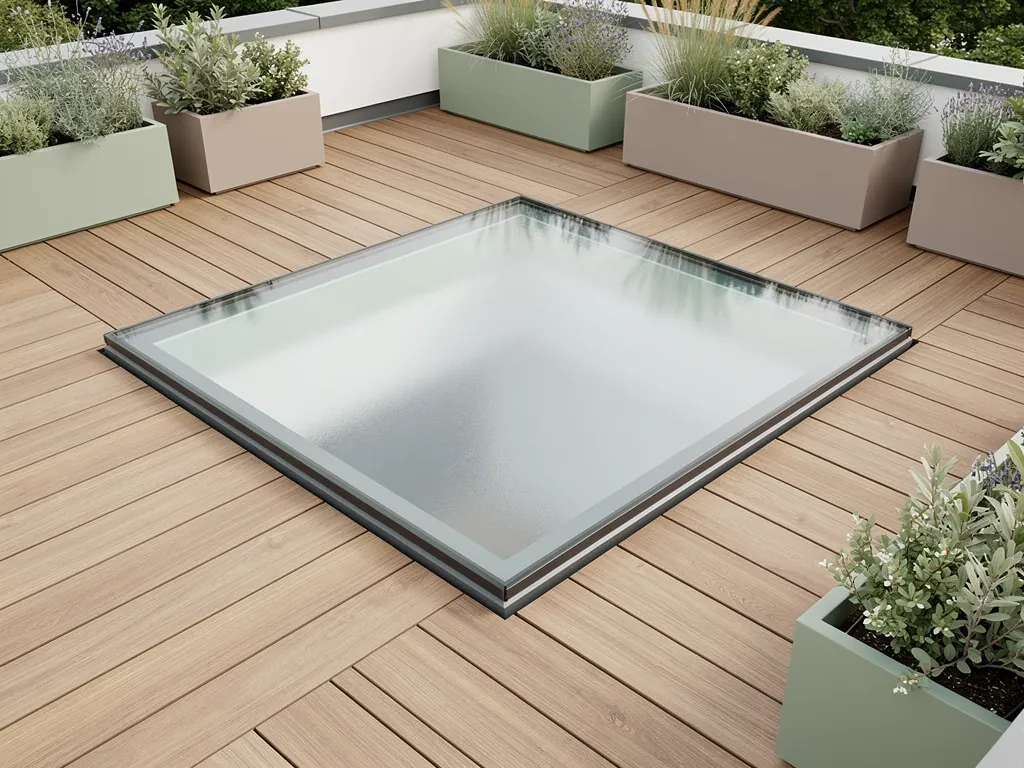
A roof terrace. Terraces see rain, frost, barbecue grease, pots and bare feet. A ceramic frit gives lasting grip that shrugs off cleaning, and it is the finish we reach for first. Where a parapet already casts shade across the glass, the loss of light to the pattern matters less. See also walk-on rooflights for roof terraces.
A basement light well. A light well is shaded, damp and often green with algae in its first winter. Grip matters here because the film that forms is slick. We lean towards a frit or a deeper texture, and we keep the pattern open, because light is scarce at the bottom of a well and every bit of clear glass counts. The guide to walk-on glass for basement light wells goes through the detail.
A flat roof that people seldom cross. A rooflight that is stepped on only for cleaning can carry a lighter finish. A light etch or a sparse frit is enough, and the room below keeps more of its daylight.
A glass floor inside the house. Indoors there is no rain, but there are socks, bare feet and polished soles. An etched or lightly blasted surface feels pleasant and diffuses the light between floors. Our guide to structural glass floor panels inside the home picks up the indoor case.
Frost, snow and heat on a textured pane
A textured surface changes how a pane behaves in cold and heat, and it is worth knowing what to expect before the first winter.
Frost forms on glass as thin ice, and ice on any surface is slippery, textured or not. A frit or blasted surface keeps some grip through a light frost, because the ice has to fill the texture before it becomes a sheet, but it will not make ice safe. Treat a frosted pane as you would a frosted paving slab. Our note on frost and snow on walk-on glass explains what to do and what to avoid, including which de-icers to keep away from the glass.
A dark ceramic frit also absorbs more sunshine than clear glass, which matters in July. On a south-facing terrace a dark pattern will feel warm under a bare foot, and a light grey or white pattern stays cooler. We talk through the colour choice with you, and the wider question is covered in whether walk-on glass gets hot underfoot.
A note on sound and footfall
Our brand is quiet light, so it is fair to ask whether a finish changes the noise in the room. The answer is that the finish matters far less than the build of the glass beneath it.
Footsteps on a walk-on rooflight reach the room as impact sound, and rain on a terrace pane reaches it as a tap or a patter. What softens both is the laminated build, the thickness of the panes, the interlayer and the way the pane is bedded on its seals and upstand. A textured face makes almost no difference to that chain. It can change the character of a patter slightly, since a rougher surface breaks up the drops, but a finish is chosen for grip and light, never for acoustic reasons.
The choice that matters for sound is written into the quiet spec that comes with every quote. The spec records the noise we heard at the survey and the glazing build we propose against it. For a bedroom below a terrace, it may well show a thicker laminated build. The guide on keeping the room below a walk-on rooflight quiet goes into it, and the overview lives on the quiet spec page.
Replacing slick glass with a proper finish
Some of the glass we are asked about is already in the roof. It is plain toughened glass, or an old finish that has gone smooth, and the household has started to feel uneasy stepping on it after rain. The right move is to replace the pane with one that has a fired finish from the start.
A replacement is usually a like-for-like swap of the glass unit, sometimes with a new set of seals, and the existing frame or kerb is kept when it is sound. We measure the opening and the bearing, check the fall on the terrace, and order a pane built to suit. Because the finish is part of the glass, the new pane is fitted in the same way as any other. You get a pane that grips for as long as the glass lasts. If the present pane is also misted or cracked, the wider story is on our misted and failed rooflight replacement page.
A new install is simpler still, because the finish is settled at the drawing stage. The walk-on rooflight installation hub sets out the whole job, from survey to made-good ceiling.
Questions people ask about grip on walk-on glass
These are the points that come up when a household chooses a finish.
Will a non slip walk on skylight be safe in every weather?
A good finish reduces the chance of slipping a great deal in rain and on damp mornings. It does not make a surface safe on ice, or under a layer of moss or oil. Keep the glass clean, and treat it with care in a hard frost.
Does the finish wear off over time?
A fired ceramic frit is part of the glass and lasts with it. Etching and sandblasting remove glass rather than adding a layer, so there is no coating to wear through. A surface film is the exception and will wear where people walk. Ask the supplier for the maintenance guidance for the specific finish.
Can I have a clear pane where I walk and a finished one elsewhere?
The other way round is the better plan. Put the finish where feet go and keep clear glass where they do not, so the room keeps its daylight. A single large pane can also carry a finish on only part of its area, for example a border or a set of bands, though the edges of any pattern need to be agreed before toughening.
Is a textured pane harder to clean?
A light frit or a fine etch cleans as easily as plain glass. A deep blast or a dense pattern holds more dirt and needs a soft brush as well as a cloth. Avoid abrasive pads, which can leave marks on the surface. Our note on whether walk-on glass scratches tells you what to use.
How do I start?
Send us the location and a few photos, or ask for a survey. We will bring finished samples, listen to the room, and put the finish, the glass build and the quiet spec on paper. Get a quote from the form on this page, or message us on WhatsApp.