Cleaning walk on glass is gentler work than people expect, and the method matters more than the muscle. The glass itself is tough, laminated and thick. The finish on its top face is the delicate part, and so is grit, which is the one thing that can turn a soft cloth into sandpaper. This guide covers the tools, the products, the order of work and the small habits that keep a walk on rooflight clear, grippy and quiet underfoot for the life of the installation. Whether it sits in a garden terrace, a flat roof deck, a basement light well or a hallway floor, the routine is the same.
Grit is the enemy, not dirt
Dirt sits on the glass. Grit gets ground into it. Every cleaning decision on a walk-on surface comes back to lifting the particles off before anything rubs across the pane.
Think about what lands on an outdoor rooflight. Fine sand blows in from paths and driveways. Brick dust drifts off neighbouring walls. Tile granules, leaf fragments and the dried residue of rainwater all collect in a film. Put a cloth on that film and drag it, and the hard particles in it act like a file. Glass is hard, but the surface treatment that gives it grip is not always as hard as the glass beneath, and a dull, hazy track is what drags leave behind.
So the order is always the same: loosen, flood, lift, then wash. A dry brush first, to move loose debris off the edges. Plenty of clean water second, so the particles float rather than scrape. Only then does a wash mitt or cloth touch the surface, and only with light pressure. If you remember one sentence from this page, make it that one.
The same thinking explains why a walk-on surface should not be treated like a car windscreen. A windscreen gets a wiper blade and a squeegee at speed. A walk-on pane carries an anti-slip treatment, and it is better served by slow, wet, soft contact. Our page on anti-slip finishes for walk-on glass explains what those treatments are made of and why they behave differently from plain glass.
The kit that belongs in the cupboard
A short list of soft, cheap tools does the whole job. Nothing on it needs to be specialist, and all of it is probably in the house already.
- A soft-bristled broom or a wide, soft brush, kept for glass and for nothing else, so it never carries concrete dust onto the pane.
- A hose with a spray head, or a watering can with a rose, for flooding the surface gently.
- Two buckets: one for wash water, one for rinsing the mitt.
- A microfibre wash mitt and a second, clean microfibre cloth for the final wipe.
- A rubber squeegee with a clean, intact blade, for clearing water off the open areas.
- A soft nylon brush on a pole, for reaching the centre of a larger pane from the edge.
- A kneeling mat, so you can reach the middle of a terrace panel without standing on wet glass.
Keep the brush and the mitt clean between uses. Rinse them, shake them out and store them off the ground. A mitt that has been dropped on a patio is now a grit carrier, and it is better swapped for a fresh one than trusted.
Leave wire wool, scouring pads, green kitchen scourers, razor blades and metal scrapers out of the cupboard entirely. They remove stuck-on marks, and they also remove the finish. Our answer on whether walk-on glass scratches goes into how a mark differs from a scratch, and why the tools above keep the surface looking as it did on the day it was fitted.
A routine that takes twenty minutes
The bulk of the work is the preparation. The washing itself is quick. This order works for a single terrace pane, and it scales up with more helpers for a larger deck.
Start with the surround
Before you touch the glass, clear the ground around it. Sweep the deck, the paving or the gravel border, and lift leaves out of the gutter channel or drainage gap at the edge. Anything that is left loose will be carried onto the pane by your own feet and by the rinse water.
Dry brush, then flood
Go over the glass with the soft broom, sweeping towards the drainage edge and not across the surface in circles. Then hose or pour clean water across the whole pane for long enough that you can see the film loosening. Patience here saves the finish later. If the glass is in direct sun, wait until the sun has moved or the area is shaded, because warm glass dries streaky and bakes cleaner into the surface.
Wash with a mitt, in straight lines
Fill one bucket with cool or lukewarm water and a small amount of a mild, neutral cleaner. Wet the mitt, squeeze it lightly and draw it across the pane in straight passes, rinsing it in the second bucket often. Straight lines make it easier to see what you have covered, and they push water towards the edge and not into the corners. Do not scrub at a spot. Let the cleaner sit on it for a minute, then pass over it again.
Rinse thoroughly, then dry
Rinse with clean water until no suds remain. Soap film that dries on the surface becomes tacky and collects the next round of dust. Squeegee the open areas lightly, working from the top of the fall to the bottom, and finish the edges with the dry microfibre cloth. A dried pane shows whether any marks remain, and it leaves the anti-slip treatment exposed and working, not sitting under a film of water.
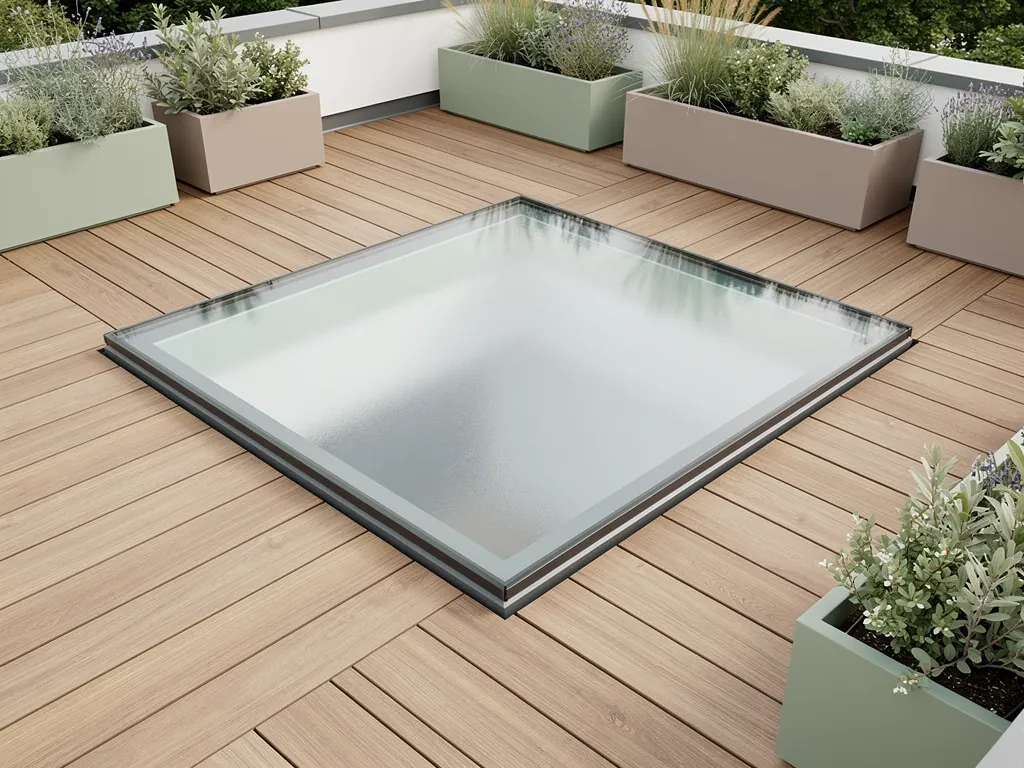
Choosing the cleaner
A walk-on pane needs a gentle cleaner with no abrasive particles and no strong solvents. The right product is often the plainest one on the shelf.
A few drops of a neutral washing-up liquid in a bucket of water will do the job for routine work. Commercial window cleaners that state they are suitable for coated or treated glass are also fine, and so are products sold for conservatory and rooflight glass. Two things matter: that the cleaner is non-abrasive, and that it rinses off completely.
| Product type | Suitable? | Reason |
|---|---|---|
| Neutral washing-up liquid | Yes | Gentle and easy to rinse |
| Glass cleaner, non-abrasive | Yes | Cuts film, leaves no residue |
| Cream cleaners and scouring powder | No | Contain hard particles |
| Bleach or strong descalers | No | Can mark sealants and finish |
| Solvents such as white spirit | Spot use only | Check the finish first |
| Household vinegar, diluted | Occasionally | Helps with hard-water film |
The edges deserve a thought. The glass sits in a frame or bed with a sealant line around it, and that line is part of the watertight detail. Harsh chemicals, especially chlorine-based products and some paint strippers, can soften or discolour it. If you have to use a stronger product on a stubborn stain, keep it off the edges, test it on a small area first and rinse straight away.
Pressure washers need special care. A narrow jet held close to the glass can drive water under edges and strip finishes, and it can blast grit across the surface at speed. A low-pressure garden hose with a spray head does what a pressure washer does without the risk. If a pressure washer is already part of your routine for the terrace, keep it well back from the glass and use a wide fan nozzle, never a zero-degree jet.
Moss, algae and the green film
Outdoor glass in a damp climate grows a green film sooner or later. It is usually algae, it forms where water sits, and it makes a wet pane more slippery than the finish alone would suggest.
Crawley and the wider Sussex Weald are a damp, leafy part of the country. Trees drop leaves, pollen and sap onto exposed roofs through the year, and a shaded terrace next to a hedge will stay damp for long stretches. Those are the conditions that let a film take hold, particularly along the lower edge of a pane and in the corners.
The answer is regular washing, plus shaping the surroundings so the glass is not the place where everything lands. Trimming an overhanging branch does more for a rooflight than any cleaner. Where a film has already formed, a soak with warm water and a neutral cleaner, left for ten minutes and then worked gently with the soft nylon brush, will usually lift it. Do not scrape it. If an algae treatment made for hard surfaces is used on the surrounding paving, rinse the glass well afterwards so no residue dries on it.
A slippery pane is a safety matter as well as a tidy one, which is why our answer on whether walk-on glass is slippery when wet is worth a read alongside this one. Clean glass with an intact finish grips. A green film over the top of it does not.
What winter asks of the surface
Frost, snow and de-icing products all have a bearing on how you clean a walk-on rooflight, and the trouble comes from shortcuts taken in a hurry on a cold morning.
Do not pour boiling water onto frozen glass. The sudden change in temperature puts stress on the pane and on the edge seals. Warm tap water is a safer choice, but patience is better still: frost on a walk-on pane usually lifts on its own once the day warms up. Do not chip at ice with a spade or a metal scraper. If a scraper is truly needed, a plastic one with a smooth edge moves ice without biting into the surface, and it should be used flat and lightly.
Rock salt and grit spread on a terrace are a particular hazard. The salt is corrosive to edge trims, and the gritty particles in spreading mixes are exactly the sort of thing that scratches a finish when someone walks over it. If the deck needs treating, keep the products off the glass, and brush any that strays onto it away with the soft broom before walking across. Our page on frost and snow on walk-on glass covers how the pane behaves in cold weather and what a safe approach looks like.
The underside: cleaning from inside and below
The lower face of the glass is protected from the weather, but it still needs attention, and the method is different because of where you are standing.
Seen from below, a walk-on rooflight is a ceiling rooflight, or in a floor application a clear panel over a room or a void. The inside face collects dust, cooking film in a kitchen and condensation marks in a bathroom or utility room. A damp microfibre cloth with a little glass cleaner is enough. Work from a stable step, use a long-handled extension pad where you cannot reach the centre, and never lean on the pane from below.
In a light well or a basement application, the space under the glass may be a shallow void that is not reachable from inside the room at all. Access routes differ from job to job, and we note how the glass can be reached for cleaning when we survey. For an internal panel set in a floor, the top surface is cleaned like any hard floor, but with a damp mop that has no abrasive strip on the head. Our guide to structural glass floor panels inside the home covers the specific points for indoor glass.
Check the glass from below from time to time. Look at the edges for a change in the seal line, and at the glass for anything that looks like a haze between the panes. A haze that moves as the light changes, or droplets that appear inside the unit and cannot be wiped off, are signs that the sealed unit has lost its seal. The answer is to replace the unit. That is a job for the misted and failed rooflight replacement service, and we write the glazing build and the seals into the spec so that the new unit suits the room.
Drainage, fall and the water that should leave
A walk-on rooflight on a flat roof or terrace depends on the fall around it. If water cannot leave, the glass stays wet, and every cleaning job is fighting a problem that was never about the glass.
Leaves and moss collect in the outlet, in the gap at the edge of a pane and along the low side of a flush frame. A blocked outlet leaves a shallow pond against the glass after rain, and the ponded area grows a film faster than the rest of the pane. When you clean, clear the outlet and run a little water down the fall to check it leaves freely. A flat roof is normally laid to a fall of 1:80 or better once built, and puddles that stay for a day or more after rain point to an area worth investigating. Our answer on whether a walk-on rooflight needs a drainage fall explains the reasoning.
Standing water also matters in another way. It is where hard-water scale forms, and scale leaves a white ring at the edge of a puddle. A little diluted vinegar on a soft cloth, left for a few minutes and rinsed off, lifts light scale. Test it on an out-of-the-way corner first, and keep it clear of sealant lines.
Looking after the anti-slip treatment
The finish on the top face is what makes the glass safe to stand on in wet shoes. Cleaning well means preserving it, so it is worth knowing what you are protecting.
Walk-on glass is commonly given its grip in one of a few ways: a fired ceramic frit pattern of small dots, an acid-etched or sandblasted texture, or a coating. Each wears differently. A fired frit is bonded into the surface and lasts well. An etched surface holds dirt in its texture, so it needs a little more rinsing. Patterned surfaces can trap fine grit in the gaps, and a soft nylon brush, used wet, frees that without harming the pattern.
Whatever the finish, do not wax it, polish it or apply a water-repellent treatment meant for vertical glass. Those products fill the texture that provides the grip. If a previous owner used one, or if the finish looks worn in a path across the pane, it is time to talk to us about renewing the glass or its treatment, and not to add another layer on top. Worn grip is something to renew properly, not something to disguise.
Look at the pane in low, raking light, which shows wear best. Low sun in the evening works well. A uniform, slightly matt appearance is healthy. Shiny, smooth lanes where people walk mean the pattern is wearing, and that is worth noting when you next talk to us.
What to keep off the glass
Good care includes the things you put on the pane between cleans. Weight, movement and trapped moisture all matter.
Plant pots with rough or wet bases, metal furniture feet, barbecue legs and paddling pools all hold grit against the finish or trap water under them. Terracotta pots are a common culprit, because the base stays damp and the clay sheds fine particles. If something does have to stand on the pane, the answer is a flat, soft pad under each foot and a regular lift-and-wipe. Our page on furniture and plant pots on a walk-on rooflight explains how to think about weight, pressure and what is sensible for your pane.
Hot items are a separate point. A barbecue, a chiminea or a fire bowl put heat into the pane, and a laminated unit with a cooler underside can be stressed by a sharp local temperature difference. Keep fire and hot cooking equipment off the glass altogether.
Keep paint, plaster, render and sealant off the pane when other trades are working nearby. Drips of wet render dry hard and are very difficult to remove without marking the surface. A sheet of plywood over the glass during building work, with a soft layer beneath it, costs little and saves a lot. Fresh splashes can be wiped away with a damp cloth straight away, before they set.
A simple calendar through the year
Cleaning on a rhythm is easier than cleaning in a rescue. The glass stays in better condition, and each visit is shorter.
| When | What to do | Why |
|---|---|---|
| Spring | Full wash, outlet clear, edge check | Clears winter film and leaf mulch |
| Summer | Brush and rinse after dust or pollen | Keeps the surface open |
| Autumn | Clear leaves, wash before the damp sets in | Stops algae taking hold |
| Winter | Brush off loose debris, warm water only | Protects seals and finish |
Busy terraces with trees close by may need the quick brush-and-rinse more often, and a sheltered, open roof may need far less. Let the glass tell you. If water sheets cleanly and the surface looks uniform, it is fine. If it beads unevenly or looks dull in patches, it is due a wash.
The quiet side of a clean pane
Care has a small effect on sound as well, and it is one owners rarely think about. Rain on a walk-on rooflight is a duller, softer sound than rain on a thin flat rooflight, because the laminated build of the pane damps it. That build is designed in at the start, and we write it into the quiet spec that comes with every quote.
The glass itself does not need maintenance to keep that quality. The seals around it are where attention goes. A firm, continuous seal keeps a room quieter than a tired, hardened or cracked one, and a rooflight with a good seal line and a settled upstand keeps wind whistle and drumming out of the room below. Looking at the edges each time you clean is the easiest way to spot a seal that has changed. Our page on keeping the room below a walk-on rooflight quiet explains what decides the sound in the room underneath.
If the seals or the finish have reached the end of their life, the answer is to renew them with the right specification, not to add a skim of something on top. A replacement glass unit or a renewed edge seal, fitted to current Building Regulations, is covered by our 10-year workmanship guarantee when we fit it.
Questions owners ask about washing walk-on glass
These come up once the pane has been through its first season, when a few marks, a dull patch or a slippery corner prompt a closer look.
Can I use a window-cleaning squeegee on a walk-on pane?
Yes, after the pane has been flooded and washed. A clean squeegee with an undamaged rubber blade clears water without touching the finish in any harmful way. Never drag it across a dry or gritty surface, and check the blade for nicks, because a nicked blade picks up particles and carries them.
Why does the glass look streaky after I have cleaned it?
Streaks are usually detergent left on the surface, or water that dried in sun. Rinse longer with clean water, clean on a cool, shaded day, and finish with a dry microfibre cloth. Hard water also leaves a film, and a diluted vinegar wipe followed by a rinse often clears it.
How do I clean a pane I cannot reach from the edge?
Use a soft nylon brush on an extension pole and a kneeling mat that spreads your weight. Do not crawl across wet glass, and do not lean on the pane from one side to reach the other. If the pane is too large to reach, tell us at the survey and we will note the access for the quote, or you can get a quote for a layout that is easier to keep clean.
Is it safe to walk on the glass while I clean it?
Laminated walk-on glass is made to carry people, and its build and load rating are designed for it. Wet, soapy glass is slippery, though, so kneel on a mat, wear clean, flat-soled shoes that have no stones in the tread, and rinse the soap away before standing up.
When you are ready to talk about a walk-on rooflight that is specified for light, for quiet and for ease of keeping clean, the walk-on rooflight installation page is the place to start.