A loft bedroom is the quietest room in the house for about six hours a night, and the noisiest for the rest of the morning. The roof window sits a metre or two above the pillow, at an angle that faces the sky, and whatever passes over or rains down lands on it first. This guide is about acoustic roof window glazing: the choices that make a loft bedroom window quieter at dawn, taken one layer at a time from the glass to the gasket around the sash. It stays with pitched roofs and sloping ceilings, where the details differ from a flat roof lantern. Nothing here relies on test numbers. Each choice is described by what it is, where it sits and what it does to the room.
Why a sloping window hears differently
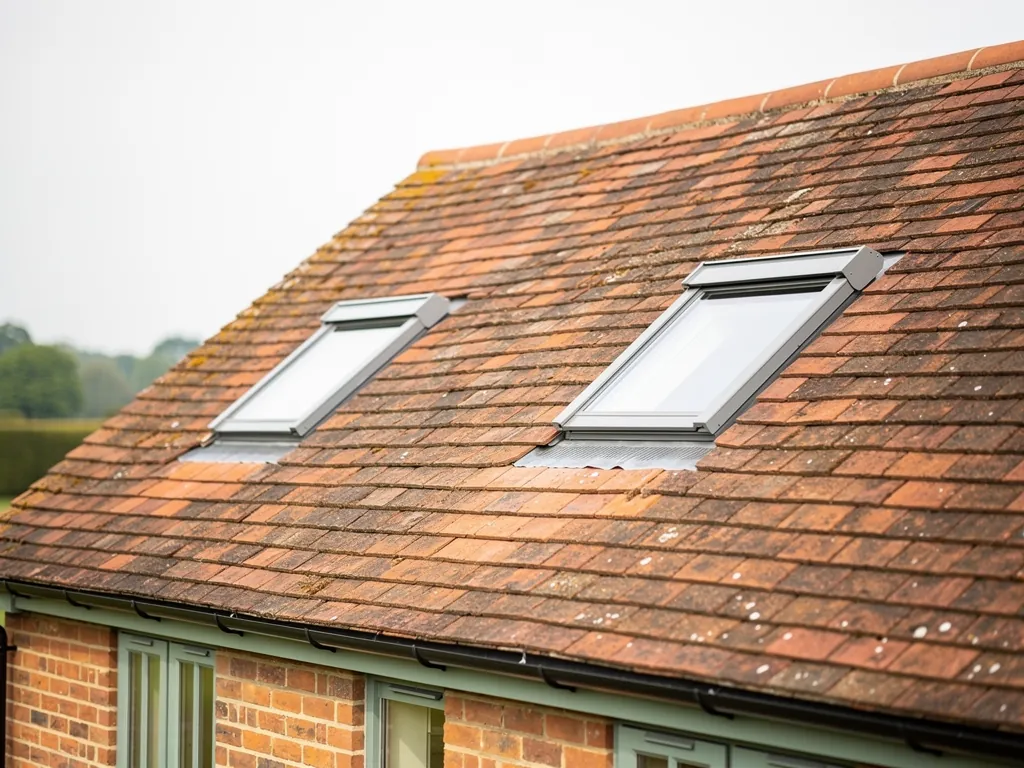
A roof window lies back at the angle of the roof, so it catches rain almost square on and looks straight up at the flight path. Those two facts explain what a loft bedroom hears.
A wall window is a vertical pane. Rain slides off it, and a passing aircraft reaches it from the side, at a glancing angle. A roof window at a pitch of 35 or 40 degrees takes each drop at something close to a right angle. The pane is also large and thin compared with the roof around it. Tiles or slates are heavy, bedded on battens, with a loft void behind them that soaks up a good deal of sound. A sheet of glass has none of that. It is the lightest part of the roof by a long way, so it is the part the room hears.
The bed matters too. In most loft conversions the bed sits under the lowest part of the slope, and the window is beside or above it. You are lying a short distance from the glass with nothing in between. In a ground floor room, a pane across the room is a distant surface. Here it is almost a lid. That closeness is why the same unit that seems fine over a landing or a study can feel too lively in a bedroom.
The honest starting point is to decide what the room has to hear less of. Rain, road and rail, and aircraft each ask slightly different things of the build. Crawley has all three: Gatwick inside the borough, the A23, the M23 and the Brighton main line, and the ordinary weather of the Weald. The survey is where we listen and write down which of them belongs to your room. The sections below work through the parts in the order sound meets them.
The outer pane is the first thing the weather touches
Before the inner pane does anything, the outer one takes the raindrops, the wind and the first pass of noise. Its thickness and the way it is fixed decide how much ringing there is to damp later.
On most roof windows the outer pane is toughened glass. It has to be, for strength against hail, a branch or a dropped slate. Toughened glass is stiff, and stiff glass rings when struck. A thin outer pane in a wide sash rings more readily than a thicker one in a small sash, in the same way a large drum skin rings more than a small one. So the first two questions on glazing are simply how thick the outer sheet is, and how big the sash is that it has to span.
Sash size is a design choice as well as an acoustic one. If a bedroom is going to have two roof windows, two smaller panes each carry less area than one large one. They also sit on either side of a rafter, which is a solid, damped, wooden line, rather than hanging from a single wide frame. We cover the layout side in stacked and side-by-side roof window combinations and the dimensions in standard roof window sizes and rafter spacing. The quiet argument is one more reason to look at the size before choosing the product.
Some manufacturers offer an outer pane with a coating that helps water sheet off, or a thicker sheet specified for noise. Those are product options, not generic upgrades, and they come with the data sheet for that named unit. We read the sheet for the product on the quote, and we write the glass build into the spec by thickness and type.
The inner pane does the damping
The inner sheet faces the bedroom. On a roof window it is almost always laminated already, because a pane overhead must hold together if it breaks. Acoustic glazing asks one more question: which interlayer is inside it.
The full construction of acoustic laminated glass has its own guide. Here the question is narrower: what does the inner pane have to do in a roof window, and what makes it different from the same pane in a wall?
First, it has to be safe. Laminated glass stays in the frame if cracked. That is the baseline for a bedroom roof window and is not a quiet feature. Second, it can be made to damp as well, by using an acoustic interlayer in place of the standard one. That is the upgrade, and it adds weight, not gloom. Third, the two sheets in the laminate can be different thicknesses. An uneven pair works against a shared ringing pitch more effectively than two equal sheets, which is one reason acoustic laminates are so often built with a thicker and a thinner sheet.
Whether this matters for your bedroom is the subject of a shorter answer: should a loft bedroom roof window have laminated glass. The safety laminate is normal, and the acoustic film is a choice made after listening.
The gap between the panes, and why unlike panes beat matching ones
Two panes of the same thickness, separated by a sealed gap, tend to ring at the same pitch. Making them different is one of the cheapest ways to quieten a roof window, because it costs almost nothing in light.
Think of two identical tuning forks. Strike one, and the other starts to hum. Two panes with the same thickness behave in a similar way. Each one passes the noise that the other also passes. Change the thickness of one, and they no longer hum together. The sealed cavity between them still gives the path a change of medium, from glass to gas to glass, and each change drags a little more energy out of the sound.
In practice this means three things on a bedroom roof window:
- An outer toughened pane and an inner laminated pane are already different kinds of glass, which helps without anyone asking.
- Where a manufacturer offers a thicker outer pane as an option, it makes the pair more different still.
- A wider cavity can help with the lower range of sound. It is limited by the depth of the frame and the thermal build, so it is never a free choice.
The thermal side of the glass is a separate conversation. A low-emissivity coating and a warm edge spacer keep heat in and condensation off, and they sit comfortably beside an acoustic build. The position of the coating and the order of the panes are set together. If you are also weighing warmth, the page on energy efficient rooflights covers that side, and why a roof window gets condensation on the inside explains what a failing spacer looks like.
The seals around the sash decide whether the glass gets a fair chance
A roof window is a moving part in a fixed roof. Between the sash and the frame there is a seal, and on a bedroom window that gasket does as much work as the glass.
Sound is indifferent to glass quality. It takes the easiest route into a room. A hairline gap around a sash is a much easier route than a laminated pane. When a window closes against a gasket, the gasket has to compress evenly all the way round. If the sash has dropped a little on its hinges, or the gasket has hardened and lost its spring, there will be a stretch where it does not quite touch. You can often find that stretch by feel, on a windy morning, with the back of your hand.
This is the reason a new acoustic pane dropped into an old, worn frame disappoints. The glass is better, and the room still hears the same noise through the same gap. When a whole unit is replaced, the sash, the gaskets and the glass arrive together and are set square in the frame. Where new glass is proposed for a tired unit, we say at the survey that the seals will have aged at the same rate as the glass, and usually the sensible course is a new unit.
A few things to check at home before you talk to anyone:
- Does the sash sit flush in the frame when closed, or can you see light at a corner?
- Is the gasket soft and springy, or is it hard, cracked or flattened?
- Does the handle pull the sash in firmly, or does it close without resistance?
- Can you hear the window rattle on a breezy night?
A rattle tells you the sash is not held tightly, which is usually a hardware or seal issue, not a glass one. A unit that has reached that point is better renewed, and misted and failed rooflight replacement sets out how we approach that.
The flashing, the frame and the rafters
A roof window is bedded into the roof with flashing, insulation and a frame fixed to the rafters. All of that is solid material, and how it is fitted decides whether it carries sound or blocks it.
The flashing is the metal or flexible dressing that joins the window frame to the tiles or slates. On a bedroom window it does two quiet jobs. It holds the roof covering tight against the frame, so the tiles do not chatter in the wind. And it is bedded so that rain running down the flashing drains away silently, rather than dripping onto a hollow surface. Tight, well-supported flashing on a window set in a tiled roof is quiet. Loose or thin flashing buzzes in a gale. The detail for each roof covering is set out in roof window flashings for tiles and slates and, for the tile case in particular, how a roof window is fitted into a tiled roof.
The frame is fixed to the rafters, and the rafters around it are trimmed or left alone depending on the window width. A frame screwed firmly to a rafter on both sides passes less vibration than one held by a single fixing and a bead of sealant. There is a practical choice between fitting between rafters and trimming the rafters, and the structural answer comes before the acoustic one. Where both routes are sound, we choose the one that gives the frame the firmest, most continuous fixing.
Around the frame there is an insulation collar. It is partly there to stop cold bridging and partly to fill the gap between frame and roof structure. Filling it fully, with no voids, removes another small route for sound from the loft void into the room. A collar pushed in carelessly leaves gaps, and gaps carry more than they should.
The lining and the ceiling reveal, inside the room
The last barrier between the window and the pillow is the lining, the boxed reveal that runs from the frame to the plasterboard. It is often treated as decoration. It also decides whether the loft void has a route into the room.
The lining is a short tunnel of board between the window and the sloping ceiling. If its joints are open and its edges are not sealed to the plasterboard, air and sound move freely behind it. A window that has been well specified outside can be undone by a lining that is loosely fitted inside. We seal the joints and the board edges, and we finish the reveal in a solid material. The detail is in roof window linings and making good the reveal.
The height of the window is part of this too. A window set low in a sloping ceiling brings the glass closer to the bed. A window set a little higher leaves more wall and roof between the pillow and the pane. The trade is between light, comfort when standing and how close the sleeper lies to the glass, and we describe the method in setting the height of a roof window in a sloping ceiling.
Inside the room, hard, flat, parallel surfaces bounce sound around. A bedroom in a loft usually has a sloped ceiling, a few short walls and a bed, so there is not much soft furnishing to soak up echo. A blind, curtains and a rug all help the room feel calmer, because they calm the echo inside, though they do little to stop sound entering through the glass. That difference is worth remembering when comparing ideas, because some quiet ideas change the room, and others change the window.
Which part answers which noise
Each kind of noise gets past the window by a different route, and each part of the build answers a different route. The table below matches the two up for a loft bedroom.
| What you hear | Usual route in | What helps most | Where it sits |
|---|---|---|---|
| Rain at dawn | Drops ring the outer pane | Thicker outer sheet, damped inner laminate | The glass |
| Road and rail | Hiss through pane and seals | Unlike panes, tight sash seals | Glass and gaskets |
| Aircraft overhead | Roof and window together | Whole build, frame and lining too | Everything |
| Wind buzz or rattle | Loose sash or flashing | New gasket, secure flashing | Seals and dressing |
| Echo in the room | Hard surfaces inside | Blind, soft furnishing | The room |
The rain row has its own page, are roof windows noisy in the rain, which goes through the sound of a shower on a roof window and what is normal. The aircraft row is the hardest, and it is worth reading slowly.
Aircraft, and the limits of any glazing choice
Gatwick is inside the borough, and a loft bedroom can hear a departure clearly. Glazing helps with part of that sound, and it cannot remove all of it.
Jet noise is not one sound. There is a mid-range hiss that a damped inner pane handles reasonably well. There is also a lower rumble, which shakes larger things than a pane: the rafters, the ceiling, the whole roof. A window does not stop a rumble that is moving the house. What the window can do is avoid adding to it. A window with loose seals, a thin lining and a hollow frame turns a rumble into a rattle and a buzz, and those are the parts of aircraft noise that wake people.
That is the reason we talk about the whole build rather than one upgrade. A laminated acoustic inner pane, a firm frame, tight seals, a filled collar and a sealed lining each take a small share of the job, and together they leave a room that feels settled. It will not feel silent, and a rooflight has never been a wall. The aim is that the sky is part of the room's atmosphere, and not an event.
The position of the window also matters. A window on the slope facing the flight path hears more than a window on the back slope. Where the roof allows, putting the opening on the sheltered side can do more than any amount of glass. That is a design decision to raise at the survey, and roof pitch and roof windows explains how the angle of the slope changes what a window can do.
Opening the window, and the quiet you lose when you do
A roof window that opens lets fresh air into the bedroom and lets noise in with it. The glazing only works when the sash is shut, so ventilation has to be planned around that.
A loft bedroom owner often wants the room quiet and cool at the same time, and those aims pull against each other. Opening the sash for summer nights gives up the acoustic build altogether. There are quieter ways of doing it. A trickle vent in the frame lets in a controlled flow of air through a small opening, at less cost to the quiet than a sash left wide. Whether a window needs one is set out in do roof windows need trickle vents. A window that opens on a motor can be set to a small ajar position for airing, then closed on a timer, and the options are in our electric and opening rooflight installation hub.
Part F of the Building Regulations covers ventilation, and on a room conversion it may require a minimum background ventilation rate. The survey checks this against the room and its use. We install to current Building Regulations, and we handle the Building Control notification where the work is notifiable. Part K sets the safety requirement for glazing in certain positions, and Part L covers the thermal performance of the whole unit. The glass choice sits within all three.
The way the window opens is also relevant. A top-hung sash opens outward at the bottom, a centre-pivot turns through the middle, and the two differ in how the gaskets close and in how they respond to rain when open. The page on centre-pivot or top-hung roof windows goes through that.
Deciding what to specify for your loft
A sensible acoustic specification for a loft bedroom starts from the room. It names the noise, then chooses the smallest set of changes that answers it.
For a bedroom on a quiet road, away from the flight path, the baseline is usually enough. A laminated inner pane for safety, a good gasket, a firm frame and a sealed lining give a calm room. Adding the acoustic film is a modest step that costs little in light.
For a bedroom near the A23 or the railway, the glass and the seals matter more, and the two panes should be chosen to be unlike each other. We write the thickness of each sheet into the spec.
For a bedroom under a departure route, the whole chain counts, including the window position, the height and the lining. We tell you plainly at the survey what the glazing can do, and what the roof will still let through.
In each case the decision is written into the quiet spec that comes with the quote. It names the noise heard at the survey, the glazing build, the seals and the finish around the frame. Because it is written down, you can compare it line by line with any other quote, and our page on the quiet spec shows how it is laid out. If you are choosing between a window and a dormer for the conversion, the quiet question belongs in that decision as well, and should you choose a roof window or a dormer weighs the two. For the wider set of choices in a conversion, see choosing roof windows for a loft conversion.
Ready to have the room listened to? Use the quote form on this page, or send a message on WhatsApp. The roof window work as a whole is set out on the roof window installation hub.
Questions about glazing for a quiet loft bedroom
These are the points that come up when someone is choosing between a standard roof window and an acoustic build for a room they sleep in.
Can the glass alone make a loft bedroom quiet?
Not on its own. The glass is one link in a chain that includes the sash seals, the frame fixing, the flashing and the lining. A very good pane in a loose frame leaves the room hearing nearly what it heard before. We specify the parts together so none of them lets the others down.
Will acoustic glazing make the bedroom darker?
Very little. A clear acoustic laminate takes a touch more light than a plain sheet, and far less than a tint or a strong solar coating. Daylight is still the point of the window, and the build is chosen so the room stays bright.
Is a blind worth having for quiet?
A blind helps the room feel softer by calming echo, and a blackout blind helps sleep in a bright dawn. It does not stop sound coming through the glass. The range is covered in blinds for roof windows, and the nursery case, where light and quiet both matter, is in what blind suits a roof window in a nursery.
Does the brand of window change how quiet it is?
The product does, because the glazing options, the gaskets and the frame all differ between ranges. We compare products on their published data, and we say which one suits which room in the written spec. The plain comparison is in comparing roof window brands without the sales talk.