Rooflight and skylight are two names for glazing set into a roof, and a quote can use either without meaning anything different by it. The words do carry habits, though. "Skylight" is the everyday word, the one people type into a search box and use across the kitchen table. "Rooflight" is the word builders, architects and the Building Regulations reach for. Once you know which habit sits behind which name, a quote from any installer reads clearly, and the real differences between products stop hiding behind the vocabulary. This guide sorts the two words out, then moves on to the terms that actually matter: fixed or opening, pitched or flat, glass or plastic, and how each one sounds in the room below.
One hole in the roof, two words for it
There is no technical line in law or in the trade that separates a rooflight from a skylight. Both words describe a glazed unit that lets daylight in through the roof instead of through a wall.
The split is one of usage. In Britain, skylight is the word used in conversation. It is short and plain. It is also the word used across the Atlantic, so a great deal of online material, from product listings to video tutorials, says skylight whatever the roof is made of.
Rooflight is the word on drawings. Structural engineers write it on calculations, architects label it on elevations, and the Approved Documents use it when they talk about glazed areas in the roof. A builder who says "we will need a rooflight over the stairs" and a homeowner who says "I would like a skylight over the stairs" are asking for the same opening in the same rafters.
That is why this site uses both words. We install the glass, the frame and the upstand, and we write the quote in whichever term you used when you first got in touch. If you would like to move straight to the practical side, our guide on how to choose a rooflight for your home picks up where the naming ends.
Where each word tends to turn up
The two words cluster in different places, and recognising the pattern saves a great deal of confusion when you compare written quotes.
On a pitched roof, the ordinary word is skylight. The unit sits in the plane of the tiles, it is usually hinged or pivoting so you can open it, and people know it by a brand name. On a flat roof, over a kitchen extension or a hallway, the trade word is rooflight. It is typically a fixed pane or a lantern, it sits on a kerb, and the person describing it is often the builder or the architect rather than the owner.
Those habits overlap constantly. A flat-roof glass box gets called a skylight by its owner. A pitched-roof window gets called a rooflight on a planning drawing. Neither is wrong. The table sets out tendencies, not rules.
| Situation | Word you may hear | Usually means |
|---|---|---|
| Chat with a neighbour | Skylight | Any glazing in a roof |
| Architect's drawing | Rooflight | A glazed unit, often fixed, often flat |
| Loft conversion quote | Either, or a brand name | An opening window in the slope |
| Extension quote | Rooflight or lantern | Glass on a kerb over a flat roof |
| Building Regulations | Rooflight | Glazing counted in the roof area |
What the quote is really describing
When the vocabulary is set aside, every roof glazing quote answers the same handful of questions. Read for those and the choice of word stops mattering.
Start with the roof it goes into. A pitched roof takes a unit that is set between rafters and flashed into the tiles or slates. A flat roof takes a unit that stands on an upstand, which is a raised kerb of timber or insulated composite that the waterproof membrane is turned up against. Those are different jobs with different materials, and the job decides the product more than the name does.
Next comes the way it moves. Some units are fixed and never open. Some open by hand with a pole or a handle. Some open by motor, with a rain sensor that closes them when a shower starts. A fixed unit is simpler and has fewer parts to wear. An opening one lets out the warm air that gathers at the ceiling in summer.
Then look at the glazing. This is where the real differences in comfort sit, and it gets its own chapter below. Finally, check the size and finish: external dimensions, structural opening, frame colour, and whether the plasterboard returns inside are included in the price.
If a quote says only "skylight, supply and fit" with no more detail than that, the gap is in the specification, not in the wording. Our page on what a rooflight quote should include lists the lines to look for.
Pitched, flat and in between
The roof's angle sorts products into families far more reliably than the word on the quote. Knowing the families shows you which question to ask first.
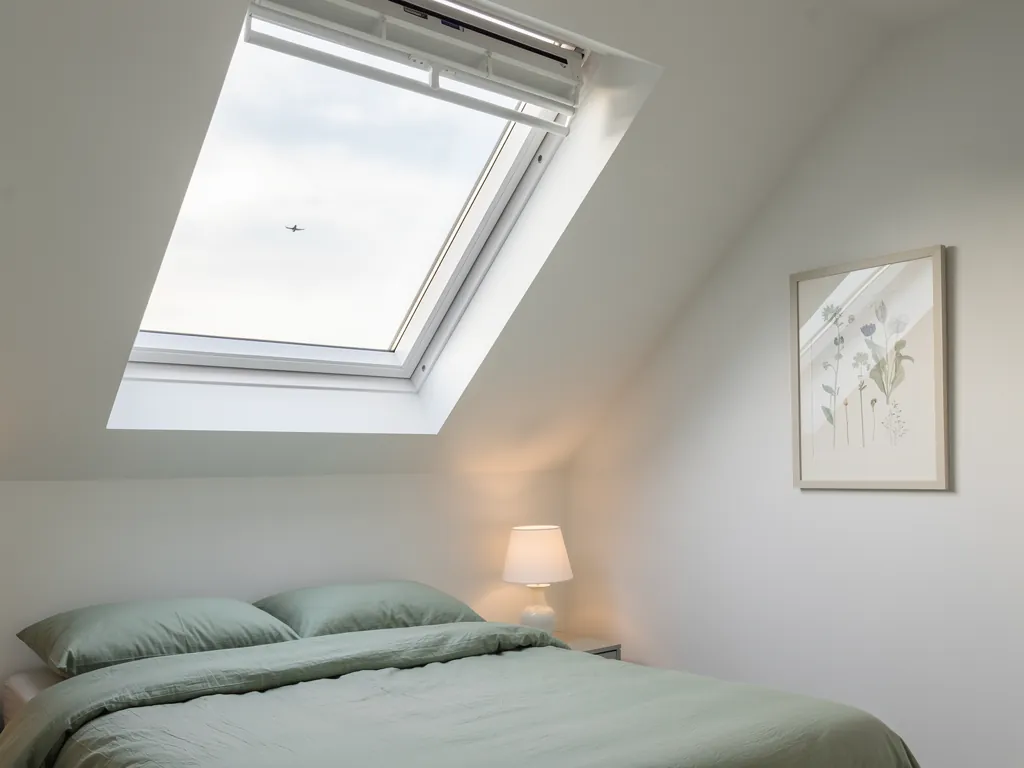
A roof window is a framed, opening unit built for a pitched roof, which is what people picture when they say skylight. The frame sits in the plane of the roof covering, and a dedicated flashing kit keeps the water running over the top of it. We cover that family at roof window installation, and the best-known brand has its own page at VELUX window installation.
A flat rooflight is a glass or polycarbonate unit on a kerb, with a very slight slope in the glass itself so that water runs off. It might be a single-pane fixed unit, a rectangular opening unit, or a larger walk-on panel. The details live on the flat roof rooflight installation page.
A roof lantern is the taller cousin. It rises above the roof in a pitched, glazed shape, with a ridge along the top and glazing bars down the sides, and it lights a room from several angles at once. It has its own page at roof lantern installation.
A fourth group sits apart from the rest. A sun tunnel carries daylight down a reflective tube from a small dome on the roof to a ceiling diffuser, and suits a landing or bathroom where a full window would be too much. It is usually the piece people mean when they say "a little skylight for the hall", and the service page is at sun tunnel installation.
Glass, plastic and what sits between the panes
The glazing matters more than the word on the quote, because it decides how the room feels on a cold morning, on a hot afternoon and in the rain.
Older units, particularly the domed ones common on flat roofs, are often a single or double skin of acrylic or polycarbonate. They are light, they are cheap to make, and they let in daylight well. They also flex in the wind, they scratch and yellow with age, and a thin plastic skin does little to slow sound or heat. If you are looking at one and wondering whether glass would be better, our answer page on replacing a plastic dome skylight with glass covers what changes.
Modern glass units are sealed double glazed units, sometimes triple, with a low-emissivity coating on one pane and a warm-edge spacer around the gap. Approved Document L sets how much heat a replacement or new unit may lose, and the detail is explained in building regulations for rooflights. The inner pane is often toughened or laminated for safety, because broken glass above a head needs to stay in place.
That last point is where the glazing becomes useful for more than safety. Laminated glass has a plastic interlayer bonded between two sheets of glass. On an ordinary unit it is chosen to hold together if it breaks. On one of ours, the thickness of each sheet, the thickness of the interlayer and the width of the cavity can be chosen for sound too, so the inner pane does two jobs. Our explanation of acoustic laminated glass for rooflights goes through the build layer by layer.
Why the choice of name does not change the sound
A roof is the thinnest part of most houses, and any glass set into it will let in more noise than a wall does. That is true of a skylight and a rooflight alike, and it is true whichever word the quote uses.
What you hear depends on the glazing build, the seals around the opening and the way the unit sits in its upstand. Rain on a flat rooflight drums because the pane is large, horizontal and close to the ceiling. Aircraft on the Gatwick routes carry into a loft room because the slope faces the sky and the room under it is small and quiet. A loft bedroom near the A23 picks up traffic because nothing in the garden stands between the glass and the road.
Each of those has a specification answer, and none of them is the word on the paperwork. A laminated inner pane, a wider cavity, well-fitted seals and a proper upstand do more than any label. We describe how those choices fit together in what goes into a quiet rooflight specification, and every quote we write comes with a one-page note for the room, set out in the quiet spec.
Planning, Building Regulations and the word rooflight
The regulations use the word rooflight, so it helps to know where it appears. Nothing in them changes depending on which word you used when you asked for the work.
For planning, a rooflight on a dwelling house is often allowed under permitted development. On a pitched roof the general condition is that the unit must not stand proud of the roof plane by more than 150 millimetres, and on the side facing the road there are extra limits. Flats, listed buildings and homes in conservation areas follow different rules. Our page on planning permission for rooflights and skylights goes through the cases, and can I add a rooflight under permitted development gives the short answer.
For Building Regulations, the glazing is counted as part of the roof, and the thermal rules in Part L apply to both new units and replacements. Structural changes come under Part A, fire under Part B, ventilation under Part F, and the safety of glazing you can reach or fall through under Part K. Where the work is notifiable, we handle the Building Control notification. The page does a new rooflight need Building Control sign-off explains when that applies.
Reading a quote without the jargon
Once the two names are treated as the same thing, a quote breaks into parts you can compare. Each part has a plain meaning, and we write ours in the same order so you can set two side by side.
The first line names the product and its position: which room, which roof, and whether it replaces an existing unit or forms a new opening. The second gives the size, ideally with both the outside dimensions and the clear opening. The third describes the glazing build, including the inner pane and the coating. The fourth covers the frame and seals, and whether the unit opens. The fifth states what is done inside the room, which means the lining, the plaster returns and the decoration. The last notes what is left to you, and the guarantee that stands behind the job. Ours is ten years on workmanship, set out on our guarantee page.
- Product, room and roof type.
- External size and structural opening.
- Glazing build and inner pane.
- Frame, seals and any motor or sensor.
- Making good inside, and the guarantee.
If one quote uses the word skylight and another uses rooflight, read only the list. Two quotes that both cover every line can be compared fairly. A quote that skips the glazing build or the inner finish has left the hardest decisions for later, and they tend to arrive as extras on the day.
The question of cost comes up straight away at this stage, and the answer rests on the same lines. Our rooflight and skylight costs page explains what moves the figure in each direction.
Replacing an old unit: which word to use on the phone
Some enquiries start from a unit already in the roof. It may be misted, it may be loose in its frame or it may simply be too small. The word you use to describe it makes no difference to the survey.
What helps is a plain description. Say which room it is in, roughly how big it is, whether it opens and what the roof looks like from the garden. A photograph from inside and one from outside tell us more than a name ever could. From that we can tell whether a like-for-like swap works or whether the opening needs altering. The thinking behind that decision is laid out in replacing an old skylight: like for like or a better unit.
A misted double glazed unit, for instance, has a failed seal in the glazing, and the answer is a new unit. The service page for misted and failed rooflight replacement explains what that looks like, and signs a rooflight has failed shows what to check at home.
To start, send a photograph and a few words through the quote form, or message us on WhatsApp.
Which name to use, and what the word really asks for
Short answers to the questions the two words tend to raise at the start of a project.
Is a rooflight bigger than a skylight?
No. Size has nothing to do with the name. A small hinged unit in a loft and a large fixed unit over a kitchen are both skylights and both rooflights. What separates products is the roof they sit on, the glass in them and whether they open.
Does a rooflight cost more than a skylight?
The name does not set the price. The size, the glazing build, the roof structure and any motor do. Two units of the same size can sit a long way apart once acoustic glass, a tall upstand or a rain sensor is added.
Is a roof lantern a type of skylight?
Yes. A lantern is a raised, pitched glass structure on a flat roof. It is a rooflight in the trade sense and a skylight in the everyday one. If you are weighing it against a flat unit, should I choose a skylight or a roof lantern sets the two side by side.
What is the difference between a rooflight and a roof window?
A roof window is a framed opening unit for a pitched roof. It falls under the wider term rooflight, but a rooflight can also be a fixed pane on a flat roof. The page what is the difference between a rooflight and a roof window goes into the detail.
Which word should I search for?
Both. Installers, manufacturers and councils use them interchangeably, so a search for one word alone can miss half the useful pages. The full picture of what we install sits on our skylight and rooflight installation home page.