Replacing an old skylight is the one moment in the life of a roof opening when every decision is open again. The hole already exists, the access is already planned, and the ceiling is about to be disturbed either way. That makes it the cheapest chance you will get to change what the glass is made of, how it is sealed and how it sounds in rain. Most people ask the narrow question first: can you fit the same size as before? Usually you can. The better question is what the old unit got wrong, and whether a like for like swap would simply hand you the same problem for another twenty years. This guide sets out how to decide. It covers what to measure, what to change and what to leave alone, and how a rooflight that is replaced today should differ from the one that went in decades ago.
The opening stays, the build does not have to
A replacement reuses the hole in your roof, not the decisions made when it was first cut. Those decisions were often made for a catalogue price, on a day when nobody stood in the room and listened.
Think of a skylight as four layers that can be changed separately: the glass, the frame, the seal where the frame meets the roof, and the kerb or upstand underneath. A plain swap changes the first two and hopes for the best on the rest. A considered replacement looks at all four. The glass might move from a single pane or a thin sealed unit to a laminated inner pane. The frame might change material. The upstand might be rebuilt a little taller and better insulated, so the waterproofing turns up it cleanly.
None of this means the opening has to grow or the room has to change. Often the footprint stays exactly as it was, the plaster reveals stay where they are and the only visible difference is a clearer, calmer piece of glass. What changes is what happens at six in the morning when a plane passes or when a storm sits over the roof.
Reading what the old unit is telling you
Before choosing a replacement, spend ten minutes with the old one. It has been testing its own design for years, and the marks it has left are the most honest brief you will get.
Start inside. Look at the ceiling reveal and the lining around the opening for stains, flaking paint or dark spots that return after cleaning. Those point to condensation or to moisture getting in at the edge of the frame, and they tell us the upstand or the seal deserves attention as well as the glass. Run a hand along the frame on a cold morning. If it is wet or icy, the frame is acting as a cold bridge and the new one needs a better thermal break.
Look at the glass itself. Fogging between two panes means the sealed unit has failed, which is covered in signs a rooflight has failed. Crazing or yellowing in a plastic dome is age in the material, and it is not something to work around. A hairline crack, a rattling sash or a handle that no longer pulls the window shut tight all point the same way: the unit has reached the end of its useful life and needs renewing.
Then listen. Sit under it in the next heavy shower and note whether the noise is a sharp patter, a low drum or a rattle in the frame. Do the same when an aircraft passes over, where that is part of your day. Each sound has a different cause, and each points to a different part of the build. Our page on when to replace a rooflight covers the point at which waiting stops being sensible.
Like for like: when matching the old unit is the right call
Matching is a good plan when the old unit worked and only its age has caught up with it. A like for like replacement is quick, tidy and keeps the ceiling and roof details untouched.
It suits a house where the rooflight sits over a landing or a bathroom, where noise has never mattered and the room is used briefly. It suits a roof window set into a pitched slope that is otherwise in good order, where the flashing kit and the surrounding tiles are sound and the new unit slides into the space the old one left. It also suits a rooflight that sits within a planning condition or a conservation setting, where the look of the existing one is part of what the house is allowed to keep. In that case the aim is to match the outside and improve the inside, and the page on conservation rooflight installation explains how those two goals sit together.
There is a trap in matching, though. Replacing a unit with the same specification often means replacing it with a product the manufacturer no longer makes, or one that has been revised. Sizes drift by a few millimetres. Flashing kits change. A good survey measures the opening rather than trusting the label on the old frame, and a like for like swap should still be written down as a specification, so you know exactly what is going in and what it is made of.
The standard of the fitting also matters more than the product. A well-fitted unit of the same type will outperform a newer one set badly into a tired upstand. That is why we look at the kerb before we talk about glass.
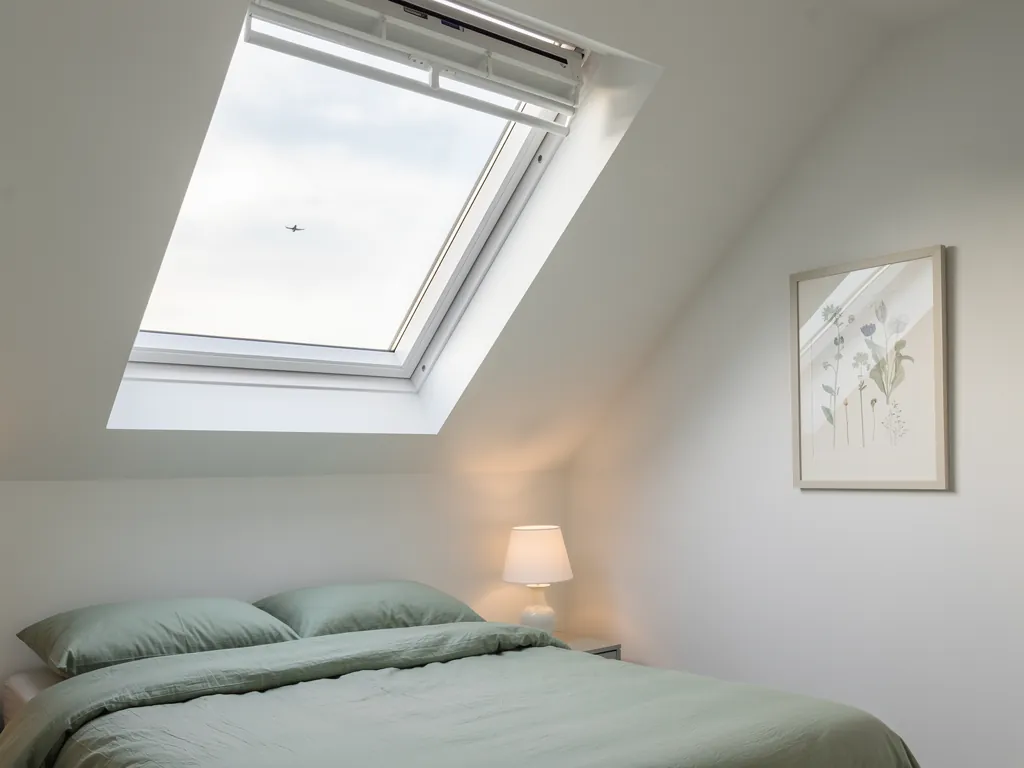
A better unit: what is worth upgrading
An upgrade earns its place when the old unit let you down in a way you can name. Changing the build for the sake of it adds cost and no benefit, so it helps to connect each change to a fault you noticed.
The table below links common complaints to the part of the build that usually answers them. It is a guide to the conversation, and the actual choice is made at the survey against the real room.
| What you noticed | Likely cause | What to change | Read |
|---|---|---|---|
| Rain drumming | Thin glass, flat area | Laminated inner pane | Rain noise |
| Aircraft overhead | Light glass, loose seals | Acoustic laminate, new seals | Gatwick routes |
| Cold frame, damp reveal | Cold bridge | Thermal break, insulated upstand | Efficient units |
| Fogged panes | Failed sealed unit | New unit, check the kerb | Failed units |
| Glare or heat | Wrong glass for aspect | Solar control coating | Choosing |
| Yellowed plastic dome | Ageing material | Glass unit, new kerb | Dome to glass |
Notice that most of the answers sit in the glass and the seal, and they add little to the job when the unit is being replaced anyway. The same changes made later, to a unit that is already installed, would mean lifting it out a second time.
Sound is the part a swap usually forgets
Older skylights were rarely chosen with sound in mind. A roof is the thinnest, lightest part of most homes, and a single thin pane or a plastic dome gives a room very little to hold back rain or aircraft.
The answer is a matter of specification. Laminated glass has a thin interlayer bonded between two sheets. That layer damps the vibration that thin, stiff glass passes straight into the room, so the same rainfall feels softer. A thicker outer pane with a different thickness on the inner side helps too, because two panes of identical thickness tend to ring at the same pitch. The cavity between them, the seals around the sash and the way the frame is fixed to the kerb all play a part. Our page on acoustic laminated glass sets out how the build works, and whether laminated glass is quieter than toughened answers the common follow-up.
It helps to know what does not work as well as people hope. A third pane adds weight and thermal performance, but it does not automatically make a rooflight quieter, as we explain in does triple glazing make a rooflight quieter. A blind softens echo in the room but it does little to stop the noise arriving, which is the subject of whether a blind reduces rain noise.
Because Crawley sits beside Gatwick and is crossed by the A23, the M23 and the Brighton main line, sound is a live question for many roofs here. We do not quote decibel figures. Instead, the written quiet spec that comes with every quote names the glass build, the seals and the upstand we propose, and why. The page on what goes into a quiet rooflight specification shows what that document covers.
Should you change the size while you are at it?
The old opening is a starting point. If the room has always felt dim, a replacement is the moment to ask whether a larger unit would fix that, and whether the roof can take it.
Enlarging an opening is a different job from swapping a unit. The rafters or joists around the hole carry load, and widening it means trimming or strengthening them. On a pitched roof, a wider roof window may need a change to the roof covering around it. On a flat roof, a larger kerb changes the falls and the margin of deck left around it. Whether any of this needs an engineer is covered in does a rooflight need a structural engineer, and the practical side of going bigger is in can you put a bigger rooflight in the same opening.
Bigger is also not automatically brighter in the way you want. Light depends on where the glass sits as well as how much of it there is, and a modest unit in the right place beats a large one in the wrong corner. Two guides help with that judgement: how to size a rooflight for the room and where to position a skylight in a room. A larger unit also brings more glass area, which matters for the Building Regulations limits on glazing, and more area for rain to drum on. Both are good reasons to settle the glass build before settling the size.
If the size is right and the position is right, keep both. Plenty of good replacements change nothing about the opening except the glass and the seal.
Regulations still apply to a replacement
Replacing a rooflight is not a free pass from the Building Regulations. The new unit is a controlled fitting, and it has to meet current standards, even though the old one met whatever applied when it was put in.
Approved Document L sets a limiting performance for replacement rooflights and roof windows, so a new unit cannot simply be as thin as the one it replaces. Approved Document K applies to glazing that people could fall against, and good practice extends the same care to glass overhead, which is why a laminated pane is the usual choice over a place where people stand or walk beneath. Approved Document F covers ventilation, which can matter when a new unit changes how much air a room gets. We install to current Building Regulations and handle the Building Control notification where the work is notifiable. The page on whether replacing a rooflight is notifiable explains when that applies, and Building Regulations for rooflights gives the wider picture.
Planning is usually simpler for a like for like swap than for a new opening, but it depends on the property. Flats, listed buildings and homes in conservation areas follow their own rules, and the position is checked for the address before any work is booked. Our guide to planning permission for rooflights and skylights and the local answer on whether Crawley Borough Council needs to approve a rooflight are the places to start. If you live outside the borough, the same checks are made against your own council.
What happens on the day of a replacement
A replacement should feel calm and tidy in a home that is still being lived in. The work follows a steady order, and knowing it removes most of the worry about the ceiling and the weather.
The old unit is released from the outside where possible, lifted clear and taken away. The kerb or upstand is checked, and if it is sound it is prepared for the new unit. If it is not, it is rebuilt before anything goes back on it, because a new rooflight on a poor kerb inherits the old problems. The waterproofing is dressed up the upstand, the new unit is fixed and sealed, and the flashings or trims are finished to suit the roof covering. Inside, the lining is made good so the reveal looks finished.
Two practical questions come up most often. The first is whether the work can be done from inside, which is answered in can a skylight be replaced from inside the house, and whether the ceiling will survive, covered in will replacing a skylight damage my ceiling. The second is access, and whether you need scaffolding depends on the roof and the height. For the time involved, see how long it takes to replace a skylight. Weather matters to the order of work more than to the outcome, and can a skylight be installed in the rain explains how a day is planned around it.
The work carries a 10-year workmanship guarantee, which you can read about on the guarantee page.
One worn unit or a whole roof of them
If the house has several rooflights of the same age, the question of doing them together is reasonable. The answer depends on condition and on how the rooms are used, and it is not a rule.
Doing them together means one survey, one access arrangement and one consistent specification across the roof, so the rooms match in look and in sound. Doing them in stages spreads the work when one unit has clearly failed and the others are sound. The trade-offs are set out in should I replace all my rooflights at once. A useful middle path is to replace the worst unit first, but to decide the specification for all of them now, so a later replacement matches the first.
Whichever you choose, a replacement is also the time to ask whether a different product type would suit a room better. A fixed unit over a bathroom might become an opening one, and a tired dome over a landing might become a sun tunnel where the roof space allows. The hubs for roof windows, electric and opening rooflights and sun tunnels show the options. On a flat roof, flat roof rooflight installation and roof lantern installation cover the larger formats.
Quotes, cost and the decision itself
A fair comparison needs quotes written to the same specification. Two prices for two different builds tell you nothing, and a low price for a bare swap can hide the very things that decide how the new unit behaves.
Ask each installer to state the glass build, the frame, the kerb work, the flashing, the making good inside, and what happens to the old unit. Our page on what a quote for a rooflight should include is a checklist, and what to ask a skylight installer covers the conversation. For the cost drivers, see what affects the cost of replacing a skylight and the costs page.
A workable way to decide is to rank your complaints. If the old unit was silent, dry and bright enough, match it and spend the effort on a good fit. If it was noisy, cold or stained, treat the replacement as an upgrade and let the specification answer each fault. If you are unsure, ask whether the extra build is worth it for your room, and weigh the upgrade against whether replacing the skylight is worth it at all. Whatever the answer, it is worth reading the quiet spec to see what you will receive in writing.
When you are ready, get a quote or message us on WhatsApp. We survey the old unit, listen in the room and write down what we would fit, so the decision is yours and is made on paper. The full range of work we cover is on the main skylight and rooflight installation page.
Questions people ask before swapping an old skylight
These are the points that come up once the like for like idea meets the real roof.
Will a new unit fit my old opening exactly?
Usually yes, but it is measured rather than assumed. Manufacturers change sizes by small amounts over the years, and old frames are often not quite square. The survey records the real opening and the kerb, and the new unit is ordered to suit. Where a standard size is a few millimetres out, a made-to-measure unit or a small adjustment to the upstand solves it.
Can I change a plastic dome for a glass unit?
In most cases, yes. A dome usually sits on a thin kerb, so the upstand is checked for strength, height and insulation before glass goes on it. Glass is heavier, and it changes how the unit sounds and looks, so the kerb is often rebuilt. The full answer is in replacing a plastic dome skylight with glass.
Is a like for like swap always quicker?
Often, because the kerb and roof details stay as they are. The time saved is usually small beside the time a second visit would take if you upgraded later. If the old upstand turns out to be poor, it is better to rebuild it during the same visit.
Does the new skylight need to look the same outside?
Only if a planning condition or a conservation setting says so. Otherwise the choice is yours, and many owners keep the outside similar and change what is inside the frame. Where the property has restrictions, we check the position for the address first.