The cost of replacing a skylight is set by five things: the size of the opening, how the crew reaches it, the glazing build, what lies behind the old frame, and how much of the ceiling has to be made good afterwards. Change any one and the quote moves. The rest of this page takes them in turn.
Why two replacements of the same size cost different amounts
A rooflight replacement looks simple from the landing: one old unit comes out and one new unit goes in. The price is rarely about the unit alone. It is about everything the unit is attached to.
Think of the job in four layers. On the outside there is the covering, whether tiles, slates or a flat roof membrane. Under that sits the frame or upstand that carries the glass. Below that is the structure, the rafters or joists around the opening. On the inside there is the lining, the plaster or plasterboard, and the paint. A replacement touches all four, and each layer can be in good order or poor order. That is why a price given from a photograph of the glass is a guess.
This page is a general guide to how the market prices the work, written to help you read a quote. It is not a price list, and it is not an offer. The ranges are typical UK figures for supply and fitting, and a real number needs a survey. If you want the wider picture first, the rooflight and skylight costs page covers new installations as well as replacements, and the homepage shows the ten services we fit.
You will see both words on quotes: skylight and rooflight. Builders use them loosely, and a rooflight replacement cost and a skylight replacement cost are the same sum under two names. The difference between them is small, and the price sits on the same five factors either way.
Size: the opening, the glass and the weight
Area drives the price, but weight drives the method. A pane that one person can carry is handled one way. A pane that needs two people, suction lifters or a hoist is handled another way.
Replacement has one advantage over a new installation. The opening already exists, so there is no cutting, no new trimmer and no change to the rafters, provided the new unit goes into the same hole. The price then follows the unit and the labour to swap it.
The trouble starts when the new unit is meant to be larger. A wider frame needs a wider hole, and a wider hole means structure. Rafters are cut back, a new trimmer goes in, and the loads are carried round the opening. The size of that work depends on the roof, which is one reason we suggest you read can you put a bigger rooflight in the same opening before you ask for a larger unit. In some lofts a modest increase in width is straightforward. In others it opens up a beam question, and a structural engineer's calculation can become part of the cost.
Compare the clear glass as well as the frame size on the brochure. Two units described as the same size can differ in how much glass you actually get, because frame sections vary. If you are choosing a size for a room, let the room below govern the answer. Bigger is not always brighter in a useful way, and it is certainly not always quieter.
Access: the line that separates alike quotes
How the crew and the glass reach the roof is priced separately in some quotes and buried in others. Ask which it is. Access can be the largest single difference between two figures for the same unit.
A single-storey rear extension can often be reached from the garden with a ladder and a working platform. A terraced house with no side passage is harder. The glass and the tools go through the house or over the front, and the crew works from a scaffold. Some Crawley streets from the New Town years have close-set terraces and short front gardens, and the same is true of some Horsham and Brighton roads. Where the roof is high and the pavement is busy, scaffold is part of the plan, and our page on whether you need scaffolding to replace a skylight explains when it is and when it is not.
Weight adds a second question. A heavy lantern pane has to be lifted, not carried. That can mean a hoist or a crane on the day, with road space to organise and a booked slot. A small fixed roof window needs none of that. The range between the two is wide, and it is almost entirely labour and equipment.
Inside the house, access matters just as much. A loft room with a finished lining needs floors covered, a clear route for the old unit to come down and furniture moved aside. We cover the stairs and the floors and leave the room clean. Working only from below is possible for a few types and not for most glass units, so the survey decides.
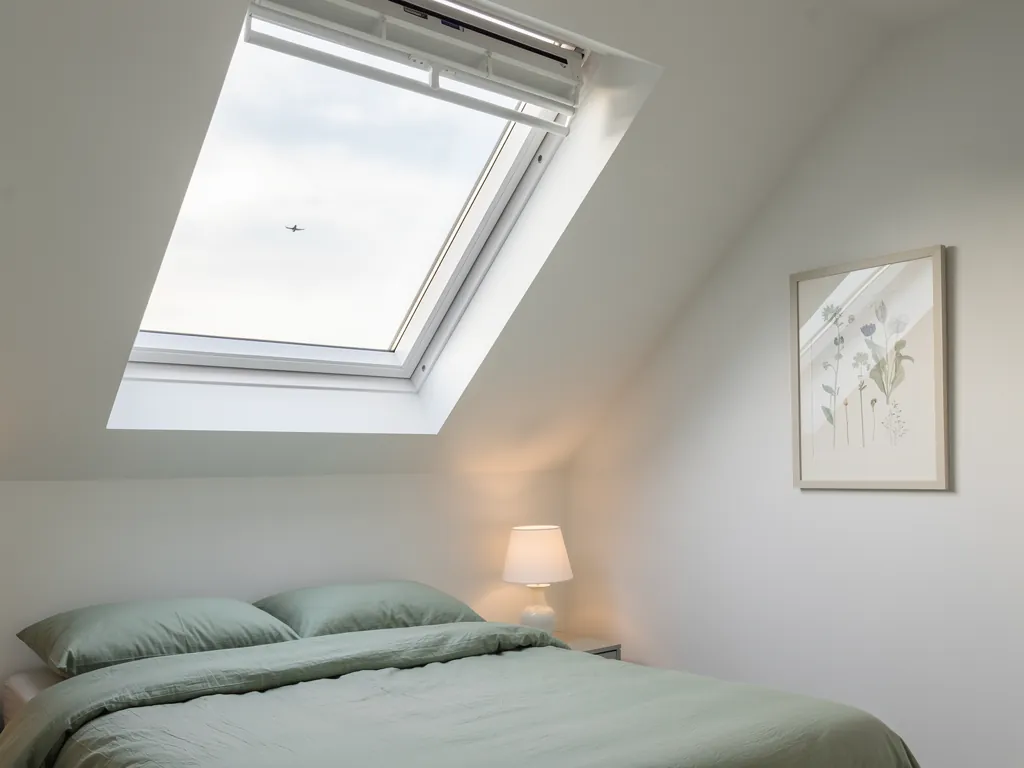
The glazing build is where the quiet is bought
Glass is the one place where spending a little more changes what the room feels like every day. A rooflight is a large area of glass in the thinnest part of the house, and the build decides how it handles rain, aircraft and sun.
The basic choices are these. A standard double-glazed sealed unit has two panes and a gap. Triple glazing adds a pane and a second gap, which adds weight and cost and mainly helps warmth. A laminated pane is two sheets bonded with a clear interlayer, and it damps the ringing of thin glass. Specifying a laminated acoustic inner pane with a thicker outer pane is the usual way to make a rooflight calmer, and it is a quiet change to make at the moment of replacement, when the labour is being paid for anyway.
That is worth saying plainly. The labour to fit a better unit is the same as the labour to fit a poorer one. The price difference is the glass. So if the old unit drummed in the rain or carried the aircraft into the bedroom, replacement is the cheapest moment to address the cause, not just the misting. The glass costs more, and whether the room needs it is a matter for the survey. Triple glazing is chiefly a warmth upgrade, and it is not a shortcut to a quieter room.
We never quote decibel figures. The choice is written down as a specification: pane thickness, interlayer, cavity and seals. That specification is the quiet spec, and it comes with every quote, so you can see exactly which build you are paying for. You can read how it is put together on the quiet spec page.
Where the room does not need it, the quote says so. A landing on a quiet close facing north does not need the same glass as a loft bedroom under an arrival path. Spending on acoustic glass where nothing needs damping is money wasted, and a good surveyor will tell you that.
What sits behind the old frame
The old unit hides the condition of the roof around it. Until it comes out, nobody has seen what the frame was bedded on. That is the largest source of change between a quote and a final bill, and a sound survey narrows it.
On a pitched roof, the concern is the timber round the opening and the flashing that joins the unit to the covering. If water has found its way past a failed seal for some years, the battens or the trimmer can be soft. Soft timber has to be replaced before anything new is fixed to it. The covering round the hole may also be old enough that lifting it breaks it, and then more of the slope has to be relaid than first planned.
On a flat roof, the concern is the upstand and the membrane. A rooflight sits on a kerb, and a kerb that has moved or rotted cannot carry a new unit. If the membrane has split or has been pooling, the new unit has to be tied into sound material, and that can widen the scope. A flat roof with a sound fall of 1:80 and a good covering is a different price from one with ponding and a worn surface, and our page on flat roof rooflight installation shows where the boundary between a rooflight job and a roof job sits.
The survey looks from inside the loft as well as from the roof edge, and it lists what it assumed. A fogged pane or a damp stain on the lining is the usual sign that a unit has gone. misted and failed rooflight replacement sets out what we check and how a replacement is specified.
Making good the ceiling and the lining
The inside finish is the part people forget to ask about. A replacement disturbs the reveal, the splay and the plaster around the opening, and someone has to put it right.
The amount varies. A like-for-like swap into the same opening often leaves the lining largely intact, with a little filling and paint round the edge. A new unit with a different frame depth needs the reveal to be reformed. A slightly larger opening cuts into the plasterboard, and a loft with a sloping ceiling lined in skim plaster needs a plasterer to match it.
Ask what the quote means by making good. The phrase can cover a line of filler, or it can cover new plasterboard, skim, mist coat and two coats of paint. Decorating to match an existing colour is its own job, and in some quotes it is left to you. Our page on whether replacing a skylight will damage the ceiling walks through what usually happens to the plaster and why.
The shaft of a flat roof rooflight, where the light passes from the roof to the room, is another spot. If the shaft is tired, it needs insulating and lining anew, because a cold shaft under a new unit gives you condensation in the first winter. The cause is usually the shaft, not the glass.
Typical UK market ranges, as a guide
Here are the general ranges a reader might expect to see across the UK market for straightforward jobs, matching the costs page. A survey moves a figure above or below them.
| Type of unit | Typical range | Moves it up |
|---|---|---|
| Fixed pitched roof window | £600 to £1,600 | Slate, steep slope |
| Opening roof window | £900 to £2,400 | Motor, blinds |
| Flat roof rooflight | £1,200 to £3,200 | Kerb rebuild |
| Roof lantern | £3,500 to £12,000 | Span, crane |
| Sun tunnel | £400 to £1,200 | Tube length |
Read the table as a map. The spread inside each row comes from the same five things on this page: size, access, glass, the condition behind the frame, and the finish inside. A like-for-like swap in a sound opening tends to sit toward the lower end of its row. A swap that uncovers a rotten kerb, needs a hoist and includes new plaster tends to sit toward the upper end or beyond.
The costs page goes further into each row, including walk-on and conservation units, if you want a full comparison.
How the five factors pull a quote in each direction
The drivers combine, and each has a cheaper and a dearer end. One useful habit is to ask the installer to mark which side of each row your job falls on. If they cannot, the quote was written without enough looking. If they can, you have something to compare with the next quote, and something to hold them to after the work.
- Size: the same opening keeps it lower, a wider opening with a new trimmer pushes it higher.
- Access: a low rear roof keeps it lower, scaffold and a hoist push it higher.
- Glass: a standard double unit keeps it lower, laminated or triple panes push it higher.
- Behind the frame: sound timber and a sound kerb keep it lower, rot or a tired upstand push it higher.
- Inside: filler and paint keep it lower, new plaster and redecorating push it higher.
Timing, season and the booking
The month you choose has a small effect on cost and a larger effect on comfort. A roof open for a few hours needs dry weather, and a good crew will move the day rather than work in rain.
Late spring and summer are simple to plan, but they are also when everyone wants the work done, so the diary fills. Autumn and winter need more care with weather windows and can give a little more choice on dates. Each season has its own trade-offs. Lead times on glass also count. A made-to-measure lantern or an acoustic build can take weeks to arrive, and the quote should state when.
The length of the job changes the price too, because labour is the main cost. A single roof window can be done in a short day. A lantern with structure and a hoist takes longer.
One unit, or every unit in the house
If a house has several old rooflights, each one has its own condition and its own access. The sensible question is whether to swap them together.
Doing them in one visit saves setup. The scaffold goes up once, the plasterer comes once and the mess is over in one go. It also means the glazing build is consistent across the house, so one room does not sound different from another. That is a real advantage when a loft has two units over two rooms. The other side is the bill arriving in a single amount.
If one unit has failed and the others are younger, replace the failed one and plan the rest.
A plastic dome that you want changed for glass is a separate case, because glass is heavier and the old curb may not suit. The price then includes a stronger kerb.
Regulations and the paperwork line
A replacement rooflight has to meet current Building Regulations, and the paperwork is a cost like any other. It should appear on the quote.
The parts that bear on the job are Part L for thermal performance, Part K for glazing safety, Part B where a unit sits near a boundary and Part F for ventilation. Whether a particular swap is notifiable depends on the work. Where it is notifiable, we handle the Building Control notification. The gov.uk site publishes the official guidance on building regulations approval.
Planning is separate. For a replacement in the same opening, the planning position is usually simple, but it is checked for your address and not assumed. Conservation areas and listed buildings change the picture.
What a complete replacement quote contains
A quote worth comparing names its parts. Use this list as a check when two figures arrive in the same week.
- The unit: make, size, opening type and the glazing build in words, including whether the inner pane is laminated.
- The frame or upstand: whether it is kept, renewed or rebuilt, and what it is made from.
- Access: scaffold, hoist or crane, included or extra.
- Structure: any trimming, timber replacement or support, priced or excluded.
- Making good: plaster, lining, shaft insulation and decorating, named.
- Regulations: Building Control notification, and who handles it.
- The guarantee: its length, its scope and who stands behind it.
Our own guide to what a quote for a new rooflight should include goes into each of these. Our workmanship cover is described on the guarantee page: ten years, written down, for the work we do.
Getting a figure for your roof
The way to a real number is a survey. Tell us the room, the roof type and what the old unit does badly, and we arrange a visit anywhere within Crawley and 30 miles around.
Photographs help. One from inside looking up, one of the frame and one of the roof from the garden or the street save time on the day. A note on anything that bothers you, such as rain noise, aircraft or a misted pane, goes straight into the quiet spec. The quote form on this page takes all of that, and the get a quote page does the same. You can also message us on WhatsApp.
The written quote arrives with its quiet spec. There is no obligation to go ahead, and you will be able to read every line of it.
Questions before you ask for a replacement price
Is swapping the glass alone cheaper than replacing the whole unit?
Sometimes the frame is sound and only the sealed glass needs renewing, but it depends on the frame type and on whether the parts can be bought. On a roof window the glass and frame are often one product. The survey shows which route makes sense, and the answer is written into the quote.
Will a quieter build push the total up by much?
It adds the cost of the extra glass. The labour, the access and the making good are the same either way, so against the whole job the change is modest. The survey will show whether the room needs it.
Why does the size of the old opening matter so much?
Because a like-for-like unit drops into a hole that already works. Any change to the opening brings structure, covering and lining with it, and each of those is a line on the quote.
Can I save by doing the decorating myself?
You can agree that with the installer, as long as the quote states where their work ends and yours begins. The plaster and the reveal should be left ready for paint, and that point is worth writing down.