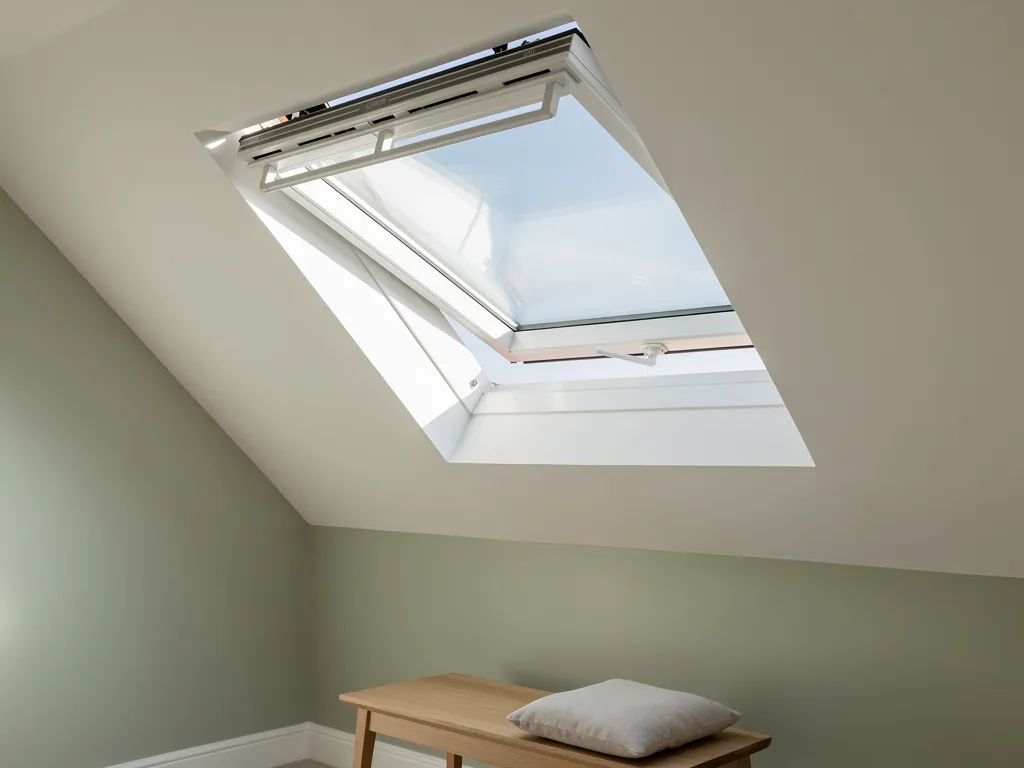
Look up at a manual VELUX roof window and you will see a bar running across the top of the sash, with a handle or a small control in the middle of it. That bar does two jobs. It opens the sash, and on models that carry a flap it also works the ventilation flap, a slot that lets fresh air in while the glass stays shut. This guide explains what each part is for, how a VELUX ventilation bar differs from the flap behind it, and why the flap matters so much in a room where people sleep. It also covers the other side of the trade: an opening is an opening for sound as well as air, so the flap needs choosing and using with some thought.
The bar across the top, and what sits behind it
The control bar is the part you touch. The ventilation flap is the part it moves. Keeping those two apart makes everything else on this page easier to follow.
On a top-hung or centre-pivot roof window, the bar sits along the upper edge of the sash, which is the edge nearest the ridge. That position is deliberate. The sash hinges about a point higher up than you would expect, so the window swings out and the handle end comes down towards you as it opens. Put the handle at the top and you can reach it from the floor of a sloping room without climbing on a chair.
Behind the bar, at the head of the frame, there is a narrow opening that connects the room to the outside air. The ventilation flap closes that opening. When the flap is open, air passes through the slot above the glass, travels over the top of the frame and into the room. The glass itself does not move. This is what people mean when they ask about the VELUX handle vent flap: the handle or bar is the control, and the flap is the valve.
The exact arrangement depends on the model and its age. Older windows, newer windows, electric versions and the solar ones do not all carry the same parts in the same places. The data plate on your window identifies the type, and the maker's instructions for that type are the reference for anything we say about how it is operated. Our guide on where the data plate is shows how to find it.
Opening the sash and opening the flap are separate actions
A sash that is swung open and a flap that is lifted are two different positions of the same control. The confusion about the bar comes from treating them as one.
When you want a lot of air, you release the catch, push the bar, and the sash swings out. That is the full opening. It ventilates quickly, it lets the room cool down on a warm evening, and it gives access to the outer pane for cleaning. It also leaves a large gap, and everything outside comes in through it: air, rain if the weather turns, insects, and every sound from the street or the sky.
When you want a little air that arrives gently and all night, you leave the sash closed and open only the flap. The window stays latched. The opening is a small one, it sits high above the glass, and air enters in a slow, steady way. That is the use the flap was made for.
- Sash opened: fast, large and open to rain and sound. Good for a hot afternoon with someone in the room.
- Flap opened, sash shut: slow and small, with the window still latched. Good for a bedroom overnight and for a room that is empty for long stretches.
Learn which position you are in by feel. The flap action is light. The sash action is firmer, because you are lifting a pane of glass on its hinges. If the bar feels heavy when you only mean to open the flap, stop and read the instructions for the model rather than forcing it.
Why fresh air matters more in a sleeping room
A person breathes out moist, carbon dioxide rich air all night, and a small bedroom with the door shut has nowhere to put it. The flap gives that air a route out and fresh air a route in, without anyone having to open a window.
Two things build up in a closed bedroom. The first is moisture. Breath and skin add water vapour to the air, and a sloping ceiling with a cold roof behind it is one of the first places that vapour will condense. You see it as damp on the lining, on the reveal or on the glass, and in time as mould in a corner. The second is stuffiness. The room feels close in the morning, and sleep is often poorer in it.
Part F of the Building Regulations is the part concerned with ventilation. It sets out how much background ventilation a habitable room should have and how purge ventilation, the big rapid airing, is provided too. A flap in a roof window is one way of delivering that background air. Whether it is enough for a particular room is a question for that room, its other openings and its extract arrangements, and we check it at the survey rather than assuming. Where the work touches Building Regulations we handle the Building Control notification.
Notice what the flap cannot do. It does not heat the air, and it is not an extractor. It relies on the air finding its own way through, driven by the small differences in temperature and pressure between inside and out. In a room that is otherwise very well sealed, one flap may not be the whole answer. In a room with some natural leakage, it often is a good part of one.
What a replacement window changes
A new VELUX is tighter than the one it replaces. That is a good thing for warmth, and it is the reason the ventilation has to be looked at again.
An old roof window, particularly one that has dropped a little in its frame or lost its seals, lets air through around the sash whether you want it to or not. That air gets in by accident. Swap it for a new unit with fresh seals and the accidental ventilation goes away. The room holds its warmth better, and it also holds its moisture better unless something else provides the air. The flap is the deliberate replacement for the draught.
So when we survey a loft bedroom for a replacement, we write down whether the existing window has a working flap, what state it is in and whether the new model offers the same. Our guide to whether a new VELUX fits the old opening covers the sizing side of that swap, and the page on how long a VELUX window lasts explains the other reason an old unit gets renewed. A window whose flap no longer closes properly, or whose seals have gone hard, is a candidate for renewal, and that is a conversation for the survey.
The quiet side of a ventilation flap
Any opening that lets air in also lets sound in. That is physics, and it is the honest centre of this page for a home near Gatwick, the M23 or the railway.
A closed, well-glazed roof window keeps much of the outside world out. A laminated acoustic inner pane, the right thickness of glass, a sensible cavity and sound seals all do their work when the sash is shut. Open the flap and you have made a deliberate small hole in that arrangement. It is a much smaller hole than an open sash, and it is screened by the frame and the position of the slot, but it is not silent. Sound that would have been stopped by the glass now has a path.
That does not mean you should keep the flap shut. A stuffy, damp bedroom costs you sleep too. It means the choice is a real one, and it is easier to make when you know what the room hears and when.
- Decide which noise matters to you at night. Early departures, late arrivals, a road or a train line, or rain on the roof each behave differently.
- Try the flap open for one night in ordinary weather and notice whether it bothers you.
- If it does, use the flap for a period before bed, then close it, or open it only on the quieter nights.
- If you want the air and the quiet together, consider the glazing and ventilation of the whole room, not the flap alone.
That last step is where the written quiet spec comes in. At the survey we note what the room hears, and we set out the glazing build and the seals to suit it. The ventilation question sits beside that. Our page on the quiet spec explains what it contains, and the guide to VELUX glazing for a quieter loft goes through the glass options one by one.
Reading the positions of the bar
Different VELUX models mark or build the positions differently, but the logic is the same. It helps to have a simple picture in your head of what each position means.
| Position | Sash | Air | Sound |
|---|---|---|---|
| Closed, flap shut | Latched | None | Least |
| Closed, flap open | Latched | Gentle, steady | Some |
| Sash open | Swung out | Fast, large | Most |
The table is a guide to the principle, not to a specific model. Your own window may have an additional catch, a child safety feature or a slightly different action. Use the maker's instructions for that model as the final word.
Electric and sensor-controlled windows work differently
A window with a keypad and a motor does not have the same handle, so the ventilation routine changes with it. The idea of a small, steady intake of air survives. The way you operate it does not.
On an electric roof window the sash is opened by a motor, and the window can be told to open by a switch, a remote or a sensor. Some installations add a rain sensor that closes the window when it detects water. That changes how you think about ventilation: you can leave the window set to open a little and trust it to shut on its own if the weather changes. Our pages on VELUX INTEGRA electric roof windows and what the rain sensor does set out how that works, and the page on VELUX ACTIVE covers sensors that respond to the air in the room.
If you have a manual window and like the sound of that, the question of converting a manual VELUX to electric has its own answer. It depends on the model, and it is worth asking before you assume.
Keeping the bar and flap working
A bar and flap that are kept clean will do their job for years. They are simple parts, and the things that stop them working are mostly dirt, paint and forcing.
- Clean the slot and the area around it when you clean the window. Dust and spiders collect there, and a clogged slot passes very little air.
- Wipe the bar and handle with a damp cloth and mild soap. Harsh solvents can mark the finish.
- Keep paint off the flap and its moving parts. If you are redecorating the lining, mask the head of the frame first.
- Never force a stiff bar. A catch that needs effort usually has something in the way.
Our page on how to clean a VELUX window goes through the routine, and the note on painting a VELUX window covers what to keep the brush away from. If the flap no longer closes, or the bar has cracked, the sensible step is renewal of the unit, and you can ask us about it through the quote form.
The ventilation line on a VELUX survey note
When we come to a loft or a pitched roof to survey for a VELUX, the ventilation gets its own line on the notes. It is not an afterthought, because it decides how the room behaves in winter.
We look at the room first. Who sleeps in it, the number of people, whether the door is usually shut, and what else provides air: another window, a trickle vent, an extract fan nearby. We then look at the model you have or the one you are considering, and whether it offers a flap on the control bar. Then we look at noise. If the room faces the flight path or a busy road, we talk through how much you are likely to want the flap open at night.
Where a replacement changes the ventilation, the written quote says so. You will know what the flap does and does not provide before anything is ordered. The overall process for this product is on the VELUX window installation page.
Questions people ask about the bar and flap
Is the ventilation flap the same thing as the handle?
No. The handle or bar is the control you hold. The flap is the valve behind it that opens a slot at the head of the frame. On a manual window one control can work both, which is why they get described as one thing.
Can I leave the flap open all night?
Generally that is what it is for. Check the maker's instructions for your model, close it in strong wind and rain, and notice whether your room is quiet enough with it open. If noise is the issue, the quiet spec for the room is the place to settle it.
Will an open flap let rain in?
The slot sits high above the glass and is designed to shed water, but the detail varies by model and by how exposed the roof is. Close it in heavy rain and whenever the room is empty. For a window you might forget, a sensor-controlled electric model closes itself.
Does a new window need the flap to meet Building Regulations?
The requirement is for adequate ventilation in the room, and the flap is one way of providing it. We assess the room at the survey and tell you in writing what we propose, including where the work is notifiable to Building Control.
Is the flap the same as a trickle vent?
They do the same job. A trickle vent is a slot fitted in a window frame, and a flap in a roof window is the equivalent for that product. Both give background air, and both are sized for the room they serve.
If you want the flap and the bar looked at on your own roof window, or you are planning a new skylight for a loft bedroom, tell us through the quote form or on WhatsApp, and we will note the ventilation and the noise on the survey.