Gatwick aircraft noise rooflight questions start in the same room: the loft bedroom. The ceiling is the roof, the glass is a few centimetres from the sky, and the first departure of the morning arrives straight through it. This guide is for homes under or beside the Gatwick routes, from the borough of Crawley out to the villages that sit beneath the climb-outs and the approaches. It covers which way the aircraft go and why that changes from day to day, what a rooflight adds to a room that a wall does not, and the parts of the build that decide how the room sounds: the glass, the seals, the upstand and the structure around them. The aim is simple. You keep the daylight that made you want an aircraft noise skylight question answered in the first place, and you keep your sleep too.
Why the room under the roof hears the sky first
A roof is the thinnest, lightest part of a house, and a rooflight is the thinnest part of the roof. Sound finds the weakest route in, so a loft bedroom hears more of the sky than a ground floor room with the same occupants.
Think about what stands between a bedroom and the open air. A downstairs wall is brick or block, often with a cavity, plaster on the inside and the garden as a buffer. Upstairs in a loft conversion the barrier is tiles or slate, a layer of insulation, a membrane and a plasterboard ceiling, all fairly light. Cut a hole in that build-up and fill it with glass, and the glass becomes the route that the sound takes. The glass itself is one part of it. The frame, the seals and the gap around the frame are the others.
This is why a rooflight that works well in a kitchen extension can disappoint in a bedroom. A kitchen has a fridge, an extractor and a radio on. A bedroom at five in the morning has nothing running, so any noise from outside is the loudest thing in the room. We take that seriously at the survey, and we write down what we heard standing in that room, not in the garden.
Daylight is still the reason to fit a rooflight, and nothing here argues against one. A well specified roof window in a loft bedroom can be quieter than an old, tired one, even though it is larger. What changes is the build, which is chosen for the noise that room actually hears.
Which way the aircraft leave, and why it changes
Aircraft take off and land into the wind. At Gatwick the main runway runs east to west, so on any given day the departures climb out one way or the other, and the homes under them swap with the wind.
The published figures give a useful picture. Gatwick's airspace documents and the airport's own community reports say that about three-quarters of operations are westerly, which over twelve months comes to 74 per cent of take-offs heading west. That is the long-run pattern. It does not tell you what this week sounds like. A run of easterly days reverses it, so places that are quiet in the long run can have a loud week, and places that are loud in the long run can have a quiet one.
For a rooflight, the pattern matters more than the average. A bedroom under the usual westerly climb-out hears departures on the days the wind blows that way, and needs a build that copes with that every morning. A bedroom on the easterly side hears something different: fewer mornings, but arrivals and departures in the other direction when the wind turns. Either way, we are choosing glass for a pattern and not for one noisy afternoon.
Gatwick also publishes that it runs roughly 400 departures a day in summer and roughly 300 in winter, mostly between 06:00 and 23:30. Those hours are the ones a bedroom cares about. The first departures land in the last part of your sleep, and the last arrivals come in while you are trying to start it. A quiet room has to work at both ends of the day, so the quiet spec records the times that matter for the household.
Where the sources place the noise
We use published sources for local noise, not memory, and we say plainly where a source is indicative and not official. The table below gathers what is on record for places around the airport.
| Place | What is on record | Direction of travel | Source type |
|---|---|---|---|
| Charlwood and Hookwood | Largest area exposed to the airport boundary | Departures, wind dependent | Parish council |
| Rusper | About 5 km west of the airport, under westerly departures | Westerly climb-out | Gatwick report |
| Horley | Lies beneath the flight path | Varies with the wind | Local press |
| Copthorne and Crawley Down | Reported concentrated corridors | Flight path changes | Residents, 2015 |
| Langley Green and Northgate | Climb-out and ground noise on the northern edge | Indicative only | Third party site |
| Edenbridge | Listed under easterly departures and westerly arrivals | Both ways | Campaign group |
| Lingfield | Gatwick's growth has brought noise | Not specified | Village design statement |
A few notes on reading it. Rusper is worth a closer look, because Gatwick's own 2019 report for that monitor gives figures you can use. Departing aircraft on westerly operations pass over at an average of 2,500 feet, there were an average of 332 aircraft noise events a day on days that were entirely westerly, and about 98 per cent of the noise events at that monitor were departures on westerly operations. That is an official picture of one place in one year, and it shows how concentrated the pattern can be.
The entry for Langley Green and Northgate comes from a third party website, not from Gatwick, the CAA or the council, so we treat it as a pointer and not as contour data. Inside Crawley, the same source says the town centre and the southern neighbourhoods sit outside the loudest band. Smallfield, Merstham and Tunbridge Wells also have Gatwick connections in the record, through distance, rail access or narrowed approach paths, which matters because a place can be affected without being right under the airport.
What none of this gives you is the answer for your bedroom. Routes are broad, hills and buildings change what reaches a window, and a house on the edge of a corridor can be very different from its neighbour. That is why the survey includes listening in the room, at a sensible hour if the timing allows.
What a rooflight lets in that a wall does not
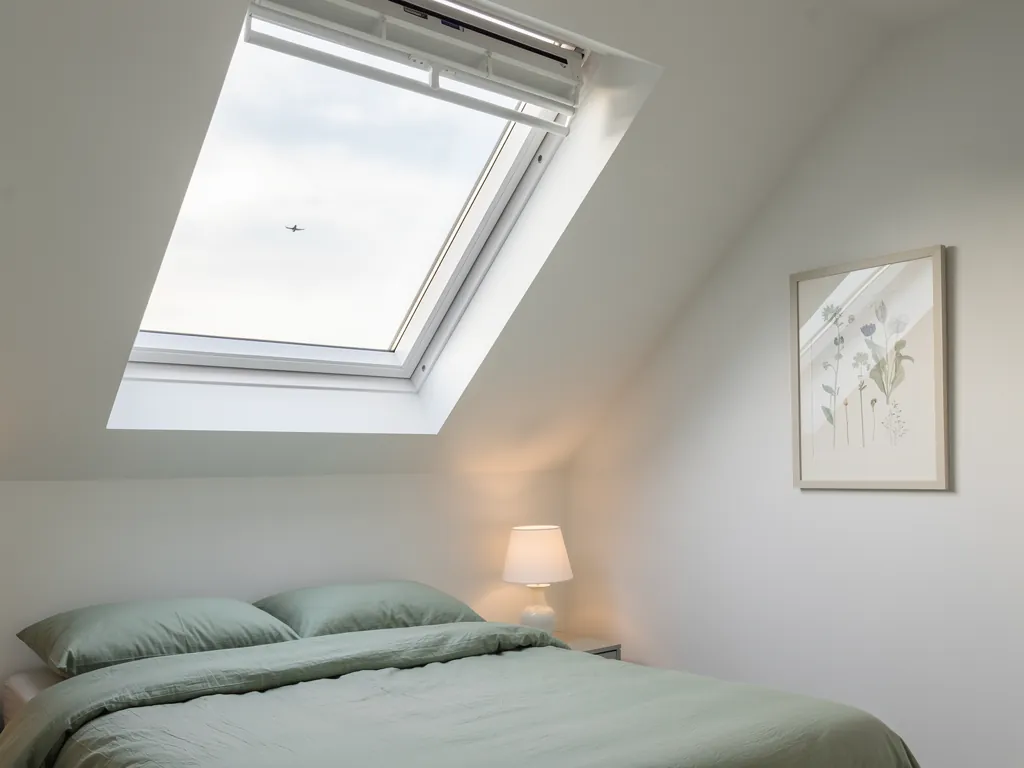
Noise reaches a room through four routes at a rooflight: through the glass, through the frame and its seals, around the edges where it meets the roof, and through any vent or opening part. Each can be improved, and each can let down the others.
The glass is the obvious one. Two panes of identical thin glass separated by a cavity are a poor barrier to the low rumble of engines, because both panes tend to vibrate together. Different thicknesses break that habit, and laminated glass, which has a plastic interlayer between two sheets, damps the vibration. Our guide to acoustic laminated glass for rooflights explains the interlayer and how it is used, and the answer on laminated against toughened glass covers the choice that comes up first.
The frame and seals come next. A sealed unit is only as quiet as the line where it meets its frame, and a flexible gasket that has hardened, shrunk or been painted over lets sound pass as easily as it lets air. Old rooflights often have a gap you can feel with a hand on a windy day. A new build has continuous seals that are compressed evenly when the sash closes.
The edges of the opening come third. The upstand, the lining inside the well and the plasterboard reveals all carry sound if they are thin or carry gaps. A rooflight set in a generous insulated upstand, with a lined well, behaves differently from one set into a thin timber box with a bead of mastic at the joint.
Ventilation is the fourth route, and it is the one people forget. A trickle vent, an opening light or an electric opener that gives fresh air also gives a route for sound. That is a fair trade in some rooms and a poor one in others, and we raise it at the survey so the decision is yours.
The glazing build that suits a loft bedroom
For a bedroom under a departure route, the inner pane does the main work. A laminated acoustic inner pane, set against an outer pane of a different thickness across a properly sized cavity, is the build we reach for first.
The pieces fit together from outside to in. The outer pane takes the weather, the hail and the tile dust. It is often toughened, and often thicker than you would expect on a window of the same size. The cavity sets how the two panes work together, and a wider cavity generally helps with low frequencies, up to the point where the unit becomes too deep for the frame. The inner pane is the laminated one. It is safer overhead, because a laminated pane holds together if it is broken, and it carries the acoustic interlayer that damps what gets through the cavity.
Overhead glazing has its own rules. Industry guidance expects safety glazing where people can be under it, which is one reason a laminated inner pane is the norm for rooflights. The acoustic benefit arrives with the safety requirement, at no extra complication to the design. Our page on Building Regulations for rooflights sets out how Parts L, K and F apply together.
Triple glazing is a common question. A third pane adds weight and insulation, but it does not automatically add quiet, and an unbalanced triple unit can sound worse than a well built double. The answer on whether triple glazing makes a rooflight quieter goes through why, and the page on what goes into a quiet rooflight specification lists the choices in order of importance.
We do not quote noise reduction numbers for any build, because the result in your room depends on the roof, the direction and the rest of the house. We describe the build, the pane thicknesses, the cavity and the seals, and we write them into the quiet spec so the choice can be checked against the quote.
Seals, upstand and the roof around the glass
A good pane in a poor surround is a wasted pane. The seals, the upstand and the lining decide whether the quiet of the glass reaches the room.
On a pitched roof the rooflight sits in a frame that is flashed into the tiles or slates. The gap between the frame and the structure is filled with insulation, and that insulation matters for sound as much as for heat. A void left empty or packed with thin offcuts behaves like a drum. A dense fill, continuous from the flashing to the plasterboard, stops it. The inside lining of the opening should be solid and tight to the ceiling, and the plaster joint should be closed and finished.
On a flat roof the same thinking applies to the kerb. A deeper insulated upstand holds the glass above the membrane, and its thickness and filling change what is heard in rain as well as in aircraft weather. For the drumming of rain on flat glass, our guide to reducing rain noise under a flat rooflight covers the roof side of the story.
- Seals: continuous, compressed evenly all round, and renewed with the unit.
- Upstand or flashing: dense insulation with no voids between the frame and the structure.
- Lining and plaster: tight to the ceiling, closed at the joint, and finished with no gaps.
- Fixings: frame fixed firmly through the upstand so it does not buzz or flex in wind.
When we replace an old unit, this is where the real difference often lies. Taking out an old sash and dropping a better pane into a tired frame leaves the weak points in place. We look at the surround as part of the survey and say in the spec whether it is sound enough to keep or should be renewed with the glazing.
Opening, fixed and ventilated: the trade-offs
A fixed rooflight is the quietest kind, because it has one fewer seal line to hold. An opening or electric one gives you air, and if it is specified well it can still be a quiet room with the sash closed.
Bedrooms need fresh air, and the need is greatest on warm nights when the windows are also the thing you would prefer to shut. An opening rooflight lets hot air out at the top of the room, which is useful, and it lets noise in when it is open. The choice is between a quiet room with the glass closed and a cooler one with it open, and the choice depends on the route and the season.
Part F governs ventilation, and a bedroom still needs a background route for fresh air. That can come from a trickle vent in the frame, from a window elsewhere in the room, or from mechanical ventilation. If the vent is in the rooflight, it should be chosen with the noise in mind, because a vent is a deliberate hole. We talk through where the air comes from before the glazing is chosen, so the two decisions are not made in isolation.
Blinds help with light and heat, and they change how a room sounds a little, but a blind is not an acoustic measure. The answer on whether a blind reduces rain noise under a skylight gives the detail. A blind is a good addition in a bedroom for another reason: it keeps dawn light out, which is a separate question, dealt with in whether a skylight in a bedroom will wake you at dawn.
Planning, noise policy and what needs checking
Noise shapes planning in this part of the world. Crawley's Local Plan treats the land between the town and the airport as heavily constrained by aircraft noise, and its noise policies restrict noise-sensitive development in the affected areas.
That policy is about new development, such as homes and other buildings where people sleep. Fitting a rooflight to an existing house is a different matter. The questions that apply are the usual ones: whether the work is permitted development, whether the address is in a conservation area, and whether Building Regulations apply. Crawley Borough Council lists thirteen conservation areas, including the High Street, Ifield Village, Worth and the Three Bridges area around Hazelwick Road, and a rooflight in any of them is checked for the address before anything is ordered. Our answer on whether Crawley Borough Council needs to approve a rooflight goes through the points to check.
Outside Crawley the authority is different. The villages around the airport sit under other councils in Surrey, Mid Sussex, Horsham and further afield, each with its own planning department, so the position is checked for the address and the authority in question. Nothing on this page assumes a status for any particular street.
On the Building Regulations side, the notification is ours to handle where the work is notifiable, and the installation meets current Approved Documents. Improving the acoustic build does not change that, although a better build often comes with thicker glass and a heavier unit, which is a reason to check the structure at the survey. If you want to see where the regulations bite, the answer on whether replacing a rooflight is notifiable explains the test.
What the survey listens for and the quiet spec records
Every quote comes with a one-page written note, called the quiet spec, for that room. For a home under the Gatwick routes it records what we heard, what we propose, and why the build suits the noise.
At the survey we stand in the room the rooflight will serve, ideally at a time when the aircraft are flying. We note what is heard, whether it is a steady rumble, a rising roar or a sudden pass, and where it seems to come from. We look at the roof from outside and from the loft: the tiles or slates, the insulation, the rafters, the existing frame if there is one, and how much of the surround is sound enough to keep. We ask about the room's use, whether it is a bedroom, a nursery or an office, and who sleeps or works there and when.
The spec then names the glazing build, the thicknesses of the panes, the cavity, the seals, the upstand or flashing and the lining, and gives the reason for each. It is a written specification and not a promise of a number, which means you can read it, ask about any line, and compare it with another installer's quote on the same terms. The page on the quiet spec shows what it covers, and the guide on what a quote for a new rooflight should include is a good checklist to hold any quote against.
If you are comparing options, the answer on whether acoustic glass is worth it for a rooflight weighs the choice plainly, and the one on whether you can hear planes through a skylight is a good place to start if you are not yet sure the noise will matter to you.
Questions from homes under the Gatwick routes
These are the questions that come up for a bedroom or a nursery under a departure or approach route, answered briefly. Each has a longer page where the topic needs it.
Will a new rooflight be louder than the one it replaces?
Not if the build is chosen for it. A larger pane of thin glass can be louder than a smaller old one, but a laminated acoustic inner pane, good seals and a properly filled upstand usually make a new unit quieter than a tired one. The spec says which build is proposed for your room.
Is a fixed rooflight always the quietest choice?
A fixed unit has one fewer seal line, so it has less to go wrong, and it is a sensible choice where the route is busy and the room has other ventilation. If the room needs the air, an opening unit specified with care is still a reasonable answer.
Does the wind direction change what I should specify?
It changes what you hear and when, but not the build in a way that needs two versions. A home under the westerly climb-out and one under the easterly side are both specified for the loudest pattern they experience, with the inner pane and surround doing the work.
Can I do this in a loft conversion that already has a rooflight?
Yes. Replacing an existing unit is often the simplest upgrade, because the opening exists. We check the frame, the upstand and the lining to decide what is worth keeping, and the structure is checked in case the new glass is heavier. You can start with a quote, and the main page shows what we install across Crawley and the wider area.